Cres
Kvarner Islands, Croatia
Cres is a long, wild island in the Kvarner Gulf of northern Croatia, about 406 square kilometres in size yet home to…
13 tours & trips
Croatia · Adriatic Sea · Beach island
Krk is one of the two largest islands in the Adriatic, 406 square kilometres of rocky coast, vineyards and stone towns in the Kvarner Gulf, joined to the mainland near Rijeka by a bridge. Easy to reach by car and home to Rijeka's airport, it suits families and drivers who want beaches, boat trips and good food without a ferry.
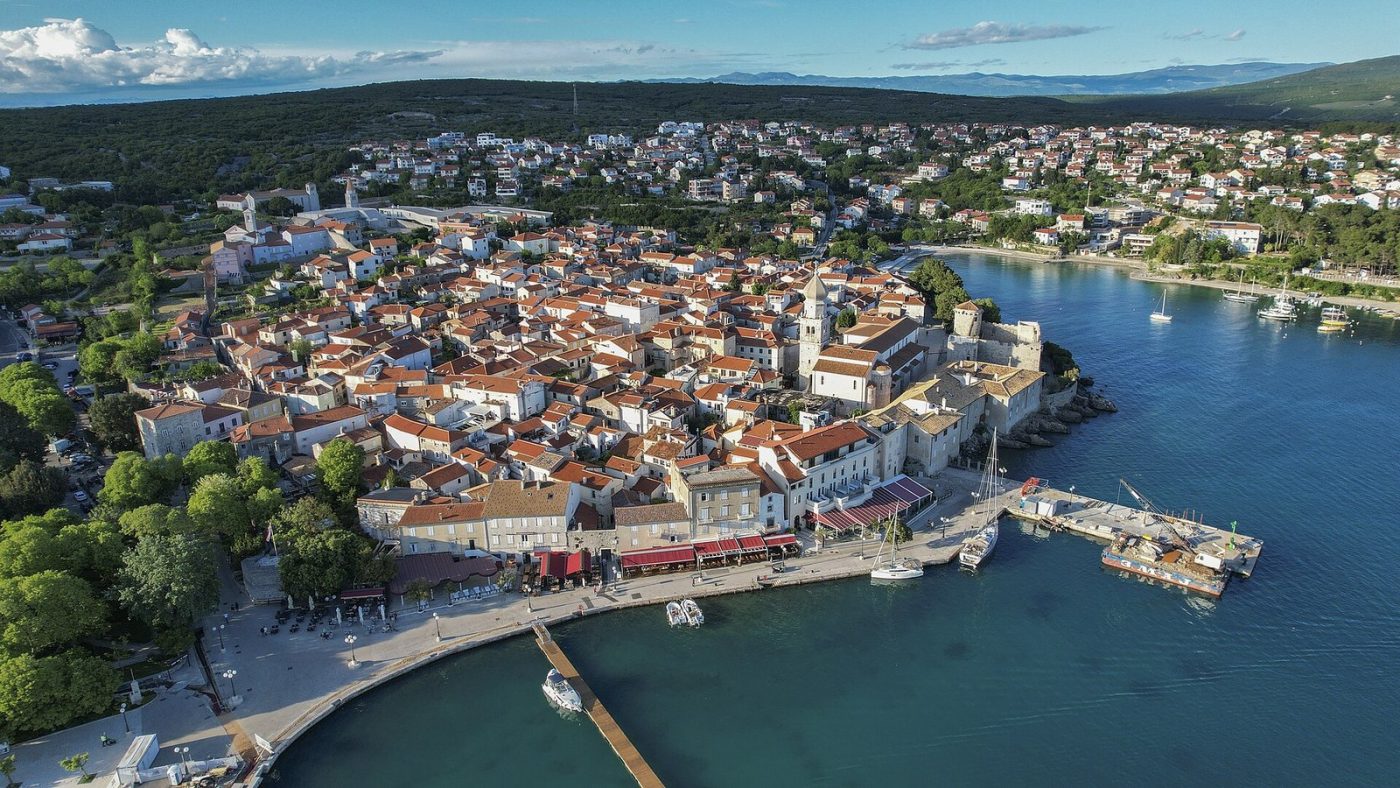
Photo: Arne Müseler, CC BY-SA 3.0 de
| Getting there | Drive over the toll-free Krk Bridge from Rijeka in about 30 min; Rijeka airport is on the island |
|---|---|
| Gateway | Rijeka (Krk Bridge) |
| Travel time | About 30 to 45 min by road from Rijeka |
| Days | 3 to 5 nights |
| Best months | Jun–Sep for swimming; May and October quieter; many places shut Nov–Mar |
| Getting around | A car is best; buses link Krk town, Baška, Punat, Malinska and Vrbnik |
| Booking | Rooms for July–August months ahead; boat trips a day or two ahead |
| Cost | Mid-range for Croatia |
| Beaches | Pebbles and rock; Vela plaža at Baška is the longest; sandy coves on boat trips |
| Sea | Adriatic Sea |
| Archipelago | Kvarner Islands |
| Area | 406 km² |
| Population | 19,916 (2021) |
| Highest point | 568 m (Obzova) |
| Airport | Yes, scheduled flights |
| Car-free | No |
| Bridge | Road bridge or causeway to the mainland |
| Checked | October 2026 |
Almost everything sold on Krk leaves from its harbours, mainly Krk town, Punat and Baška, and most of it is a boat trip.
The classic is a half-day or full-day cruise from Krk town or Punat to the small uninhabited islands to the south-west, above all Plavnik, where boats anchor at a pale cove for swimming and nose into a sea cave lit blue by the sun. Longer versions visit four or five islands, with lunch on board. Sunset cruises follow the same coast, sometimes looking out for dolphins, with a drink included. From Baška, day boats cross to Rab, sometimes with a stop at Goli Otok, the former political prison island, and some go on to Pag; lunch is often included.
Smaller boats suit couples and families: a sailing trip along the coast, a semi-submarine with windows below the waterline, and motor boats you can rent without a skipper. A guided kayak trip paddles under the Krk Bridge.
On land, the best options are tastings: a family winery pouring the local white Žlahtina, and a farm growing immortelle for essential oil, with donkeys that children enjoy.
Prices usually include the boat, a skipper and a welcome drink; lunch varies. Book the cruise to Plavnik first, then a tasting.
The island's capital is a compact walled town on the south-west coast, with a Romanesque cathedral, a Frankopan castle on the harbour square and narrow lanes opening onto small piazzas. Look for Roman remains built into later houses, walk the seafront promenade to the town beaches, and come back for dinner in the old town when the stone cools.
At the southern end of the island, below bare limestone mountains, Baška curves around a pebble beach about 1.8 km long, one of the finest in the northern Adriatic. Paths climb from the village into the hills for views over the channel towards the Velebit range, and boats leave for Rab and Goli Otok. It is about half an hour's drive from Krk town.
This old village stands on a cliff high above the sea on the east coast, a maze of stone lanes, one claimed to be among the narrowest streets in the world. The vineyards on the plain behind produce Žlahtina, a crisp white served in the village taverns with local sheep's cheese and prosciutto. Come for the late afternoon light and stay for dinner.
A wooded islet in the bay of Punat holds a Franciscan monastery founded in the 15th century, with a church, a small museum of folk costume and religious art, and shady walks among the trees. Taxi boats cross from the Punat waterfront in a few minutes through the day in summer. Dress modestly and allow an hour or so.
In the small church of St Lucy at Jurandvor, just before Baška, a copy of the Baška tablet stands where the original was found. Carved around 1100, it is one of the oldest inscriptions in the Croatian language, written in the Glagolitic script that the island's priests used for centuries. The original is kept in Zagreb.
Our pick for each kind of trip, with live dates and prices. Free cancellation on most.
Best for: First boat trip from Krk town
A cruise to a pale cove and a blue sea cave among the small islands off the coast, with swimming stops; the trip most visitors remember.
Krk is the easiest Croatian island to reach. The Krk Bridge, a pair of concrete arches about 1.4 km long in all, carries the road from the mainland south of Rijeka and has been toll-free since 2020. From Rijeka to Krk town takes about 45 minutes, from Zagreb about two hours.
Rijeka Airport stands on the island itself, near Omišalj, with mostly seasonal flights from European cities in summer; Zagreb, Pula and Trieste airports have more choice, with a bus or hire car to continue. Buses run from Rijeka and Zagreb to the main towns.
For island hopping, car ferries leave Valbiska on the west coast for Merag on Cres all year, and in summer boats also link Krk with Rab. Expect queues on the bridge approach on summer Saturdays.
A car makes the most of Krk: the island is about 40 km long, the roads are good, and the beaches, wineries and villages are spread out. Buses link Krk town with Baška, Punat, Malinska, Njivice, Omišalj and Vrbnik several times a day in summer and less often in winter. Scooters and bicycles can be rented in the main resorts, and marked cycling and walking routes cross the interior. Parking in Krk town and Baška fills up on summer afternoons, and most car parks charge in season.
June to September is the swimming season, with the sea warmest in August at about 24 to 26 degrees. July and August are the busiest months: Krk is close to Slovenia, Austria, Germany and Zagreb, so queues on the bridge, full beaches and higher prices come with the summer. June and early September offer warm water with more space.
May and October are quieter and good for walking, cycling and wine, though the sea is cool and some boat trips do not run. The bora, a cold north-easterly wind, can blow hard at any time, especially in winter, and occasionally closes the bridge to high-sided vehicles.
From November to March most hotels, campsites and restaurants close, apart from some in Krk town, and the island returns to its residents. Three to five nights is the right length for beaches, a boat trip and the old towns.
Krk town is the most rounded base, with the old town, a choice of restaurants, the busiest harbour for boat trips and good bus links. Baška suits beach lovers and walkers, though it is at the far end of the island. Malinska and Njivice on the north-west coast are family resorts with calm, shallow bays and pine shade, close to the bridge and the airport. Punat has a large marina and the boat to Košljun, and Vrbnik suits couples who want wine and a quiet village. Campsites are plentiful.
Krk has been settled since prehistory; the Liburnians called it Curicum, and the Romans built a walled town where Krk town stands. In the Middle Ages the island was the seat of the Frankopans, counts of Krk, who later spread across Croatia and built the castles that still guard its harbours. Its priests kept the Glagolitic script and the Slavonic liturgy alive for centuries, which is why Krk is called a cradle of Croatian literacy. Venice ruled from 1480, then Austria. The bridge opened in 1980 and, with the airport, made Krk the most populous island in the Adriatic, home to about 20,000 people.
Rijeka, about 45 minutes away, has a lively centre and the Trsat castle above it, and the seafront promenade of Opatija is half an hour further west. Car ferries from Valbiska cross to Cres, from which Lošinj is reached over a short bridge, making a route of three islands. Rab lies just to the south, and the Plitvice Lakes are about two and a half hours inland.
Drive over the toll-free Krk Bridge from Rijeka in about 30 min; Rijeka airport is on the island.
From Rijeka (Krk Bridge): about 30 to 45 min by road from Rijeka.
3 to 5 nights.
Jun–Sep for swimming; May and October quieter; many places shut Nov–Mar.
A car is best; buses link Krk town, Baška, Punat, Malinska and Vrbnik.
Go if you want an easy drive-in island with pebble beaches, old walled towns and local wine. Skip it or choose Cres or Lošinj if you want empty coves, wilder nature and fewer summer crowds.
Mid-range for Croatia.
Pebbles and rock; Vela plaža at Baška is the longest; sandy coves on boat trips.
Rooms for July–August months ahead; boat trips a day or two ahead.
Yes. Boat trips, guided tours and day trips for Krk can be booked online; live prices and free cancellation on most are shown on this page.
Kvarner Islands, Croatia
Cres is a long, wild island in the Kvarner Gulf of northern Croatia, about 406 square kilometres in size yet home to…
13 tours & trips
Kvarner Islands, Croatia
Rab is a 22-kilometre island in the Kvarner Gulf of northern Croatia, bare and wind-scoured on the side facing the…
10 tours & trips
Kvarner Islands, Croatia
Lošinj is a long, narrow island of about 74 square kilometres in the Kvarner Gulf of northern Croatia, joined to its…
2 tours & trips