Hainan
China
Hainan is China's largest tropical island, about 32,900 square kilometres of beaches, rainforest mountains and…
82 tours & trips
China · Seas of Japan & Korea · Historic island
Gulangyu is a car-free island of under two square kilometres facing downtown Xiamen, filled with colonial villas, consulates, churches and gardens from its years as an international settlement. Listed by UNESCO in 2017, it is one of the most visited places in China, and a 20-minute ferry makes it an easy day out from the city.
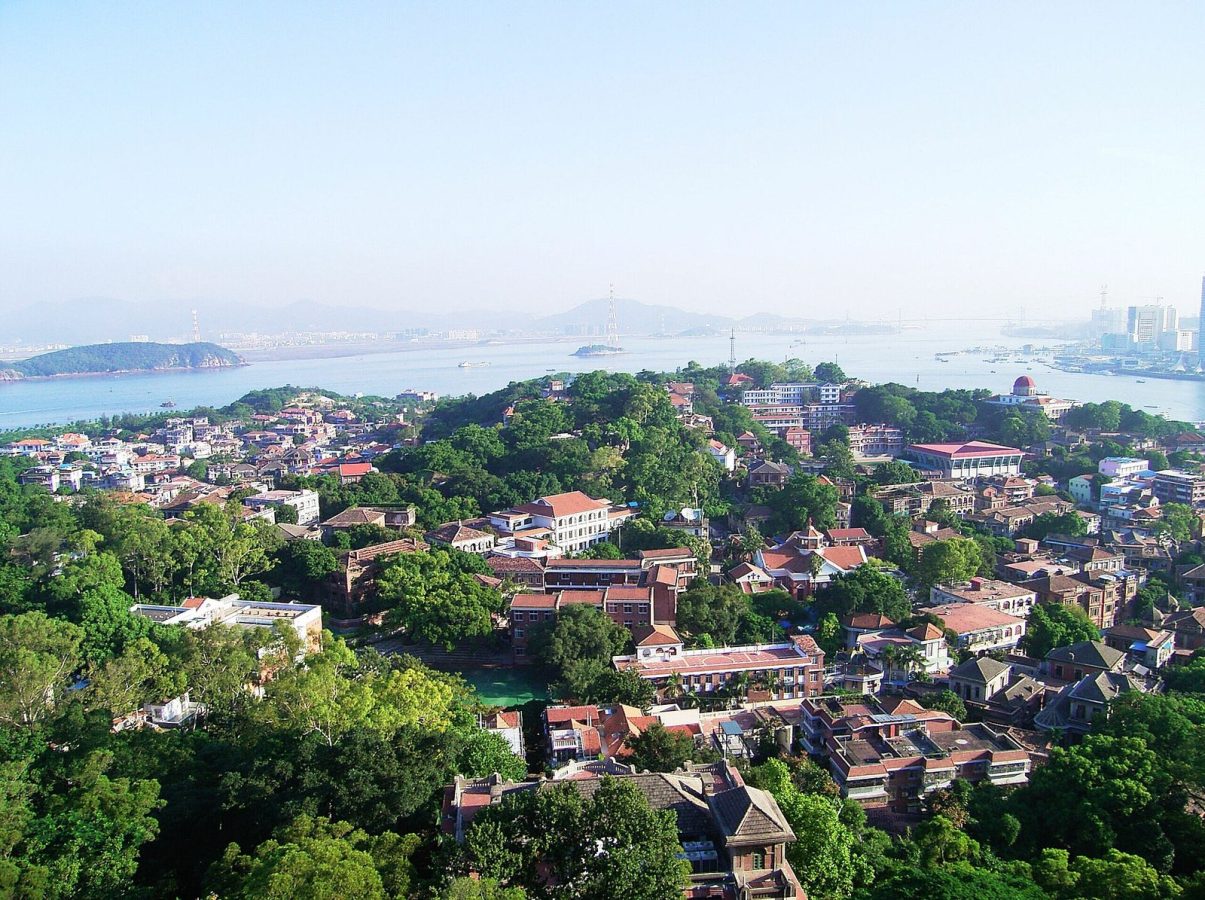
Photo: gdczjkk, CC BY 3.0
| Getting there | 20-min ferry from Xiamen's Dongdu cruise terminal; tickets need your passport and sell out on holidays |
|---|---|
| Gateway | Xiamen (Dongdu international cruise terminal) |
| Travel time | About 20 min by ferry |
| Days | A day trip is enough; one night is nicer |
| Best months | Mar–May and Oct–Nov; Jun–Sep hot and humid with typhoon risk |
| Getting around | Car-free and bicycle-free: walk the lanes; small electric buggies circle the island |
| Booking | Ferry tickets a few days ahead, weeks ahead for holidays; island rooms for weekends |
| Cost | Mid-range for China; island rooms cost more than Xiamen |
| Beaches | Small sandy coves; Gangzaihou on the south side is the main swimming beach |
| Sea | Seas of Japan & Korea |
| Area | 1.9 km² |
| Population | 12,509 (2023) |
| Highest point | 93 m (Sunlight Rock) |
| Ferry | 20 min from Xiamen (Dongdu international cruise terminal) |
| Airport | No |
| Car-free | Yes |
| UNESCO | Kulangsu, a Historic International Settlement |
| Checked | October 2026 |
You do not need a tour to see Gulangyu: the ferry is short, the island is small and you can walk across it in half an hour. What a tour adds is help with the ferry, which is the hardest part for foreign visitors. Tickets are sold by name against a passport, numbers are capped on busy days, and the tourist boats leave from a different terminal from the one directly opposite the island.
The most common product is a guided day or half day from Xiamen with the ferry ticket and a local guide included, sometimes with hotel pickup. Guides explain the history of the consulates and the merchant families, which the island's small signs do not. Some versions add a cultural session such as tea tasting or a photo shoot in traditional flower headdresses, a fashion borrowed from the fishing women of Quanzhou.
Private city tours combine the island with Xiamen's temple and university, and evening cruises along the city waterfront look across at Gulangyu lit up after dark. Multi-day packages add the earthen tulou villages in the hills of western Fujian.
Entry to the island itself is free, but a few sights, such as Shuzhuang Garden and Sunlight Rock, charge separately; check whether a tour includes them. If you are comfortable booking the ferry with your passport, go alone, early in the morning. If not, a guided half day is worth it.
The island's highest point, at 93 metres, is a granite outcrop reached by steps through a park on the southern side. From the viewing platform you see the whole island, the red roofs of the villas and the towers of Xiamen across the channel. Go at opening time; by late morning the stairs are a slow queue.
A garden built in 1913 by a wealthy Taiwanese family, with a zigzag bridge over the sea, rock gardens and pavilions on the shore below Sunlight Rock, a ten-minute walk away. Inside is the Piano Museum, a collection of old instruments that explains why Gulangyu is nicknamed Piano Island: it once had more pianos per head than anywhere in China.
The real sight is the maze of lanes between Longtou Road and Neicuoao, lined with brick villas, churches and former consulates from the British, American, Japanese and other powers. Many houses are now cafes, small museums or guesthouses. Walk without a plan, look up at the verandas and carved balconies, and use the map boards at junctions.
On the south-eastern headland stands a huge granite statue of Koxinga, the Ming loyalist who used Xiamen as his base before taking Taiwan from the Dutch in 1662. The garden around it is calmer than the centre and looks straight out over the harbour entrance, about 15 minutes on foot from Sunlight Rock.
The south coast has the island's sandy coves, with Gangzaihou the largest and best for a paddle or a swim in summer. A shoreline path links it with Shuzhuang Garden, passing rocky bays where families hunt for crabs at low tide. It is the place to sit with a coconut once the lanes get busy.
The commercial street near the ferry pier is where most people eat: fish balls, oyster omelettes, grilled squid, mango sweets and pastries filled with green bean paste. It is noisy and crowded at midday but cheap and quick. For a quieter meal, walk a few lanes back towards the villas, where small family restaurants serve seafood.
Our pick for each kind of trip, with live dates and prices. Free cancellation on most.
Best for: First visit, a guided day from Xiamen
The guide handles the passport-linked ferry tickets and leads you through the villas, gardens and Sunlight Rock without getting lost in the lanes.
Tourist ferries to Gulangyu leave from the Xiamen International Cruise Terminal at Dongdu, on the north-west side of Xiamen Island, about 20 minutes by taxi from the old town. Boats run frequently from early morning to evening and take about 20 minutes, landing at Sanqiutian or Neicuoao piers. A second route leaves from Haicang on the mainland side. The downtown pier facing the island across the narrow channel is for residents only.
Tickets are tied to your passport, so buy them at the terminal with the document in hand or in advance online, and expect daily limits and sold-out boats during national holidays and summer weekends. There are no cars on the island, so leave any vehicle in Xiamen. Xiamen itself has an international airport with flights across Asia and high-speed trains from Fuzhou, Shenzhen and Shanghai.
Gulangyu is a pedestrian island: private cars and even bicycles are banned, and the only vehicles are small electric service carts. Most visitors simply walk. The island is about 2 km across, the lanes are steep in places and badly signposted, and phone maps are not always accurate, so follow the boards at junctions. Electric sightseeing buggies run a loop around the coast and are useful for tired legs. Porters with carts meet the ferries to carry luggage to guesthouses.
The most pleasant months are March to May and October to November, with temperatures in the low to mid twenties and less humidity. June to September is hot, sticky and rainy, and typhoons can stop the ferries for a day or two, usually between July and September. Winter is mild and grey but quiet, a good time for walking the lanes.
Crowds matter more than weather here. The island takes millions of visitors a year, most of them domestic tourists, and it is packed during the Spring Festival, the May Day holiday and the first week of October, when ferries sell out days ahead. Weekdays outside school holidays are far calmer. Whatever the season, catch the first boats of the morning or stay until evening, when day visitors leave and the lanes go quiet. One full day covers the sights; a night in a villa guesthouse lets you see the island empty.
Staying on Gulangyu means sleeping in a converted villa or family guesthouse, quiet after dark and atmospheric, but with your luggage to drag up the lanes and prices above the city. The area around Neicuoao and the lanes below Sunlight Rock are the most peaceful. For more choice, cheaper rooms and easy transport, stay in Xiamen near Zhongshan Road, which also has the best food streets, and take an early ferry across.
Gulangyu was a fishing island until the First Opium War, after which Xiamen became a treaty port and foreign merchants, missionaries and consuls built homes on the island across the water. In 1903 it became an international settlement run by a council of foreign powers, and wealthy Chinese families returning from South-East Asia added their own grand villas. The mix of styles, from colonial verandas to Chinese roofs, is what UNESCO recognised. Japanese occupation in the Second World War ended the settlement, and the villas now hold museums, cafes and homes.
Most people see Gulangyu as one day of two or three in Xiamen. Add Nanputuo Temple and the campus of Xiamen University next door, the seaside cycle path along Huandao Road, and the old streets around Zhongshan Road. The Fujian tulou, round fortified earth houses listed by UNESCO, are about three hours west by road and make a good overnight trip.
20-min ferry from Xiamen's Dongdu cruise terminal; tickets need your passport and sell out on holidays.
From Xiamen (Dongdu international cruise terminal): about 20 min by ferry.
A day trip is enough; one night is nicer.
Mar–May and Oct–Nov; Jun–Sep hot and humid with typhoon risk.
No. Gulangyu is car-free. Car-free and bicycle-free: walk the lanes; small electric buggies circle the island.
Go if you like old architecture, quiet lanes without traffic, small museums and seafood snacks within a short ferry ride of Xiamen. Skip it on weekends and Chinese holidays if you hate crowds, or head to the Fujian tulou instead if you want rural China. With about 20 min each way from Xiamen (Dongdu international cruise terminal), a day trip is easy to do.
Mid-range for China; island rooms cost more than Xiamen.
Small sandy coves; Gangzaihou on the south side is the main swimming beach.
Ferry tickets a few days ahead, weeks ahead for holidays; island rooms for weekends.
Yes. Boat trips, guided tours and day trips for Gulangyu can be booked online; live prices and free cancellation on most are shown on this page.
China
Hainan is China's largest tropical island, about 32,900 square kilometres of beaches, rainforest mountains and…
82 tours & trips
China
Shamian is a small sandbank island in the Pearl River in central Guangzhou, 900 metres long and 300 metres wide, cut…
3 tours & trips
Zhoushan Archipelago, China
Putuoshan is a small island of 12.5 square kilometres in the Zhoushan archipelago off Zhejiang, one of the four sacred…
No tours listed