Great Keppel Island
102 km away
Great Keppel Island lies 15 km off Yeppoon on Queensland's Capricorn Coast, at the southern end of the Great…
5 tours & trips
Australia · Pacific Ocean · Nature & wildlife island
Heron Island is a coral cay on the southern Great Barrier Reef, 87 km north-east of Gladstone in Queensland, only about 800 metres long and sitting right on the reef. With one resort, a research station and no day visitors, it offers snorkelling from the beach, nesting turtles in summer and tens of thousands of seabirds.
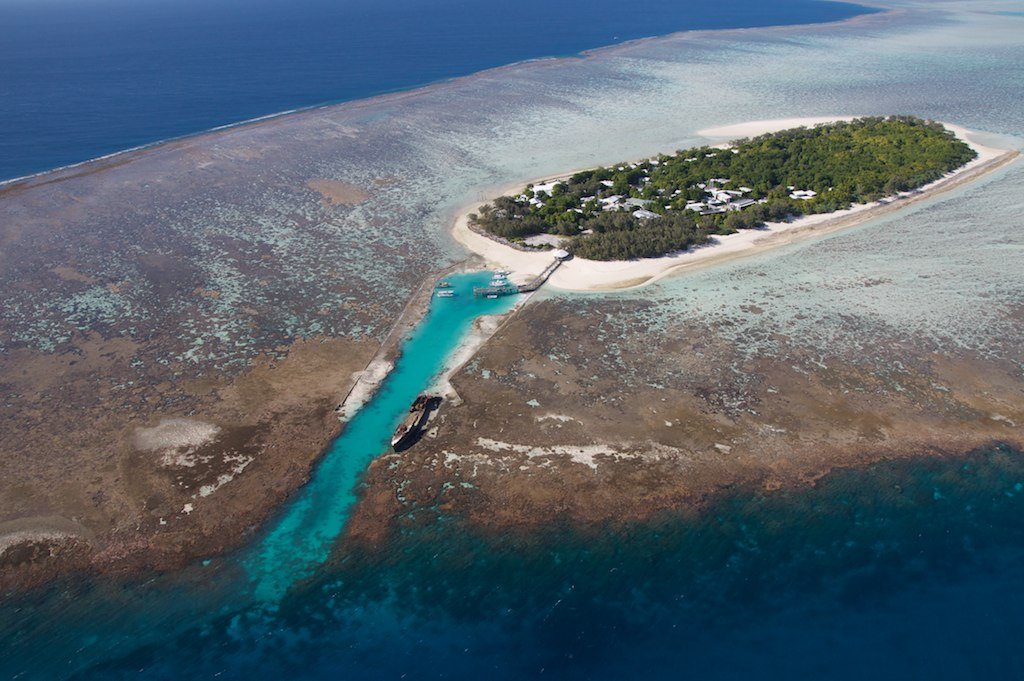
Photo: Ciambue, CC BY 2.0
| Getting there | Resort launch from Gladstone in about 2 h, or a helicopter or seaplane flight of about 30 min |
|---|---|
| Gateway | Gladstone, Queensland |
| Travel time | About 2 h by launch, 30 min by air |
| Days | 3 to 5 nights |
| Best months | Nov–Mar for nesting and hatching turtles; Jun–Sep for whales; Apr–Oct calmest |
| Getting around | Car-free: walk the island in about 30 minutes |
| Booking | Rooms and launch together months ahead, especially for turtle season and school holidays |
| Cost | Expensive, as with most Barrier Reef islands |
| Beaches | White coral sand all round; Shark Bay for rays and reef sharks in the shallows |
| Sea | Pacific Ocean |
| Archipelago | Capricorn and Bunker Group |
| Area | 0.2 km² |
| Highest point | 8 m |
| Ferry | 2 h from Gladstone, Queensland |
| Airport | No |
| Car-free | Yes |
| UNESCO | Great Barrier Reef |
| Checked | October 2026 |
Nothing is sold online for Heron Island alone, and there are no day trips: you can visit only by staying at the island's single resort, which sells accommodation packages that include or add the return launch from Gladstone, with helicopter or seaplane transfers as an expensive option. Meals are usually bundled in packages.
Activities are booked on the island. The resort runs guided reef walks at low tide, snorkelling trips by boat to the reef edge, glass-bottom boat or semi-submersible tours, and nightly turtle-watching talks in season. Some of these are included, and others are charged separately. The dive shop runs boat dives several times a day to sites such as Heron Bommie, with training courses for beginners. Snorkelling straight from the beach costs nothing and is excellent at high tide.
The University of Queensland research station on the island is not open to casual visitors, but resort guests can often attend talks on the reef and turtles given by staff and researchers.
Plan three or four nights, book the launch with your room, and choose a package that includes breakfast and dinner, since there is nowhere else to eat. Divers should reserve dives a day ahead in busy periods.
The reef starts at the water's edge, so you can wade in and snorkel among corals, turtles, rays and reef fish within minutes. The best spots are near the harbour channel and along the island's western end, ideally on a rising tide. Currents can be strong at the channel, so check conditions and the tide times at the resort.
From November to March, green and loggerhead turtles come ashore at night to dig nests and lay eggs in the dunes. From January, hatchlings emerge and scramble to the sea, mostly after dark. Join the guided turtle walks or watch quietly with a red torch, keeping your distance and never blocking their way to the water.
At low tide the reef flat on the island's southern side is exposed, and guided walks follow marked paths across it to see sea cucumbers, starfish, giant clams and small sharks in the pools. Wear closed shoes, carry a walking pole and step only on sand to protect the coral. Times shift daily with the tides.
Divers reach more than a dozen sites within a short boat ride of the island. Heron Bommie, a coral pinnacle just off the reef edge, is the best known, with turtles, manta rays at times, schools of fish and cleaning stations. Visibility is usually good, and the sheltered western sites suit beginners and night dives.
In summer the pisonia forest and dunes host vast numbers of nesting seabirds, mainly black noddies in the trees and wedge-tailed shearwaters in burrows, whose eerie night calls surprise many first-time visitors. Reef herons, which gave the island its name, stalk the shallows. A walk around the island at dusk shows the full scene.
Heron Island lies about 87 km off Gladstone, on the central Queensland coast. Gladstone has an airport with flights of about an hour from Brisbane and connections from other Australian cities, and the town is also on the coastal railway and highway north from Brisbane, about six hours' drive away.
The resort launch leaves from Gladstone Marina once a day, usually in the late morning, and takes about two hours across open water; on windy days the crossing can be rough, so take seasickness tablets. Transfers from Gladstone airport to the marina can be arranged. Helicopter and seaplane transfers take about 30 minutes and offer views of the reef but cost several times more. Luggage limits apply on the flights. The launch must be booked with the resort, and there is no public ferry.
The island is car-free, and you walk everywhere on sandy paths. A loop around the beach takes about 30 minutes, and the resort, the jetty, the research station and the forest are all within a few minutes of one another. Bring reef shoes and sandals; most people go barefoot or in flip-flops. There is no transport and none is needed, though guests with limited mobility can ask for help with luggage on arrival.
Heron Island is open all year, and each season has its draw. From November to March turtles nest and hatch, seabirds crowd the forest and the weather is hot and humid, with sea temperatures around 26 to 28 degrees; this is also the wet season, when storms and the occasional cyclone can bring rough seas. School holidays and the Christmas period fill the resort early.
From June to September humpback whales pass on their migration and are often seen from the beach or the boats. The water cools to about 21 to 22 degrees, so a wetsuit helps, but skies are clearer and the air dry and mild. April, May and October are often the calmest months for diving and snorkelling. Three to five nights lets you see the reef walk, a few dives and the turtles.
There is only one choice: the island's resort, which offers rooms and suites of different levels, from simple garden rooms to beachfront ones with reef views. Beachfront rooms are worth the extra in turtle season, when nesting happens right outside. Families should look for interconnecting rooms. There is no camping, and the research station does not take tourists. Those who cannot afford the resort can see similar reefs on day trips from Agnes Water or Bundaberg to other islands.
Heron Island shows no sign of Indigenous settlement, its isolation from the mainland keeping it unvisited for most of its history. It was charted in the 1840s by a British survey ship and named for the reef herons seen on its shores. In the 1920s a turtle soup cannery operated here, a reminder of how recently turtles were hunted. A fishing and holiday resort opened in the 1930s, the island became a national park in 1943, and the research station followed in 1951. Today the cay is part of the Great Barrier Reef World Heritage area.
Combine Heron Island with Agnes Water and the Town of 1770, about two hours' drive south of Gladstone, from where boats visit Lady Musgrave Island. Lady Elliot Island, the southernmost Barrier Reef island, is reached by small plane from Bundaberg or Hervey Bay, which is also the base for K'gari (Fraser Island). Brisbane is a short flight away.
102 km away
Great Keppel Island lies 15 km off Yeppoon on Queensland's Capricorn Coast, at the southern end of the Great…
5 tours & trips
236 km away
K'gari, long known as Fraser Island, is the largest sand island in the world, about 120 km long off the coast of…
8 tours & trips
Resort launch from Gladstone in about 2 h, or a helicopter or seaplane flight of about 30 min.
From Gladstone, Queensland: about 2 h by launch, 30 min by air.
3 to 5 nights.
Nov–Mar for nesting and hatching turtles; Jun–Sep for whales; Apr–Oct calmest.
No. Heron Island is car-free. Car-free: walk the island in about 30 minutes.
Go if you want to walk off the beach straight onto the Great Barrier Reef and watch turtles nest. Skip it or choose a Cairns or Airlie Beach base if you want nightlife, choice of restaurants, rainforest or a budget trip. At about 2 h each way from Gladstone, Queensland, it is worth staying at least one night.
Expensive, as with most Barrier Reef islands.
White coral sand all round; Shark Bay for rays and reef sharks in the shallows.
Rooms and launch together months ahead, especially for turtle season and school holidays.
Yes. Heron Island is part of the World Heritage property Great Barrier Reef.
Capricorn and Bunker Group, Australia
Lady Elliot Island is the southernmost coral cay of the Great Barrier Reef, a 45-hectare speck of land 85 km north-east…
No tours listed