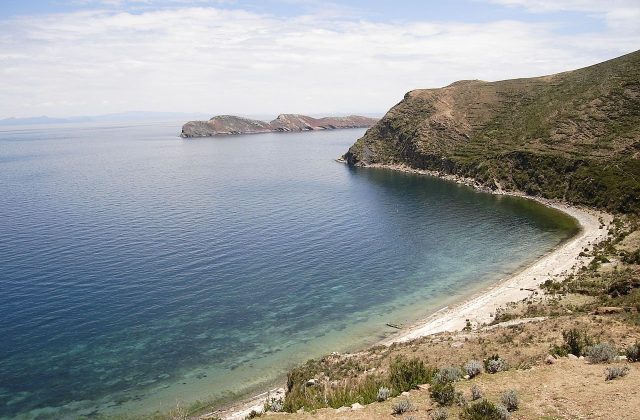
Isla del Sol
Bolivia
Isla del Sol is a rocky, terraced island in the Bolivian part of Lake Titicaca, at about 3,800 metres above sea level,…
No tours listed
Bolivia · Lakes & rivers · Historic island
Isla de la Luna is a small, dry island of about 2 square kilometres in the Bolivian part of Lake Titicaca, a few kilometres east of Isla del Sol and 3,800 metres above sea level. It holds the stone ruins of an Inca temple linked to the moon and a 20th-century political prison, and is usually visited by boat from Copacabana.
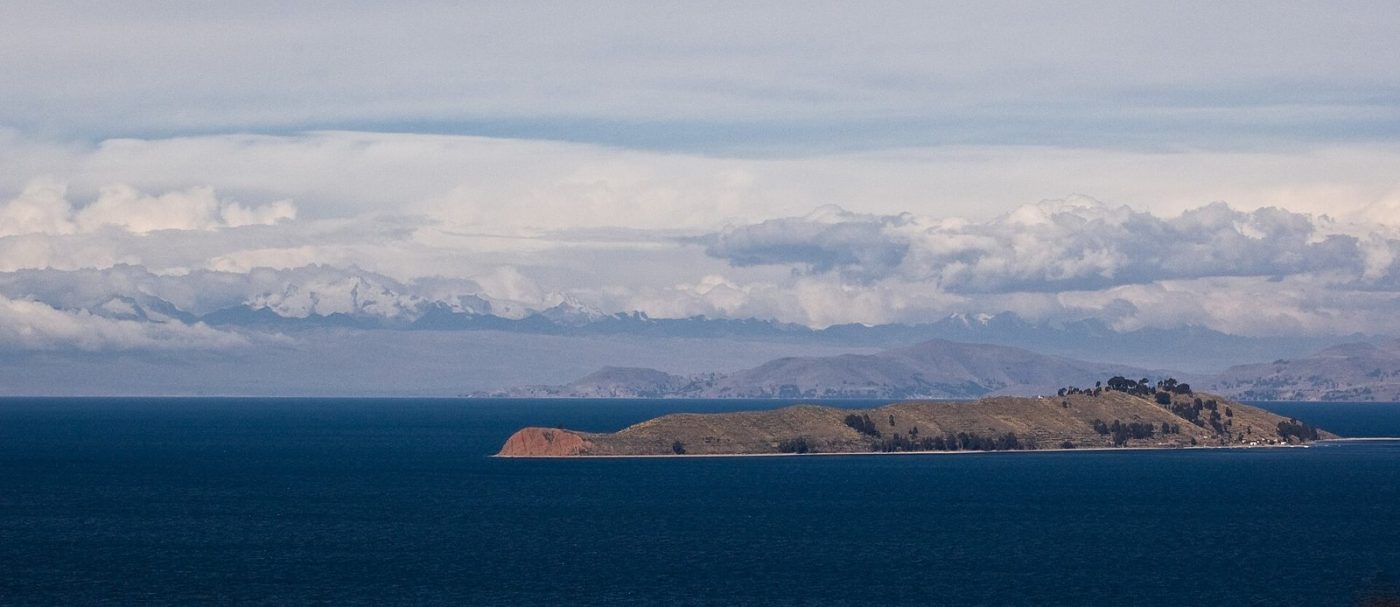
Photo: Alexandre Buisse (Nattfodd), CC BY-SA 4.0
| Getting there | Lake boats from Copacabana, about 1.5 to 2 h, usually on a full-day trip that also stops at Isla del Sol |
|---|---|
| Gateway | Copacabana, Bolivia |
| Travel time | About 1.5 to 2 h by lake boat |
| Days | A day trip is enough |
| Best months | May–Oct dry, sunny and cold at night; Dec–Mar rainy and choppy |
| Getting around | Car-free: one footpath climbs from the landing past the ruins |
| Booking | No need to book ahead; buy boat tickets on the Copacabana shore the day before |
| Cost | Cheap, even by Bolivian standards |
| Beaches | No beaches to speak of; the lake is cold, around 10 to 14 degrees, and few swim |
| Sea | Lakes & rivers |
| Area | 2.1 km² |
| Highest point | 3,925 m |
| Airport | No |
| Car-free | Yes |
| Checked | October 2026 |
Very little is sold online for Isla de la Luna on its own. The packaged option is a long day from La Paz that covers the road to Copacabana, a boat to Isla del Sol and a stop on Isla de la Luna, with transport, a guide and usually lunch included; it is tiring, with eight hours or more on the road and lake, and leaves little time on either island. Agencies in Puno sell similar two-day trips from the Peruvian side, with a night in Copacabana or on Isla del Sol.
Most people simply go on their own. Boat cooperatives on the beach at Copacabana run day trips that leave in the morning, stop at Isla de la Luna for about an hour, then continue to Isla del Sol for lunch and a walk before returning in the late afternoon. Tickets are sold from kiosks on the shore and cost little; the island's own entry fee is paid in cash at the landing. If you are sleeping on Isla del Sol, ask in Yumani about a boat across, alone or shared with others.
There is nothing to book in advance outside festival weekends. Bring cash in bolivianos, water and sun protection, and choose a guided trip only if you want the history explained in detail.
The main ruin stands just above the landing on the eastern shore: terraced courtyards and buildings of fitted stone with trapezoidal doorways and niches, the classic Inca style. It is usually described as a temple of women chosen to serve the sun and moon. A local guardian collects the fee and may show you round; allow 30 to 45 minutes.
A path climbs from the ruins up the bare slope to the ridge, past dry-stone walls and small fields. At this altitude the walk of 20 minutes or so feels hard, so go slowly. From the top you see Isla del Sol to the west and, on clear days, the snow peaks of the Cordillera Real across the deep blue water.
On the island stand the remains of the prison built in the 1930s for political detainees, with thick adobe walls that earned it a reputation as the Alcatraz of the Andes. Little is left beyond walls and foundations, and it is not signposted, so ask the guardian or your boatman to point it out.
A small Aymara community lives on the island, also known as Coati, farming terraces and herding sheep. Families sometimes sell weavings and snacks near the landing. Be polite about photographs and ask first. There are only a few houses, a school and simple facilities, so do not expect cafes or shops beyond what is laid out for visitors.
Almost every trip continues to the much larger Isla del Sol, 30 to 45 minutes west by boat. At Yumani in the south an old Inca stairway climbs past a spring to the village, and the ruin of Pilko Kaina sits on the shore nearby. Access to the northern ruins has been interrupted by local disputes, so check before you go.
Live dates and prices. Free cancellation on most tours.
The gateway is Copacabana, the lakeside town on the Bolivian shore. Buses from La Paz take about three and a half to four hours and cross the narrow Strait of Tiquina, where passengers go over by small boat and the bus follows on a wooden barge. From Puno in Peru, buses take about three hours via the border at Kasani, just outside Copacabana.
Boats to the islands leave from the beach at the bottom of the town, mostly in the morning, and return in the afternoon; the slow boats take about an hour and a half to two hours to Isla de la Luna. Faster launches can be hired privately. There is no road, airport or car on the island, so leave any vehicle in Copacabana.
Everything is on foot. Boats land at a small jetty on the east side, right below the ruins, and a single path leads up from there to the village and the ridge. Distances are short, but the altitude makes every climb slow, and the ground is stony and dusty. There is no shade and the sun is fierce, so bring a hat, sun cream and water. Boatmen wait about an hour before moving on.
The dry season from May to October is the time to go: sunny days around 15 degrees, a calm lake in the mornings and very clear air for views of the Cordillera Real. Nights are cold and can drop below freezing in June and July, so pack warm layers even on a day trip.
From December to March the rainy season brings afternoon storms, grey skies and choppy water, and boats may be cancelled. April and November are in between.
Copacabana fills up for the festivals of its Virgin in early February and around Bolivian Independence Day in early August, when buses and rooms are scarce and prices rise. Visit after a few days in La Paz or Puno to adapt to the altitude. A single morning is enough for the island itself.
Few visitors sleep on Isla de la Luna, which has only very basic community lodging at best. Copacabana is the practical base, with simple hotels and hostels along the lakefront and up the hill, restaurants serving trout, and the boats at the door. For a night on an island, choose Yumani on Isla del Sol, with guesthouses on the ridge above the stairway, sunset views and a calm evening after the day boats leave.
For the Incas, Lake Titicaca was the place of creation, and in their stories the god Viracocha raised the moon from this island, as he raised the sun from its larger neighbour. The temple they built here is linked to women chosen for religious service. In the 1930s Paraguayan prisoners of war from the Chaco War built a prison on the island, which held political prisoners for decades; in 1949 future president Hernan Siles Zuazo was among those who escaped by boat to Peru. Today a small Aymara community farms the island and receives visitors.
Most people pair it with Isla del Sol on the same boat day and spend a night or two in Copacabana, climbing Cerro Calvario for sunset. La Paz is three and a half to four hours away by bus, with Tiwanaku on the way. Crossing into Peru, Puno and the floating Uros islands and Taquile are about three hours west.
Lake boats from Copacabana, about 1.5 to 2 h, usually on a full-day trip that also stops at Isla del Sol.
From Copacabana, Bolivia: about 1.5 to 2 h by lake boat.
A day trip is enough.
May–Oct dry, sunny and cold at night; Dec–Mar rainy and choppy.
No. Isla de la Luna is car-free. Car-free: one footpath climbs from the landing past the ruins.
Go if you are already at Copacabana and want Inca ruins, deep blue lake views and near silence for an hour or two. Skip it or choose Isla del Sol if you have time for only one island, want walks, villages and places to sleep.
Cheap, even by Bolivian standards.
No beaches to speak of; the lake is cold, around 10 to 14 degrees, and few swim.
No need to book ahead; buy boat tickets on the Copacabana shore the day before.
Yes. Boat trips, guided tours and day trips for Isla de la Luna can be booked online; live prices and free cancellation on most are shown on this page.
Bolivia
Isla del Sol is a rocky, terraced island in the Bolivian part of Lake Titicaca, at about 3,800 metres above sea level,…
No tours listed