Phillip Island
Australia
Phillip Island is a low, farm-covered island about 125 km south-east of Melbourne, joined to the mainland by a bridge…
45 tours & trips
Australia · Pacific Ocean · Nature & wildlife island
Maria Island is a mountainous national park 4 km off the east coast of Tasmania, reached by a 30-minute ferry from Triabunna. There are no cars, shops or permanent residents, only convict ruins at Darlington, sandstone sea cliffs and wombats grazing on open grassland, which makes it one of the easiest places in Australia to see wildlife up close.
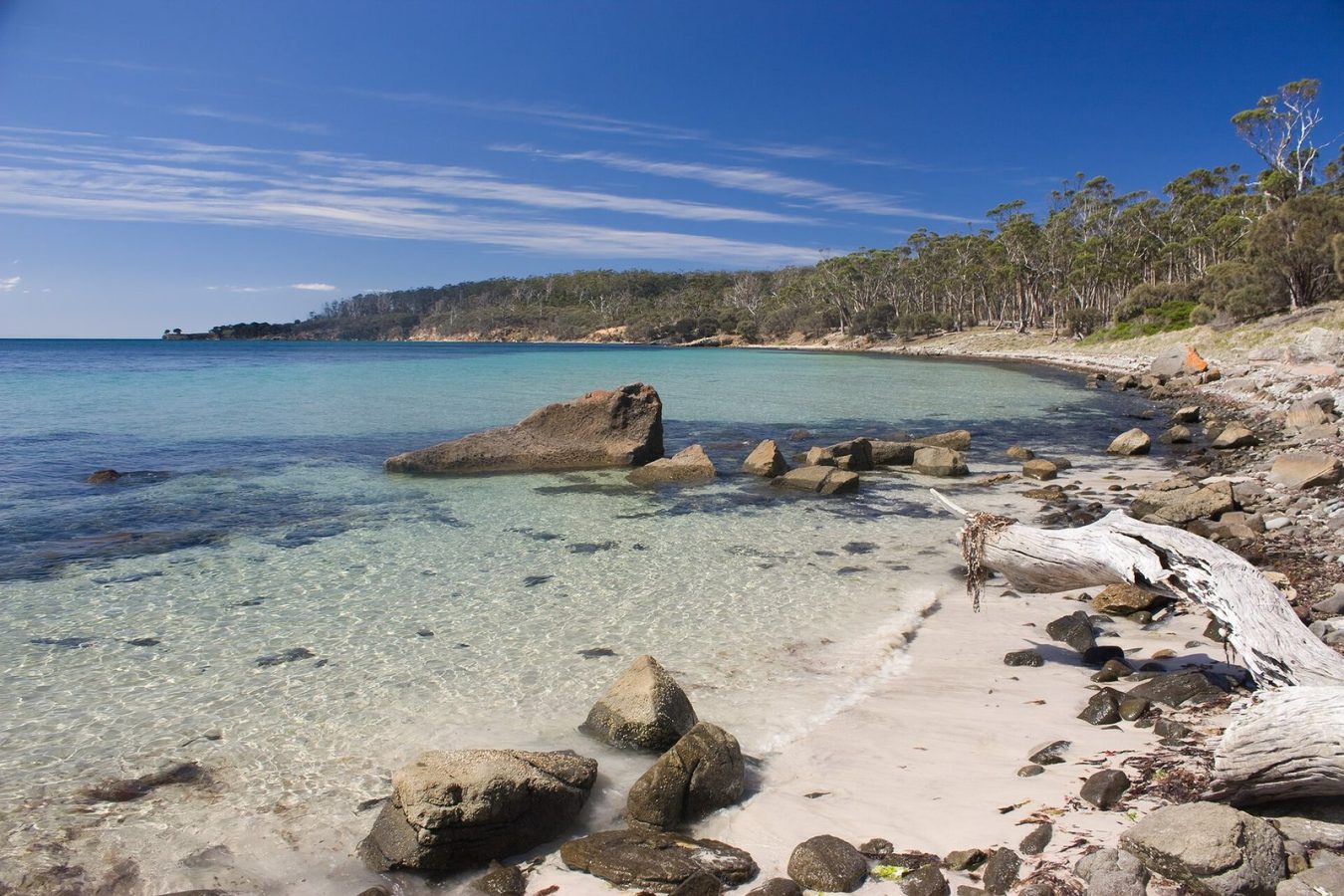
Photo: JJ Harrison (https://www.jjharrison.com.au/), CC BY-SA 3.0
| Getting there | Drive 1.25 h from Hobart to Triabunna, then a 30-min passenger ferry to Darlington |
|---|---|
| Gateway | Hobart (ferry from Triabunna) |
| Travel time | 30 min by ferry; Triabunna is 1.25 h from Hobart |
| Days | A day trip, or 1 to 2 nights |
| Best months | Nov–Apr for warmth and calmer seas; Jun–Aug cold and windy with fewer ferries |
| Getting around | Car-free: walk or cycle; hire a bike on arrival or bring your own on the ferry |
| Booking | Ferry seats and Penitentiary bunk rooms ahead in summer; buy a park pass before you go |
| Cost | Mid-range; bring your own food, as there are no shops |
| Beaches | Empty white-sand bays: Hopground Beach near Darlington, Riedle Bay and Shoal Bay further south |
| Sea | Pacific Ocean |
| Area | 116 km² |
| Population | Uninhabited |
| Highest point | 658 m (Mount Maria) |
| Ferry | 30 min from Hobart (ferry from Triabunna) |
| Airport | No |
| Car-free | Yes |
| UNESCO | Australian Convict Sites |
| Checked | October 2026 |
Most visitors come for the day, and three kinds of trip are sold.
The simplest is the ferry itself: a return crossing from Triabunna, with optional bike hire, after which you are free to walk the short loops from Darlington. Some packages add a coach transfer from Hobart, which suits travellers without a car because public buses to Triabunna are infrequent.
The second is a guided day tour from Hobart. A small group drives up the east coast, crosses on the ferry and spends five or six hours on the island with a guide who knows where the wombats, Forester kangaroos and Cape Barren geese graze, walks to the Painted Cliffs and explains the convict buildings. Lunch and the park fee are often included; check whether the ferry is.
The third is a boat cruise from Triabunna that follows the northern coast past the Fossil Cliffs to the seal colony on Ile des Phoques, showing sea caves and cliffs that walkers never see.
There are also multi-day guided walks with camp or lodge accommodation for people who want to cover the whole length of the island.
For a first visit with a car, take the ferry on your own and hire a bike; without a car, the guided day tour from Hobart is the easiest option.
The ferry lands at Darlington, the best-preserved part of the old probation station and one of the eleven Australian Convict Sites on the UNESCO list. Walk past the Commissariat Store, the Penitentiary and the Coffee Palace, which hold small displays, and look out for wombats grazing on the lawns between them. Allow an hour before heading off on the trails.
A flat walk of about 40 minutes south from Darlington along Hopground Beach leads to sandstone cliffs streaked with orange and brown swirls of iron oxide. You can only walk along their base at low tide, so check the tide times at the visitor area before setting off. Afternoon light brings out the colours best.
North of Darlington a loop of about two hours climbs gently past the ruins of the industrial era to limestone cliffs packed with fossil shells laid down in an ancient shallow sea. Look closely at the rock faces by the path, then return across open grassland, where kangaroos and Cape Barren geese gather in large numbers towards dusk.
The serious walk is the climb to the 620-metre dolerite summit of Bishop and Clerk, about four to five hours return from Darlington. The last section is a scramble over boulders and is exposed to wind; the reward is a view straight down the cliffs to the sea and north to the Freycinet Peninsula. Start by mid-morning if you are catching an afternoon ferry.
Staying overnight shows the island at its best: after the last ferry leaves, wombats, Bennett's wallabies and Forester kangaroos spread across the Darlington fields. Tasmanian devils were released here as a disease-free insurance population, and you may hear them at night. Keep food sealed, never feed the animals and use a red torch after dark.
Our pick for each kind of trip, with live dates and prices. Free cancellation on most.
Best for: First visit, a day from Hobart
Transport from Hobart, the crossing and a guided walk around Darlington and the grasslands in one day, the easiest choice if you have no car.
Triabunna, the ferry port, is a small fishing town on the east coast, about an hour and a quarter by car from Hobart along the Tasman Highway. Passenger ferries cross to Darlington in about 30 minutes, with several return sailings a day in summer and fewer in winter. Book ahead for school holidays and note the time of the last return boat, which sets the length of your day. Bikes can travel on the ferry but cars cannot, so leave yours in the car park by the Triabunna terminal. Without a car, look for a ferry package that includes a coach from Hobart, because ordinary buses up the east coast are few and slow. There is no airport and no road link, and the crossing can be cancelled in strong winds.
Visitors cannot bring vehicles, so you walk or cycle. Bikes can be hired through the ferry operator or brought across, and the gravel tracks from Darlington south to the narrow isthmus between Shoal Bay and Riedle Bay make easy riding. The main walks are signposted, but there is little shade on the open grassland, no shop and drinking water only at Darlington and the campsites. Carry food, water, sunscreen and a warm layer even in summer, as the weather changes fast.
The warmest and most reliable months are December to March, when days are long, the crossing is usually calm and the tracks are dry. Daytime temperatures are often in the low twenties, but cold southerly changes can arrive in any month, so pack a jacket. The summer school holidays, from late December to the end of January, bring the most day visitors and the campsites fill up.
Spring, in October and November, has wildflowers, young wombats and joeys, and fewer people; April is often settled and mild. From June to August it is cold, windy and sometimes wet, the ferry runs less often and rough weather can cancel crossings, but the island is nearly empty.
One full day covers Darlington, the Painted Cliffs and the Fossil Cliffs. Stay a night or two to climb Bishop and Clerk, cycle south and watch the animals at dusk.
Almost everyone stays at Darlington. The old Penitentiary has simple bunk rooms bookable through the parks service; bring bedding, food and a stove. Camping is allowed on the grassy ground at Darlington, with toilets and water, and at the more remote sites of French's Farm and Encampment Cove further south, which suit cyclists and walkers. Guided walks use their own camps. If you prefer a proper bed, sleep in Triabunna, Orford or Swansea on the mainland and come across for the day.
Aboriginal Tasmanians of the Oyster Bay nation crossed to the island by canoe for thousands of years and left shell middens along the shore. Abel Tasman sighted it in 1642 and named it after Maria van Diemen. From 1825 to 1832 it held a penal settlement, and from 1842 the Darlington Probation Station housed hundreds of convicts. In the 1880s the Italian businessman Diego Bernacchi tried to build a resort with vineyards and silk, and a cement works followed in the 1920s. Both failed, farming faded, and in 1972 the island became a national park. Kangaroos and geese were introduced as a safe refuge, which is why the wildlife is so relaxed today.
Maria Island fits neatly into an east coast drive from Hobart. Spend the night before in Orford or Triabunna, then continue north to Swansea and the Freycinet Peninsula, about an hour and a half beyond Triabunna, for Wineglass Bay. Port Arthur, the best-known convict site in Tasmania, is about two hours south and tells the same story on a larger scale.
Drive 1.25 h from Hobart to Triabunna, then a 30-min passenger ferry to Darlington.
From Hobart (ferry from Triabunna): 30 min by ferry; Triabunna is 1.25 h from Hobart.
A day trip, or 1 to 2 nights.
Nov–Apr for warmth and calmer seas; Jun–Aug cold and windy with fewer ferries.
No. Maria Island is car-free. Car-free: walk or cycle; hire a bike on arrival or bring your own on the ferry.
Go if you want wombats, convict ruins and coastal walks on a car-free island near Hobart. Skip it or choose Bruny Island if you want cafes, food producers and a car, because Maria has no shops at all. With about 30 min each way from Hobart (ferry from Triabunna), a day trip is easy to do.
Mid-range; bring your own food, as there are no shops.
Empty white-sand bays: Hopground Beach near Darlington, Riedle Bay and Shoal Bay further south.
Ferry seats and Penitentiary bunk rooms ahead in summer; buy a park pass before you go.
Yes. Boat trips, guided tours and day trips for Maria Island can be booked online; live prices and free cancellation on most are shown on this page.
Australia
Phillip Island is a low, farm-covered island about 125 km south-east of Melbourne, joined to the mainland by a bridge…
45 tours & trips
Australia
Rottnest Island is a low, sandy, car-free reserve 18 km off Fremantle, with turquoise bays, salt lakes and the small…
33 tours & trips
Australia
Tasmania is Australia's island state, about 240 km south of the mainland across Bass Strait, with a main island of…
33 tours & trips
Australia
Moreton Island is a sand island of high dunes and long beaches on the eastern edge of Moreton Bay, about 58 km…
24 tours & trips
Australia
Magnetic Island lies 8 km off Townsville in tropical north Queensland, a granite island of about 52 square kilometres,…
23 tours & trips
Australia
Bruny Island lies just south of Hobart across the D'Entrecasteaux Channel, two halves joined by a thin sandy neck,…
18 tours & trips