Santorini
Cyclades, Greece
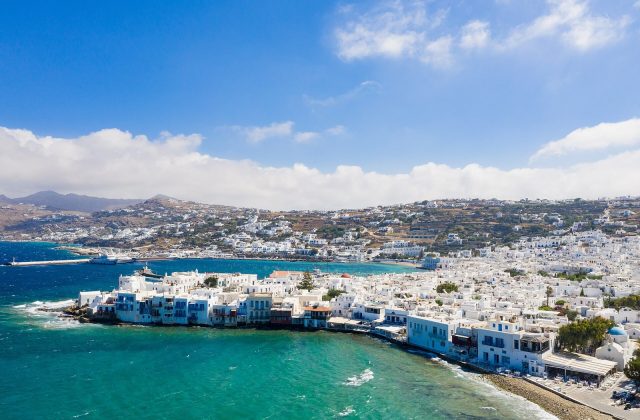
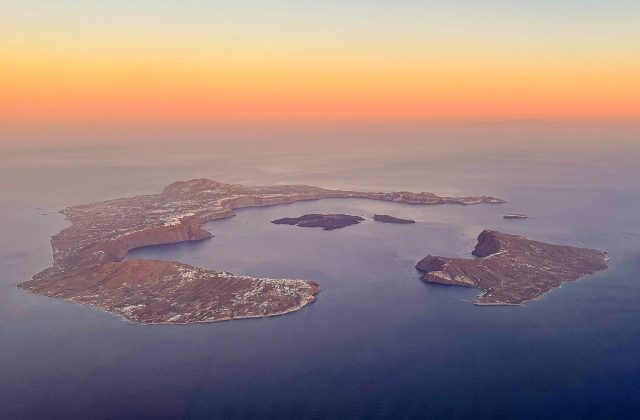
Santorini is the ring of a drowned volcano in the southern Cyclades: white villages along a 300-metre cliff, black-sand…
772 tours & trips
Greece · Aegean Sea · Nature & wildlife island
Andros is the northernmost and second-largest of the Cyclades, a green, mountainous island about 40 km long that rises to almost 1,000 metres. It is two hours by ferry from Rafina near Athens, yet it has springs, streams, stone-walled terraces and a waymarked trail network that most Aegean islands cannot match.
| Getting there | Ferry from Rafina to Gavrio in about 2 h, several sailings a day in summer; boats continue to Tinos and Mykonos |
|---|---|
| Gateway | Athens (Rafina port) |
| Travel time | About 2 h by ferry |
| Days | 3 to 5 nights |
| Best months | May–June and Sep–Oct for walking; August busy with Greek families |
| Getting around | Rent a car or bring one on the ferry; buses link Gavrio, Batsi, Chora and Korthi |
| Booking | Car ferries and rooms in August; walking guides a few days ahead |
| Cost | Mid-range for Greece, cheaper than Mykonos or Santorini |
| Beaches | Many small coves; Batsi for a town beach, Achla and Vitali down dirt roads, Tis Grias for the rock |
| Sea | Aegean Sea |
| Archipelago | Cyclades |
| Area | 380 km² |
| Population | 9,221 (2011) |
| Highest point | 995 m |
| Ferry | 2 h from Athens (Rafina port) |
| Airport | No |
| Car-free | No |
| Checked | October 2026 |
Andros sells a small range of things, almost all run from the island itself, so you have to get there first.
The most useful option for visitors without a car is a full-day minibus tour that covers Chora, a couple of mountain villages and a beach, with a guide who explains the island's shipping history. Half-day versions focus on the springs at Menites and the old village of Foros. A separate tour visits the monasteries above Batsi, which is worth it because some are hard to find alone and keep their own hours.
Walking is the island's real strength. Guided hikes on the waymarked trails, especially the walk down the Achla river valley to the sea, include a guide and usually transport back, though you bring your own water and lunch.
On the water there are private boat hires of a few hours with snacks, good for reaching coves that have no road, and an evening cruise with snorkelling. A day trip to Syros to see the neoclassical town of Ermoupoli is offered too.
Our advice: rent a car for at least two days, walk one trail on your own and book a guide for the longer valley routes.
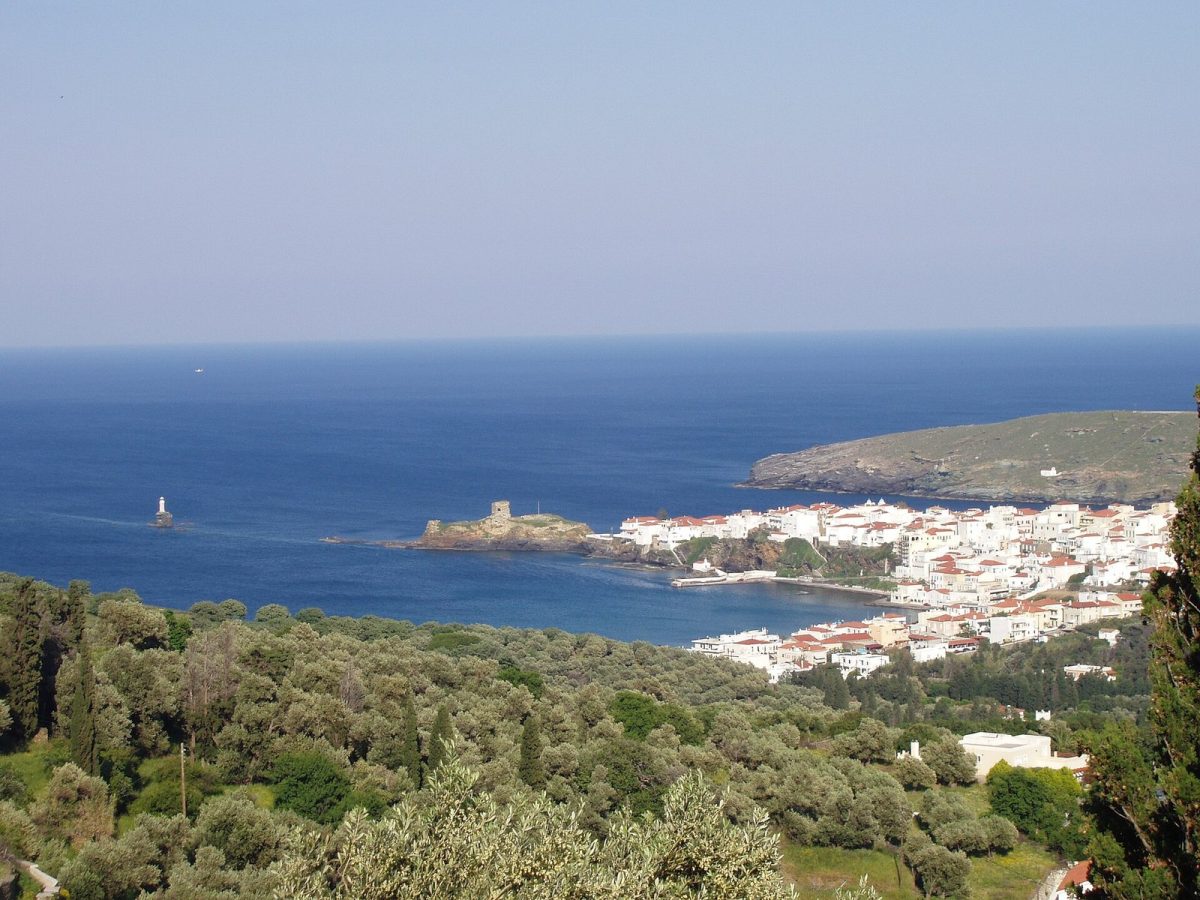
The main town sits on a narrow ridge on the east coast, with marble-paved lanes, captains' mansions and a stone bridge leading to the ruined Venetian castle on a rock in the sea. Visit the archaeological museum and the museum of contemporary art, both founded by shipowning families, and walk to the statue of the Unknown Sailor at the tip.
A network of restored mule paths, marked and numbered, crosses the island from coast to coast and links villages, springs, water mills and chapels. Stages range from an hour to a full day, and route maps are sold in the villages. Spring is the best time, when the streams run and the hillsides are green.
A short drive inland from Chora, the village of Menites has water pouring from carved lion heads beside a church under plane trees. Nearby Apoikia has the Sariza spring, whose water is bottled. These shady valleys are where to have a long lunch in a village taverna on a hot day.
Achla, a wide bay of sand at the mouth of a wooded valley, is reached by a long dirt road or on foot from Chora. Vitali and Zorkos further north are similar: little shade, few buildings and clear water. Check the road with your rental company, as some tracks are rough.
South of Korthi, a tall stone pillar stands in the water off a small beach, the subject of a local legend about an old woman who leapt from the cliff. Combine it with the quiet harbour of Ormos Korthiou and the village of Aidonia above it.
The busiest resort is a fishing village on a curving bay near Gavrio, with a sandy town beach, tavernas on the harbour and most of the island's rooms. From here roads climb to the monasteries and to Palaeopolis, the ancient capital, whose sunken harbour wall lies below the village.
Our pick for each kind of trip, with live dates and prices. Free cancellation on most.
Best for: First visit, the island in one day
A driven loop of the main villages, Chora and the beaches, useful if you arrive without a car and want to see how varied the island is.
There is no airport, so everyone arrives by sea. Ferries leave Rafina, the port east of Athens about 30 minutes from the airport, for Gavrio on the west coast. The crossing takes about two hours on conventional ferries and a little less on fast boats; in summer there are several departures a day, in winter usually one or two. Most boats continue to Tinos and Mykonos, so Andros fits at the start of a Cyclades trip.
Buy tickets online or at agencies in Rafina, and book car space early for August weekends, when Athenians fill the boats. Bringing a car is worth it on an island this size. Strong north winds can delay crossings in July and August.
Andros is big and hilly, and the beaches and villages are spread out, so a car is the practical choice. Rental offices are in Gavrio, Batsi and Chora. Local buses run between Gavrio, Batsi, Chora and Korthi a few times a day in summer, timed loosely with the ferries, and taxis wait at the port. Roads are paved between the main towns but narrow and winding, and the drive from Gavrio to Chora takes about 45 minutes. Many beaches are reached by dirt tracks.
May and June are the best months for walking: the hills are green, the streams still run and the sea warms through June. September and October are the other good window, with warm water and empty trails, though some tavernas close in mid-October.
July and August are hot and the meltemi blows hard from the north, which can make the east coast beaches choppy. August is the busiest month, mostly with Greek families, and prices rise around the 15 August holiday. From November to March the island is quiet and rainy, with fewer ferries and many rooms shut, but Chora stays open all year. Greek Easter is a lively time in the villages. Allow three nights for the main sights and a walk, and five if you want to hike several stages.
Batsi has the most rooms, restaurants and a sandy beach, and it is close to the port, so it suits a first visit and families. Chora is the most beautiful base, with museums and evening life in the lanes, but its beaches are small. Gavrio is practical for an early ferry. Korthi in the south is quiet and good for walkers. Village houses inland, around Menites or Stenies, suit people with a car who want shade and silence.
People lived on Andros long before the classical age: the Neolithic settlement of Strofilas on the west coast is one of the oldest fortified villages in the Aegean. The ancient city stood at Palaeopolis. In 1207 the Venetians took the island and built the castle at Chora, and Ottoman rule followed. From the nineteenth century Andros became an island of sea captains and shipowners, whose money paid for the mansions and museums of Chora. Tourism came late, which is why the island still feels lived in rather than built for visitors.
Tinos is the obvious next stop, about an hour away by ferry, with its pilgrimage church and marble villages. Mykonos is around two hours from Gavrio on the same line. A relaxed route is Rafina to Andros for four nights, then Tinos and Mykonos, flying home from Mykonos. Syros is close too, but crossings depend on the season.
Ferry from Rafina to Gavrio in about 2 h, several sailings a day in summer; boats continue to Tinos and Mykonos.
From Athens (Rafina port): about 2 h by ferry.
3 to 5 nights.
May–June and Sep–Oct for walking; August busy with Greek families.
Rent a car or bring one on the ferry; buses link Gavrio, Batsi, Chora and Korthi.
Go if you want long walks between springs and villages, quiet beaches and a real Greek island close to Athens. Skip it or choose Naxos or Paros if you want nightlife, many organised beaches or a quick flight in. At about 2 h each way from Athens (Rafina port), it is worth staying at least one night.
Mid-range for Greece, cheaper than Mykonos or Santorini.
Many small coves; Batsi for a town beach, Achla and Vitali down dirt roads, Tis Grias for the rock.
Car ferries and rooms in August; walking guides a few days ahead.
Yes. Boat trips, guided tours and day trips for Andros can be booked online; live prices and free cancellation on most are shown on this page.
Cyclades, Greece
Santorini is the ring of a drowned volcano in the southern Cyclades: white villages along a 300-metre cliff, black-sand…
772 tours & trips
Cyclades, Greece
Mykonos is a small, dry and windy island in the central Cyclades, about 85 square kilometres of brown hills ringed by…
294 tours & trips
Cyclades, Greece
Naxos is the largest and greenest of the Cyclades, 428 square kilometres of long sandy beaches, marble villages and…
208 tours & trips
Cyclades, Greece
Paros sits at the heart of the Cyclades, about 150 km south-east of Piraeus and a short hop from Naxos and Mykonos, a…
138 tours & trips
Cyclades, Greece
Milos is a volcanic island at the south-western edge of the Cyclades, wrapped round a large flooded caldera that forms…
122 tours & trips
Cyclades, Greece
Antiparos is a small, relaxed island in the Cyclades, separated from Paros by a channel less than two kilometres wide…
38 tours & trips