Maria Island
Australia
Maria Island is a mountainous national park 4 km off the east coast of Tasmania, reached by a 30-minute ferry from…
211 tours & trips
Australia · Indian Ocean · Nature & wildlife island
Christmas Island is a remote Australian territory in the Indian Ocean, 350 km south of Java and about 1,550 km from the Australian mainland. Most of its 135 square kilometres is rainforest national park, famous for the annual migration of tens of millions of red crabs, endemic seabirds and excellent diving.
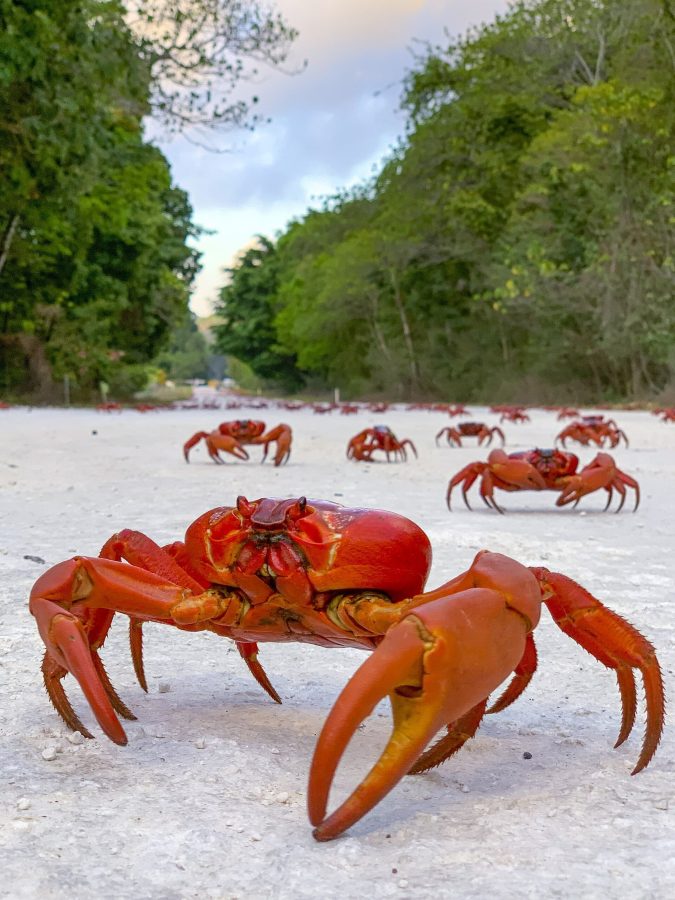
Photo: ChrisBrayPhotography, CC BY-SA 4.0
| Getting there | Flights from Perth a few times a week, about 4 h; some routed via the Cocos (Keeling) Islands |
|---|---|
| Gateway | Perth (flight) |
| Travel time | About 4 h by air |
| Days | 3 to 5 nights |
| Best months | Oct–Dec for the red crabs; Apr–Nov drier with calmer diving; wet season Dec–Apr |
| Getting around | Rent a car, ideally a 4WD, from the airport; no public buses |
| Booking | Flights, lodging and car months ahead, especially for the crab migration |
| Cost | Expensive, even by Australian standards |
| Beaches | Few: Flying Fish Cove for swimming and snorkelling; Dolly and Lily beaches on rough tracks |
| Sea | Indian Ocean |
| Area | 135 km² |
| Population | 1,692 (2021) |
| Highest point | 361 m (Murray Hill) |
| Airport | Yes, scheduled flights |
| Car-free | No |
| Checked | October 2026 |
Nothing is sold online for Christmas Island on its own in this catalogue. Visitors fly in independently, rent a car and arrange guides locally or through the island's tourism office.
The main things booked on the island are dives, nature tours and fishing. Dive operators in the Settlement take divers to the walls that drop away a short distance from shore, with excellent visibility, sea caves and, in the right season, whale sharks; snorkelling trips cover the same reefs. Birdwatching and nature tours, often half-day trips with a local naturalist, help you find the endemic birds, robber crabs and the best rainforest dales. During the red crab migration, guided tours explain the spawning and take you to the crossing points at the right time.
Some operators sell packages bundling flights, accommodation and a car, which can be cheaper than booking separately. Fishing charters and kayak trips are also offered, depending on the swell.
The plain recommendation is to book flights, accommodation and a car well in advance, then add a guided nature tour on the first day to get your bearings and a day or two of diving if you are certified.
At the start of the wet season, usually between October and December, tens of millions of red land crabs leave the forest and march to the coast to breed, timed to the phase of the moon. Roads close, bridges carry the crabs over the traffic, and the beaches turn red. Check predictions from the national park before booking flights.
The sheltered bay by the Settlement is the island's main swimming spot, and the reef drops away into deep water within metres of the beach. Snorkellers see hard corals, reef fish and sometimes spinner dolphins; divers descend along steep walls. From November to April whale sharks sometimes pass. The north-west swell can close the cove in the wet season.
On the west coast, a series of deep, forested gullies called the Dales are protected wetlands. A boardwalk leads through tall rainforest with buttress roots to Hugh's Dale waterfall, best after rain. Robber crabs, the world's largest land crabs, are often seen near the track. The walk takes about an hour return from the car park.
On the south coast, ocean swells force water through holes in the jagged limestone shore, sending jets of spray high into the air with a deep roar. A boardwalk and lookout let you watch safely; never walk on the wet rocks. The drive from the Settlement takes around 30 minutes, on a road through forest and plateau.
Dolly Beach, reached by a boardwalk through coastal forest on the east coast, is a sheltered cove of coral sand where turtles nest. Swimming is possible only in calm conditions inside the reef. Lily Beach and Ethel Beach, further north on the same coast, have picnic shelters and rock pools. Tracks can be rough after rain, so check with the visitor centre.
The island is a breeding ground for rare seabirds, including the Abbott's booby, the Christmas Island frigatebird and the golden bosun. Lookouts along the edge of the plateau give wide views of the cliffs and the ocean. Frigatebirds gather above the Settlement in the late afternoon, and red-footed boobies nest in trees near the coast.
The only practical way to reach the island is by air. Scheduled flights from Perth operate a few times a week and take about four hours; some services fly a loop that also calls at the Cocos (Keeling) Islands, making it possible to visit both territories on one trip. Charter flights from Asia have operated at times, but they are irregular.
Seats are limited and fares high, so book months ahead, particularly for the crab migration season. The airport lies a few kilometres from the Settlement, and car hire firms meet flights if booked.
Flights from Perth are domestic, so Australians need only photo ID, while other visitors need a valid Australian visa. There is no passenger ferry; cargo ships call at Flying Fish Cove, and a few expedition cruises visit.
A rental car is essential. There are no public buses, few taxis, and sights are spread around a large plateau with sealed roads near the Settlement and unsealed tracks elsewhere. A 4WD is recommended for the beaches and the Dales, especially in the wet season. Book the car with your flight, as the fleet is small. During the crab migration some roads close to protect the animals; drive slowly, use crab rakes where provided and follow the park's advice.
The island has a wet season from about December to April, when the north-west monsoon brings heavy showers and swell, and a drier season from April to November, with south-east trade winds and calmer conditions on the north coast. Temperatures stay warm all year, between about 23 and 30 degrees, with high humidity.
The red crab migration is the peak attraction. It starts with the first heavy rains, usually between October and December, and the spawning follows the lunar cycle, so the exact dates vary each year; the national park publishes predictions. Accommodation and flights sell out for those weeks.
Diving is good all year, with the clearest water in the dry season and whale shark sightings mainly from November to April. Birdwatching is excellent at any time. Three to five nights covers the main sights; divers and photographers often stay a week.
Accommodation is limited to a few small resorts, motels and self-contained apartments and houses, nearly all in or near the Settlement, the main township on the north-east coast. Staying there puts you close to Flying Fish Cove, the dive shops, the few restaurants and the shops. A handful of lodges lie further out among the forest, suiting those who want quiet and wildlife at the door. Self-catering is common, as food is expensive and restaurants are few.
Christmas Island was named on Christmas Day 1643 by a passing English captain but stayed uninhabited until phosphate deposits were found in the late nineteenth century. Britain annexed it in 1888, and mining began in 1899, using workers brought from China, Malaya and Singapore, whose descendants make up much of today's population; temples, mosques and Chinese shops reflect this. Japan occupied the island in 1942 for its phosphate. In 1958 it was transferred from Singapore to Australia. Mining still continues, alongside a large national park.
The Cocos (Keeling) Islands, another Australian territory with lagoons and white-sand beaches, is the natural pairing, linked by the same flight loop about 900 km to the west. Perth is the gateway for both, and a few days there or on the coast north of the city round off the trip.
Flights from Perth a few times a week, about 4 h; some routed via the Cocos (Keeling) Islands.
From Perth (flight): about 4 h by air.
3 to 5 nights.
Oct–Dec for the red crabs; Apr–Nov drier with calmer diving; wet season Dec–Apr.
Rent a car, ideally a 4WD, from the airport; no public buses.
Go if you love wildlife, diving, rainforest walks and genuinely remote places, especially for the red crab migration. Skip it or choose the Cocos Islands or Ningaloo if you want white-sand beaches, easy swimming or an affordable trip.
Expensive, even by Australian standards.
Few: Flying Fish Cove for swimming and snorkelling; Dolly and Lily beaches on rough tracks.
Flights, lodging and car months ahead, especially for the crab migration.
Australia
Maria Island is a mountainous national park 4 km off the east coast of Tasmania, reached by a 30-minute ferry from…
211 tours & trips
Australia
Phillip Island is a low, farm-covered island about 125 km south-east of Melbourne, joined to the mainland by a bridge…
45 tours & trips
Australia
Rottnest Island is a low, sandy, car-free reserve 18 km off Fremantle, with turquoise bays, salt lakes and the small…
33 tours & trips
Australia
Tasmania is Australia's island state, about 240 km south of the mainland across Bass Strait, with a main island of…
33 tours & trips
Australia
Moreton Island is a sand island of high dunes and long beaches on the eastern edge of Moreton Bay, about 58 km…
24 tours & trips
Australia
Magnetic Island lies 8 km off Townsville in tropical north Queensland, a granite island of about 52 square kilometres,…
23 tours & trips