Sylt
North Frisian Islands, Germany
Sylt is Germany's northernmost island, a narrow strip of dunes and heath in the North Sea with a sandy beach about…
20 tours & trips
Germany · North Sea & Channel · Beach island
Föhr is a flat, green island in the Wadden Sea off the coast of Schleswig-Holstein, the second-largest German island in the North Sea. It is less than an hour by ferry from Dagebüll and is known for a long sandy south coast, thatched Frisian villages, cycling and walks across the mudflats at low tide.
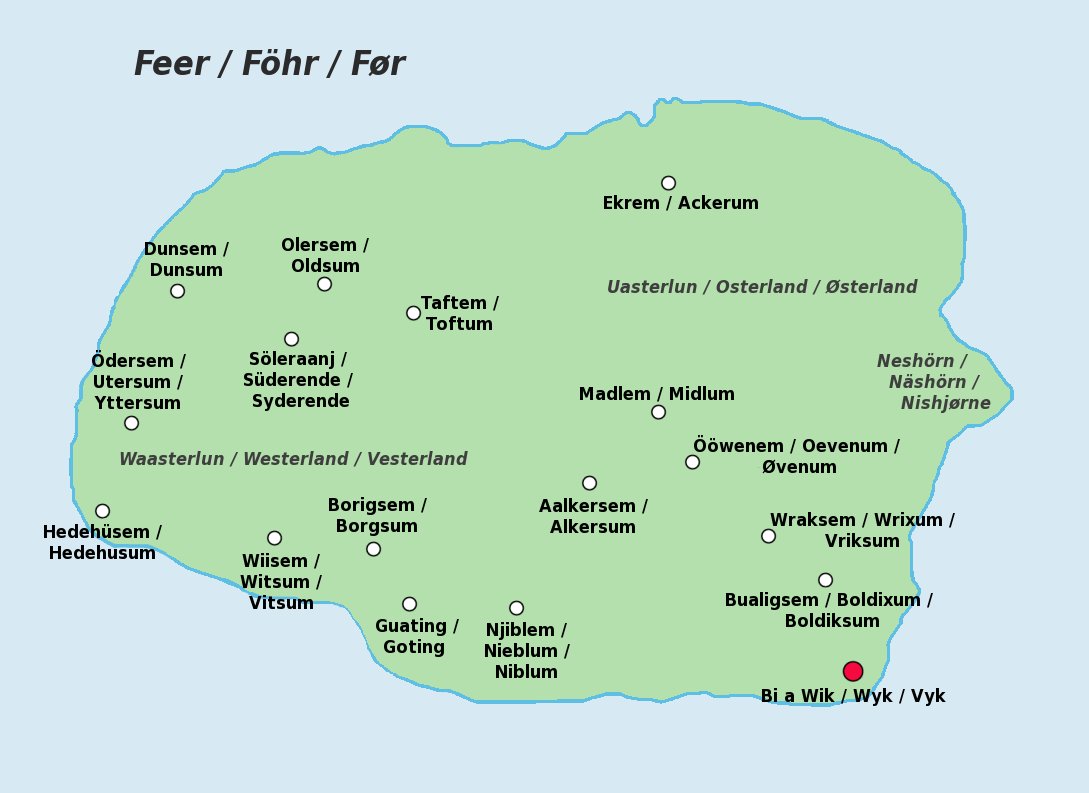
Photo: MarGrete, CC BY-SA 3.0
| Getting there | Car ferry from Dagebüll to Wyk in about 50 min, roughly hourly in summer; trains run to the pier |
|---|---|
| Gateway | Dagebüll Mole (ferry to Wyk) |
| Travel time | About 50 min by ferry |
| Days | 3 to 5 nights |
| Best months | Jun–Sep; sea cool even in summer, mudflat walks spring to autumn |
| Getting around | Hire a bike; flat lanes link all villages, and buses run round the island |
| Booking | Car places on the ferry and holiday flats months ahead for summer and school holidays |
| Cost | Mid-range for a German island, cheaper than Sylt |
| Beaches | About 15 km of fine sand on the south coast from Wyk to Utersum, with beach chairs and shallow water |
| Sea | North Sea & Channel |
| Archipelago | North Frisian Islands |
| Area | 83 km² |
| Population | 8,488 (2022) |
| Highest point | 13 m |
| Ferry | 50 min from Dagebüll Mole (ferry to Wyk) |
| Airport | No |
| Car-free | No |
| Checked | October 2026 |
Almost everything sold on Föhr is a boat trip, and most of them use the island as a base for the wider Wadden Sea.
If you are staying on the mainland or in Nordstrand, there are day trips by ferry to Föhr itself; they are simply a timed return crossing, and you explore on your own by bike or bus. If you are staying on Föhr, the boats from Wyk harbour go the other way: to Amrum next door, to the much bigger island of Sylt, to Hallig Hooge, and on longer days to Helgoland far out in the open sea.
The most popular short trip goes to the seal banks, where common and grey seals lie on the sand at low tide. These run one to two hours, often include a demonstration of a trawl net with crabs and fish, and suit children well.
Guided mudflat walks are booked locally and are among the best things to do here.
Our advice: book a seal trip and one hallig day, rent bikes for the rest, and leave Helgoland for calm weather.
The island's only town, by the ferry harbour, has been a seaside resort since the early nineteenth century, when Danish kings spent summers here. Walk the Sandwall promenade above the beach, browse the shops of the old centre and visit the Frisian Museum, which tells the story of the island's whalers and seafarers.
A strip of fine sand runs along the south coast from Wyk past Nieblum and Goting to Utersum. The water is shallow and calm, sheltered by Amrum, so it suits small children; at low tide it retreats far out. Wicker beach chairs are hired by the day, and the western end near Utersum is the quietest.
Three kilometres west of Wyk, Nieblum is the prettiest village, with thatched brick houses, rose gardens and a large medieval church known as the Frisian cathedral. In the churchyard, the carved gravestones of sea captains record their voyages and families in long inscriptions. It is an easy 15-minute bike ride.
At low tide, guides lead groups across the seabed from the south-west of Föhr to Amrum, a walk of several hours barefoot through mud and shallow channels, returning by ferry. Shorter walks show worms, crabs and shells close to the shore. Never go out alone: the tide comes back quickly.
In the village of Alkersum, in the middle of the island, a modern museum shows paintings of the sea and coast of northern Europe, from Danish and German artists to Norwegian ones. Its garden and café make it a good stop on a rainy day, about 20 minutes by bike from Wyk.
The northern half of the island is flat marshland behind a sea dike, crossed by straight lanes and grazed by sheep and cattle. Cycle along the top of the dike for wide views over the mudflats to the halligs, and look for geese and waders in spring and autumn.
Our pick for each kind of trip, with live dates and prices. Free cancellation on most.
Best for: First visit, a day from the mainland
The return crossing from Dagebüll with a day on the island, enough to cycle from Wyk to Nieblum and walk on the beach.
Ferries leave Dagebüll Mole on the mainland for Wyk, taking about 50 minutes on the direct boats. In summer they run roughly every hour from early morning to evening, and less often in winter. Some sailings continue to Amrum, and a few go via Amrum first, which takes longer.
Regional trains run from Niebüll to the pier at Dagebüll, with connections from Hamburg. If you bring a car, reserve a place in advance for summer and holiday weekends, as space is limited; parking at Dagebüll is the alternative, and many visitors leave the car there. Foot passengers can usually just turn up and buy a ticket. There are no flights for normal visitors. In autumn and winter, storms occasionally cancel crossings.
Föhr is flat and only about 12 km across, so a bike is the best way to get around; rental shops are by the harbour in Wyk and in most villages, and e-bikes help into the wind. Cycle paths and quiet farm lanes link all the villages. Island buses run on loops from Wyk to the villages, roughly hourly in summer. A car is useful only for families with a lot of luggage, and taxis are available in Wyk.
The beach season runs from June to early September, when the air is mild rather than hot and the North Sea reaches the high teens at best. July and August coincide with German school holidays, so flats, ferries and beach chairs are fully booked and prices are highest.
May and September are good months for cycling and mudflat walks, with fewer people and longer stretches of empty beach. Guided walks across to Amrum run from spring to early autumn, depending on tides. Wind is a constant; even in summer, bring a windproof jacket.
Winter is grey and stormy, but Wyk stays open and the island is very quiet. On 21 February the islanders light the Biikebrennen bonfires. Three nights cover the island; a week suits families with children.
Wyk has the most holiday flats, hotels, restaurants and the harbour for boat trips, and its beach and promenade are a few minutes' walk from most rooms. It suits visitors without a car. Nieblum is more peaceful and close to the beach. Utersum and Goting on the south-west coast are quiet villages near the emptiest sand. Farmhouse flats in the inland villages, around Oevenum or Süderende, suit families who will cycle everywhere.
Föhr was part of the mainland until a great storm flood in 1362 broke up the coast and left it an island. For centuries it belonged to Denmark, and only in 1864 did it pass to Prussia. In the seventeenth and eighteenth centuries many island men served as captains on Dutch whaling ships, and their wealth built the brick houses and carved gravestones you still see. Later many emigrated to America. The local Frisian language, Fering, is still spoken in the villages.
Amrum, with its huge beach of white sand and a lighthouse, is 20 minutes away by ferry and easy as a day trip or a second base. Sylt is a short crossing by excursion boat in summer. On the mainland, Husum and the North Frisian coast are an hour or two by car, and Hamburg is about two and a half hours from Dagebüll by train.
Car ferry from Dagebüll to Wyk in about 50 min, roughly hourly in summer; trains run to the pier.
From Dagebüll Mole (ferry to Wyk): about 50 min by ferry.
3 to 5 nights.
Jun–Sep; sea cool even in summer, mudflat walks spring to autumn.
Hire a bike; flat lanes link all villages, and buses run round the island.
Go if you want an easy family beach holiday with cycling, brick villages and mudflat walks in the North Sea. Skip it or choose Sylt if you want dunes, surf, smart restaurants and nightlife. With about 50 min each way from Dagebüll Mole (ferry to Wyk), a day trip is easy to do.
Mid-range for a German island, cheaper than Sylt.
About 15 km of fine sand on the south coast from Wyk to Utersum, with beach chairs and shallow water.
Car places on the ferry and holiday flats months ahead for summer and school holidays.
Yes. Boat trips, guided tours and day trips for Föhr can be booked online; live prices and free cancellation on most are shown on this page.
North Frisian Islands, Germany
Sylt is Germany's northernmost island, a narrow strip of dunes and heath in the North Sea with a sandy beach about…
20 tours & trips
North Frisian Islands, Germany
Amrum is a small North Frisian island in the German Wadden Sea, south of Sylt and west of Föhr, famous for the…
8 tours & trips