Tahiti
Society Islands, French Polynesia
Tahiti is the largest island of French Polynesia, 1,042 square kilometres of jagged green volcanic peaks rising to…
90 tours & trips
French Polynesia · Pacific Ocean · Remote island
The Marquesas Islands are a group of steep volcanic islands in the far north-east of French Polynesia, about 1,400 km from Tahiti and among the most remote inhabited places on earth. Instead of lagoons they offer jagged green peaks, deep valleys, stone tiki and a living Polynesian culture, listed by UNESCO in 2024.
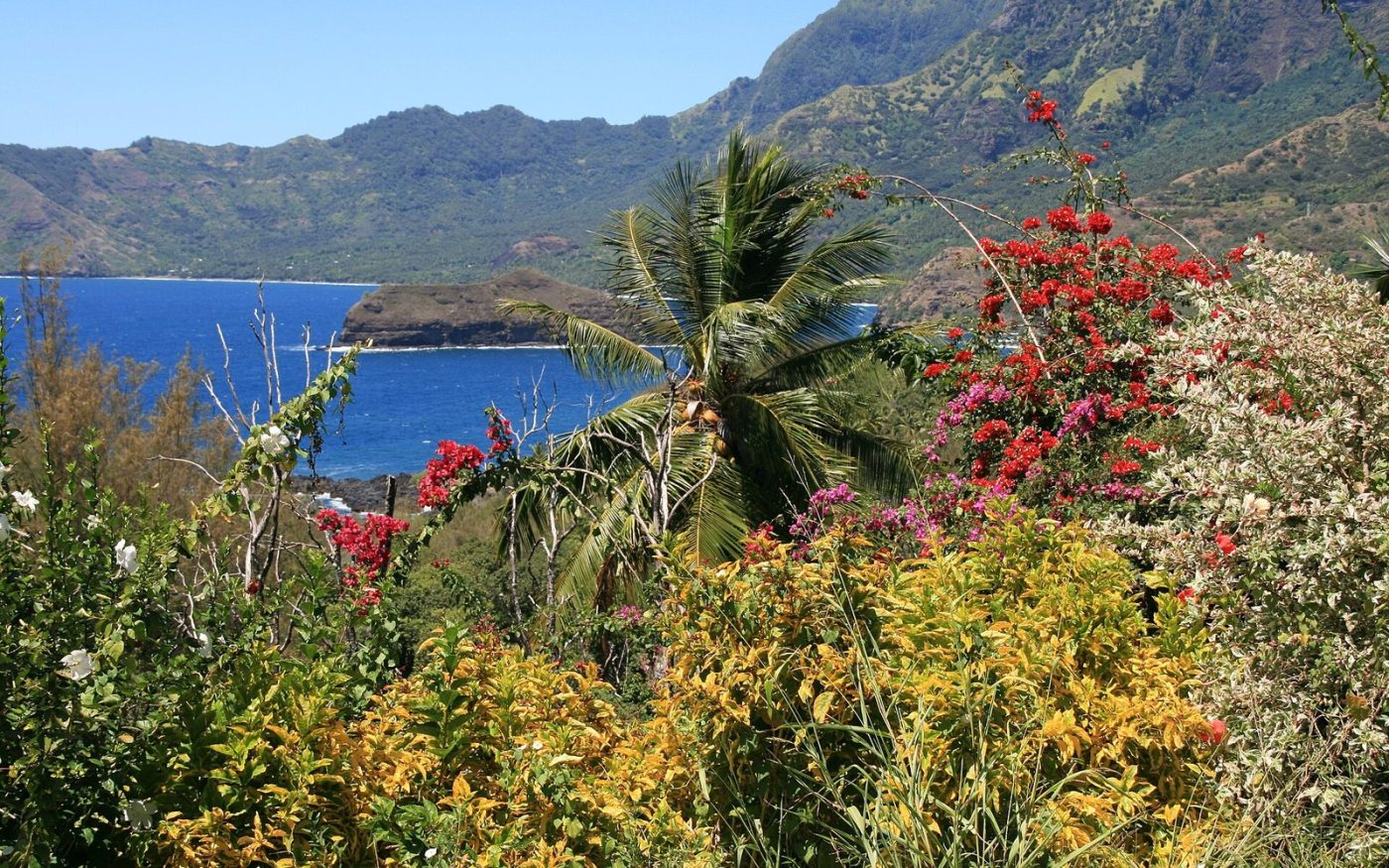
Photo: Sémhur ·✉·✍·, CC BY-SA 3.0
| Getting there | Flights from Papeete to Nuku Hiva or Hiva Oa in about 3.5 h, or the Aranui cargo-cruise ship from Papeete |
|---|---|
| Gateway | Papeete (Tahiti) |
| Travel time | About 3.5 h by air; the ship takes 13 days |
| Days | A week or more |
| Best months | Year-round; drier Sep–Dec; seas rougher Jun–Aug |
| Getting around | 4x4 with driver or rental on Nuku Hiva and Hiva Oa; small planes and boats between islands |
| Booking | Flights, guesthouses and 4x4s weeks ahead; the ship months ahead |
| Cost | Expensive, even by French Polynesian standards |
| Beaches | Few good beaches, mostly dark sand with biting sandflies; Anaho on Nuku Hiva is the best |
| Sea | Pacific Ocean |
| Area | 997 km² |
| Population | 9,478 (2022) |
| Highest point | 1,230 m (Mount Oave (Ua Pou)) |
| Airport | Yes, scheduled flights |
| Car-free | No |
| UNESCO | Te Henua Enata – The Marquesas Islands |
| Checked | October 2026 |
Almost nothing is sold online for the Marquesas: one guided hike on Nuku Hiva to the top of the Vaipo waterfall in the Hakaui valley, which includes the boat ride along the coast from Taiohae, a local guide and usually a fruit snack along the way. It is a long, hot walk through the valley and worth booking ahead.
Most visitors arrange everything else locally through their guesthouse. The standard options are full-day 4x4 tours with a driver-guide, who knows the archaeological sites and the rough mountain roads, boat trips to bays only reachable by sea, horse riding, and hiking guides for the high trails. Guesthouse rates often include breakfast and dinner, because restaurants are few.
The other way to see the islands is aboard the Aranui, a cargo and passenger ship that sails from Papeete on a round trip of about 13 days, calling at all six inhabited Marquesas islands with guided excursions ashore and meals included. It is expensive but solves the hard part, which is moving between islands. For an independent trip, fly to Nuku Hiva and Hiva Oa, spend three or four nights on each, and hire a driver-guide for at least one full day on each island.
The largest island has the capital, Taiohae, on a huge bay below green cliffs. A boat ride west brings you to the Hakaui valley, where a trail of about two hours each way leads through old stone platforms to the Vaipo waterfall, one of the highest in French Polynesia. Swim in the pool below and bring repellent for the sandflies.
Atuona, the main village of Hiva Oa, is where Paul Gauguin spent his last years and the Belgian singer Jacques Brel lived in the 1970s; both are buried in the hillside cemetery above the bay. A small cultural centre recreates Gauguin's house and shows copies of his work, and a hangar keeps Brel's aircraft.
On the north-east coast of Hiva Oa, a slow 4x4 drive of about two hours from Atuona, the Iipona site holds the largest stone tiki in French Polynesia, more than two metres tall, among platforms and smaller figures in a quiet valley. Go with a guide who can explain the carvings, then eat in the village by the bay.
On the north coast of Nuku Hiva, Hatiheu is a pretty village with a restored ceremonial ground and the Kamuihei site nearby, where petroglyphs sit under giant banyan trees. From Hatiheu a steep path of about an hour crosses the ridge to Anaho, the archipelago's best beach, with a reef and calm water for swimming.
Ua Pou is recognisable from far out at sea by its basalt spires, the highest of which, Mount Oave, reaches 1,230 metres and is often wrapped in cloud. The island is reached by small plane or boat from Nuku Hiva and has the archipelago's liveliest dance and music traditions, best seen on festival days.
The southernmost inhabited island has no airport and is reached only by boat, often from Hiva Oa. Hanavave, below the rock towers of the Bay of Virgins, is one of the most striking anchorages in the Pacific. A road of about 17 km over the mountains leads to Omoa, where women still make tapa bark cloth.
Live dates and prices. Free cancellation on most tours.
Almost everyone arrives by air from Papeete. Flights to Nuku Hiva take about three and a half hours, sometimes with a stop, and there are also flights to Hiva Oa; smaller planes link Nuku Hiva, Hiva Oa, Ua Pou and Ua Huka. Services are only a few times a week, so plan the trip around the flight schedule and allow a spare day before any international connection from Tahiti.
The airport on Nuku Hiva is on the dry north-west plateau, a drive of over an hour on a winding road to Taiohae. The alternative is the Aranui, which carries cargo and passengers from Papeete about once every three weeks. Inter-island boats exist but are irregular, and yachts crossing the Pacific often make the Marquesas their first landfall.
Roads are steep, narrow and partly unsealed, so a four-wheel drive is essential. On Nuku Hiva and Hiva Oa you can rent one, but many visitors prefer a driver-guide, who also explains the sites. There is no public transport, and taxis are 4x4s booked through guesthouses. Some bays are reached only by boat or on foot, and moving between islands means small planes, irregular boats or the cargo ship. Distances look short on a map but take hours.
The Marquesas lie close to the equator, so it is hot and humid all year, with air temperatures around 26 to 30 degrees and sea temperatures similar. There is no sharp dry or wet season, but rain varies more by island and by side of the island than by month: the windward valleys are lush and wet, while the north-west of Nuku Hiva is almost desert. The months from September to December are often the driest.
From June to August the trade winds are stronger and the sea between islands can be rough. Sandflies, known as no-nos, are present all year on beaches and in valleys, so long sleeves and repellent are essential. The Marquesas Arts Festival, held every few years, brings dancers from all the islands. Because flights are infrequent, plan at least a week, ideally ten days.
Nuku Hiva has the widest choice, with family guesthouses and a few small hotels in Taiohae, a good base for boat trips and the south coast, and simpler places in Hatiheu for the north. On Hiva Oa, Atuona has the guesthouses and hotels and is closest to the airport. On the smaller islands accommodation is a handful of family-run guesthouses, often including meals, which must be booked in advance.
Polynesian voyagers settled the Marquesas around the 10th century, and the islands later became the starting point for the settlement of Hawaii, Easter Island and much of eastern Polynesia. Spanish navigators named them in 1595, and France took control in 1842. Contact brought disease that cut the population to a fraction of its former size, and tattooing and dance were suppressed for decades. Since the 1970s a cultural revival has brought back the language, carving and tattoo, visible everywhere today alongside the stone platforms in the valleys.
A Marquesas trip almost always starts and ends in Tahiti, and many travellers add Moorea or one of the Leeward Islands for lagoons and beaches. The Tuamotu atolls, such as Rangiroa, are the natural contrast for diving and white sand, and multi-island air passes can link Papeete, the Tuamotus and the Marquesas in one route.
Flights from Papeete to Nuku Hiva or Hiva Oa in about 3.5 h, or the Aranui cargo-cruise ship from Papeete.
From Papeete (Tahiti): about 3.5 h by air; the ship takes 13 days.
A week or more.
Year-round; drier Sep–Dec; seas rougher Jun–Aug.
4x4 with driver or rental on Nuku Hiva and Hiva Oa; small planes and boats between islands.
Go if you want dramatic mountain scenery, ancient stone sites, hiking and a Polynesia with almost no tourism. Skip it or choose Moorea or Maupiti if you want white beaches, lagoon snorkelling and comfortable resorts.
Expensive, even by French Polynesian standards.
Few good beaches, mostly dark sand with biting sandflies; Anaho on Nuku Hiva is the best.
Flights, guesthouses and 4x4s weeks ahead; the ship months ahead.
Yes. Boat trips, guided tours and day trips for Marquesas Islands can be booked online; live prices and free cancellation on most are shown on this page.
Society Islands, French Polynesia
Tahiti is the largest island of French Polynesia, 1,042 square kilometres of jagged green volcanic peaks rising to…
90 tours & trips
Society Islands, French Polynesia
Bora Bora is a small volcanic island in French Polynesia, about 230 km north-west of Tahiti, ringed by a turquoise…
67 tours & trips
Society Islands, French Polynesia
Moorea is a jagged volcanic island in French Polynesia, just 17 km north-west of Tahiti and half an hour away by ferry.
54 tours & trips
Society Islands, French Polynesia
Raiatea is the second largest of the Society Islands in French Polynesia, a mountainous island that shares one lagoon…
17 tours & trips
Tuamotus, French Polynesia
Rangiroa is the largest atoll in the Tuamotus of French Polynesia, a ring of about 415 coral islets around a lagoon so…
7 tours & trips
Society Islands, French Polynesia
Taha'a is a quiet, flower-shaped island in the Leeward group of the Society Islands, sharing one lagoon and…
6 tours & trips