Lipari
Aeolian Islands, Italy
Lipari is the largest and busiest of the Aeolian Islands, a volcanic island of about 37 square kilometres off the north…
63 tours & trips
Italy · Tyrrhenian Sea · Volcanic island
Stromboli is the most active volcano in Europe that you can easily visit, a cone rising 926 metres straight out of the Tyrrhenian Sea at the northern end of the Aeolian Islands. It erupts every few minutes, and on a clear night the glowing bursts are visible from the sea and the village, which has no cars and black-sand beaches.
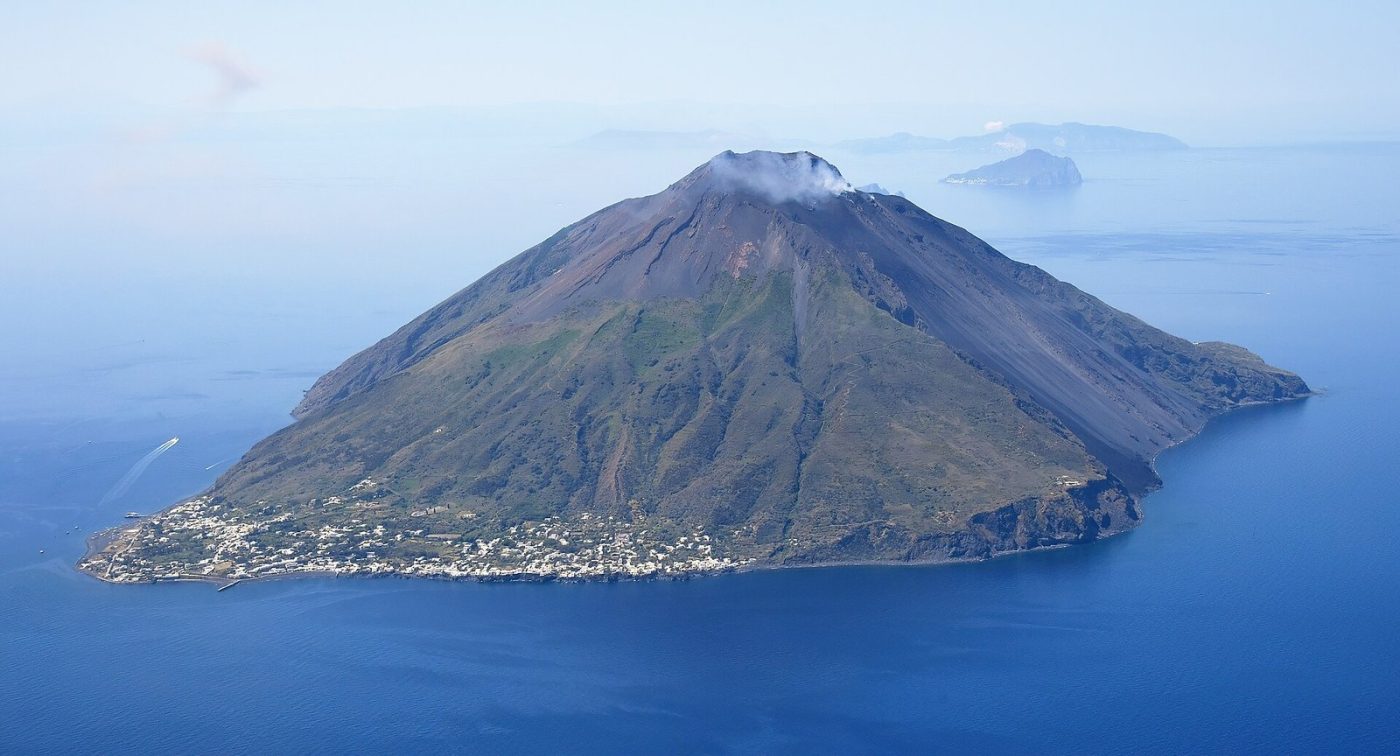
Photo: Carsten Steger, CC BY-SA 4.0
| Getting there | Hydrofoil from Milazzo about 2.5 to 3 h, from Lipari about 1 h 15 min; ferries from Naples overnight |
|---|---|
| Gateway | Milazzo (Sicily) or Lipari |
| Travel time | 2.5 to 3 h by hydrofoil from Milazzo |
| Days | 1 to 2 nights |
| Best months | Apr–Jun and Sep–Oct; summit access may be restricted; August crowded |
| Getting around | Car-free: walk, or take the small electric taxis and three-wheelers from the port |
| Booking | Rooms for July–August months ahead; guided hikes and night boats a few days ahead |
| Cost | Mid-range for Italy; higher in August |
| Beaches | Black volcanic sand and pebbles at Ficogrande, Forgia Vecchia and Scari; rough beaches, deep water |
| Sea | Tyrrhenian Sea |
| Archipelago | Aeolian Islands |
| Area | 13 km² |
| Population | 450 (2001) |
| Highest point | 926 m (I Vancori) |
| Airport | No |
| Car-free | Yes |
| UNESCO | Isole Eolie (Aeolian Islands) |
| Checked | October 2026 |
What is sold for Stromboli is mostly one experience in several forms: seeing the eruptions at night.
The most common product is the long boat day from Milazzo, Lipari, Tropea, Cefalu or Capo d'Orlando. These usually stop first at Panarea for a swim or a walk, then land at Stromboli for an hour or two in the village, and after sunset wait off the Sciara del Fuoco while the craters throw up glowing bursts. They return late at night, and the crossing from the Calabrian coast or Sicily can be rough. Some run only in the evening and skip Panarea; small-group versions use faster boats.
The second group is guided hiking. Licensed guides lead groups from the village up the slopes, as far as the current restrictions allow, timed for sunset and the first hour of darkness. Helmets are usually supplied, while boots, a torch and warm clothes are your responsibility. A few operators offer two-day hiking packages with a night on the island.
Prices for boat days normally include the boat and a skipper; food, drinks and the hike are extra. Recommendation: if you have one evening, take the boat day; if you can, sleep on the island and do the guided walk.
The path from the village climbs through reed and broom to the ridge, where you can watch the craters explode every ten to twenty minutes. In recent years walkers have been allowed above about 400 metres only with licensed guides, and at times the summit has been closed entirely. Check the current ordinance locally and book with an official guide.
On the north-west flank, a wide scar of black debris runs from the craters straight into the sea. After dark, boats cut their engines below it, and you watch glowing rocks roll down the slope and steam rise where they hit the water. Boats leave the village harbour every evening in season for a trip of about two hours.
A free path from the western end of the village, about an hour's walk on a gentle gradient, leads to a viewpoint at about 400 metres facing the Sciara, with a bar-restaurant on the way. At dusk you see the eruptions without a guide. Bring a torch for the walk back, and check that the path is open.
The village spreads along the north-east coast from Scari, where the boats land, through San Vincenzo with its church square to Ficogrande and Piscita. Whitewashed houses, narrow lanes and bougainvillea fill the gaps. The church terrace looks out to Strombolicchio, and there is a small visitor centre on the volcano near the port.
This rock stack two kilometres offshore is the plug of an older volcano, topped by a lighthouse. Boat tours round the island pass close to it, and the water around is deep and clear for swimming from the boat. A circuit of the whole island by boat takes about two hours, with stops at grottoes and coves.
On the south-west side, the tiny hamlet of Ginostra can only be reached by sea and has a few dozen residents, mules instead of carts and stepped paths. Some hydrofoils call there, or take a boat taxi from the main village. It has a couple of places to eat and is the quietest spot in the Aeolian Islands.
Our pick for each kind of trip, with live dates and prices. Free cancellation on most.
Best for: First visit, a day from Milazzo
A long boat day that stops at Panarea, gives an evening ashore in Stromboli village and finishes off the Sciara del Fuoco to watch the eruptions after dark.
Hydrofoils run from Milazzo on the north coast of Sicily via Lipari, Salina and Panarea, taking roughly 2.5 to 3 hours, with fewer services in winter. Slower car ferries take longer and stop at more islands, but cars cannot be used on Stromboli, so leave yours in Milazzo. From Lipari, the hydrofoil takes about 1 hour 15 minutes. Overnight ferries from Naples call at Stromboli several times a week, and in summer a hydrofoil links Naples directly. Boats from Tropea and Vibo Valentia in Calabria serve day trippers.
Boats land at Scari, and Ginostra has its own tiny landing. The nearest airports are Catania, about two hours by road from Milazzo, and Naples for the ferry. Rough seas can cancel hydrofoils, especially outside summer, so do not plan a tight connection with a flight.
There are no cars for visitors. The village lanes are too narrow, and residents use small electric carts and three-wheeled vans. From the port, electric taxis and porters carry luggage to hotels; ask your host about pickup. Everything in the village is within a 20- to 30-minute walk. Ginostra is reached only by boat. Paths to the viewpoints are steep and dark at night, so carry a torch and wear proper shoes.
The best months are April to June and September to October, when the weather is mild enough for evening hikes and the boats are less crowded. July and August are hot, the village is busy, and rooms are expensive, though the night-time eruptions are the same. The sea is warm enough to swim from June to October.
Clear evenings matter most: cloud or haze can hide the glow, so allow two nights to improve your chances. In winter most hotels and restaurants close, hydrofoils are fewer, and storms can cut the island off for a day or more. Volcanic activity also shapes access. After violent eruptions in 2019 and a wildfire in 2022, the authorities have limited climbing, and boat viewing is never affected. One night is enough to see the eruptions; two let you walk, swim and take a boat round the island.
Nearly all rooms are in Stromboli village, divided between Scari near the port, San Vincenzo around the church and Ficogrande and Piscita further west along the beach. Scari is convenient for luggage, San Vincenzo is central for restaurants and guides, and Piscita is quieter and closest to the volcano path. Ginostra suits those who want isolation and do not mind the boat. Book ahead in summer, as the island has few beds.
The ancient Greeks called the island Strongyle, the round one, after its cone, and it has erupted almost without pause for at least two thousand years, giving its name to the style of short, regular explosions known worldwide. Sailors used it as a natural lighthouse. A large eruption in 1930 and hard times led most inhabitants to emigrate to Australia and America, leaving many houses empty. The 1950 film Stromboli, with Ingrid Bergman, brought it fame, and tourism slowly refilled the village.
Stromboli works as the final stop of an Aeolian route. Panarea is about 30 minutes away by hydrofoil, Salina about an hour, and Lipari and Vulcano under 1.5 hours. A good week runs Vulcano, Lipari, Salina, then Stromboli, ending with the overnight ferry to Naples. On the Sicilian side, Mount Etna and Taormina are about two hours from Milazzo.
Hydrofoil from Milazzo about 2.5 to 3 h, from Lipari about 1 h 15 min; ferries from Naples overnight.
From Milazzo (Sicily) or Lipari: 2.5 to 3 h by hydrofoil from Milazzo.
1 to 2 nights.
Apr–Jun and Sep–Oct; summit access may be restricted; August crowded.
No. Stromboli is car-free. Car-free: walk, or take the small electric taxis and three-wheelers from the port.
Go if you want to watch a live volcano erupt at night and spend a slow day in a car-free village. Skip it or stay on Lipari or Salina if you need easy connections, good beaches and plenty of choice for eating out.
Mid-range for Italy; higher in August.
Black volcanic sand and pebbles at Ficogrande, Forgia Vecchia and Scari; rough beaches, deep water.
Rooms for July–August months ahead; guided hikes and night boats a few days ahead.
Yes. Boat trips, guided tours and day trips for Stromboli can be booked online; live prices and free cancellation on most are shown on this page.
Aeolian Islands, Italy
Lipari is the largest and busiest of the Aeolian Islands, a volcanic island of about 37 square kilometres off the north…
63 tours & trips
Aeolian Islands, Italy
Panarea is the smallest of the seven inhabited Aeolian Islands north of Sicily, just 3.4 square kilometres of white…
32 tours & trips
Aeolian Islands, Italy
Vulcano is the southernmost of the Aeolian Islands, about 20 kilometres north of Sicily, an island of 21 square…
27 tours & trips
Aeolian Islands, Italy
Salina is the greenest of the Aeolian Islands off northern Sicily, two extinct volcanoes joined by a saddle of…
8 tours & trips