Capri
Italy
Capri is a limestone island of just 10 square kilometres at the southern edge of the Bay of Naples, 20 minutes by fast…
513 tours & trips
Italy · Lakes & rivers · Historic island
Tiber Island is the only island on the Tiber in Rome, a boat-shaped strip of land about 270 metres long between the old Jewish quarter and Trastevere, joined to both banks by bridges since antiquity. Once the site of a temple of healing, it still holds a hospital, a medieval basilica and the oldest Roman bridge in use.
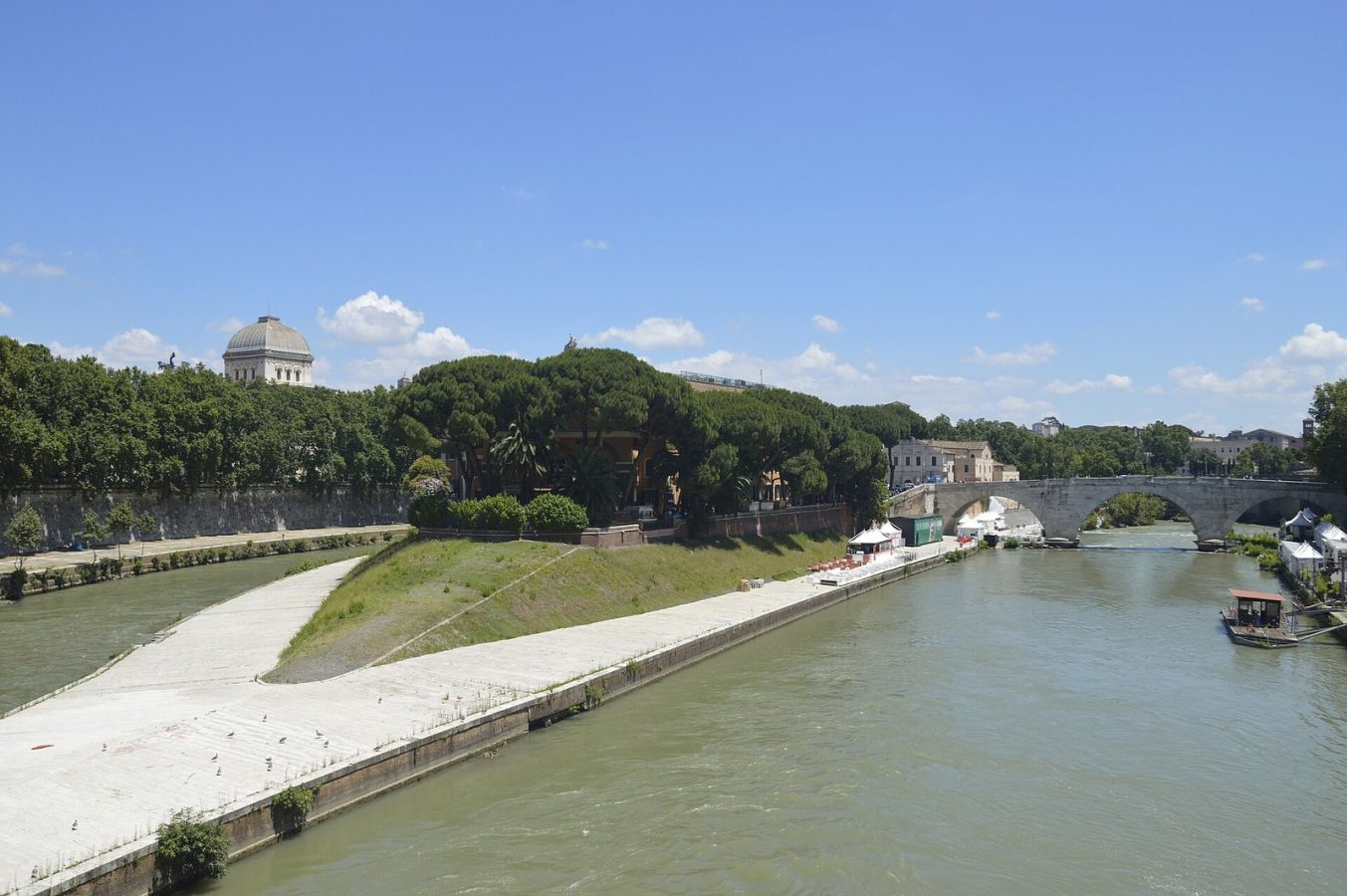
Photo: Livioandronico2013, CC BY-SA 3.0
| Getting there | Walk across Ponte Fabricio from the Jewish Ghetto or Ponte Cestio from Trastevere; buses and tram 8 stop nearby |
|---|---|
| Gateway | Rome |
| Travel time | 10 to 15 min on foot from Campo de' Fiori |
| Days | An hour is enough |
| Best months | Apr–Jun and Sep–Oct; Jul–Aug hot, with the open-air cinema on the island |
| Getting around | On foot only; the island is crossed in a few minutes |
| Booking | Nothing for the island itself; food tours and river cruises a few days ahead in spring |
| Cost | Free to walk; mid-range for Rome when eating nearby |
| Beaches | No beaches; in summer the paved riverbank below fills with bars and stalls |
| Sea | Lakes & rivers |
| Area | 2 ha |
| Airport | No |
| Bridge | Road bridge or causeway to the mainland |
| UNESCO | Historic Centre of Rome |
| Checked | October 2026 |
Tiber Island is free and open at all hours, and most people simply walk across it on the way between the Jewish Ghetto and Trastevere. What is sold is a set of Rome tours that include the island as one stop.
Guided walking tours of the Jewish Ghetto often cross Ponte Fabricio and explain the bridges, the temple of Asclepius and the hospital, which suits travellers who want the story behind the stones. Food tours of Trastevere and the Ghetto pass over the island between tastings; they last three to four hours and include several stops of food and wine, but not a full meal. A cooking class nearby adds a short visit to the island.
On the river, hop-on hop-off boats and private cruises with aperitifs pass the island and its bridges, and some combine the ride with other sights. An urban rafting trip and e-bike tours along the river paths go past it too. These are about the Tiber more than the island.
For most visitors the best plan is to visit on your own, combined with a walk through the Ghetto, or to book a Ghetto walking tour or a food tour that crosses it.
The stone bridge that joins the island to the left bank was built in 62 BC and is the oldest Roman bridge still in its original form and in daily use. Look for the inscription naming its builder, Lucius Fabricius, carved on the arches, and the four-faced herms on the parapets that give it the local name of the bridge of the four heads.
The basilica on the small square was founded around the year 1000 on the site of the temple of Asclepius, and its Romanesque bell tower rises above the island. Inside, the side chapels are a memorial to the Christian martyrs of the twentieth and twenty-first centuries, with objects that belonged to them. An ancient well stands on the altar steps.
Walk down the steps to the lower embankment and around to the southern tip, where a fragment of travertine carved in antiquity makes the island look like a ship, with the staff and serpent of Asclepius still visible. From the water level you also see the arches of the bridges and the current racing past. The view from here is best in the late afternoon.
The bridge to Trastevere, Ponte Cestio, was rebuilt in the nineteenth century but keeps ancient stones and its central arch. Just downstream stands Ponte Rotto, the broken bridge: a single surviving arch of the Pons Aemilius, the first stone bridge in Rome, alone in the middle of the river. Cross into Trastevere for lunch afterwards.
Most of the island is occupied by the Fatebenefratelli hospital, still working and run by a religious order founded in the sixteenth century. In July and August an open-air film festival fills the island in the evenings with a screen, bars and outdoor seating, and the embankments along the Tiber host stalls and restaurants. It is the island's liveliest season.
Our pick for each kind of trip, with live dates and prices. Free cancellation on most.
Best for: First visit, island and Ghetto on foot
A guided walk that pairs the island's ancient bridges and medical history with the streets, synagogue and Roman ruins of the Jewish quarter just across the river.
Tiber Island lies in the centre of Rome, on the bend of the river opposite the Jewish Ghetto. It is about 10 minutes on foot from Campo de' Fiori, 15 from Piazza Venezia and 5 from the heart of Trastevere. Ponte Fabricio leads onto the island from the Ghetto side and Ponte Cestio from Trastevere.
Tram 8, which runs between Largo Argentina and Trastevere, stops at Belli just over the river, and several buses run along the embankment roads on both banks. The nearest metro station, Circo Massimo, is about 15 minutes' walk. From Fiumicino airport, the express train reaches Termini in about half an hour, and a bus or taxi does the rest. The historic centre has limited traffic zones, so do not drive.
The island is pedestrian except for hospital access and is crossed in two or three minutes. Steps lead down from the square to the lower embankment, which you can walk around in about ten minutes; it is not accessible for wheelchairs. The rest of Rome nearby is best explored on foot, with trams and buses for longer distances and e-bikes on the riverside cycle path.
The island is open at all hours, every day. Spring, from April to June, and autumn, from September to October, are the most comfortable seasons in Rome, with warm days and long evenings for a riverside walk. Early morning is the quietest time, and late afternoon gives the best light on the river.
July and August are hot, often above 30 degrees, but the island is livelier then, with the open-air film festival and evening stalls on the embankments. In winter the city is cooler and less crowded, and the river sometimes rises high enough after heavy rain to close the lower embankment.
Easter and other major church holidays bring crowds to Rome and higher hotel prices. The island itself needs only half an hour, an hour if you go down to the riverbank.
There is nowhere to stay on the island, but it sits between two of Rome's best areas for a base. Trastevere, just across Ponte Cestio, has lively evenings, trattorias and small hotels, though it is noisy at night. The Jewish Ghetto and Campo de' Fiori area is central and quieter in the evenings. Monti and the streets around Piazza Navona are a short walk further.
Legend says the island formed from grain thrown into the river after the fall of the last Roman king. In 291 BC, after a plague, Romans built a temple to Asclepius, god of medicine, here, and the island became a place of healing. A church replaced the temple in the Middle Ages, and the hospital followed in the sixteenth century. In 1943 its doctors protected Jews from the Nazis by admitting them as patients with an invented contagious illness. Medicine is still its main activity.
Pair the island with a walk through the Jewish Ghetto, the Portico of Octavia and the Theatre of Marcellus, all within ten minutes. Then cross to Trastevere for lunch and Santa Maria in Trastevere, or walk south to the Bocca della Verita and the Circus Maximus in about 15 minutes.
Walk across Ponte Fabricio from the Jewish Ghetto or Ponte Cestio from Trastevere; buses and tram 8 stop nearby.
From Rome: 10 to 15 min on foot from Campo de' Fiori.
An hour is enough.
Apr–Jun and Sep–Oct; Jul–Aug hot, with the open-air cinema on the island.
On foot only; the island is crossed in a few minutes.
Go if you want a short, atmospheric walk across the river between the Jewish Ghetto and Trastevere, with ancient bridges. Skip a special trip if you are short of time in Rome: it takes half an hour and fits any walk south of the centre.
Free to walk; mid-range for Rome when eating nearby.
No beaches; in summer the paved riverbank below fills with bars and stalls.
Nothing for the island itself; food tours and river cruises a few days ahead in spring.
Yes. Boat trips, guided tours and day trips for Tiber Island can be booked online; live prices and free cancellation on most are shown on this page.
Italy
Capri is a limestone island of just 10 square kilometres at the southern edge of the Bay of Naples, 20 minutes by fast…
513 tours & trips
Italy
Sicily is the largest island in the Mediterranean, a whole region of Italy separated from the mainland by the narrow…
227 tours & trips
Phlegraean Islands, Italy
Ischia is the largest island in the Bay of Naples, a green volcanic island about 30 km from the city, crowned by Mount…
193 tours & trips
Italy
The La Maddalena Archipelago is a national park of seven main granite islands and dozens of islets in the Strait of…
162 tours & trips
Venetian Lagoon, Italy
Murano is a cluster of small islands joined by bridges in the Venetian Lagoon, about 1.5 km north of Venice, and the…
120 tours & trips
Aegadian Islands, Italy
Favignana is the largest of the Egadi Islands, a flat butterfly-shaped island of 20 square kilometres about half an…
87 tours & trips