Stockholm Archipelago
104 km away
The Stockholm Archipelago is a maze of about 24,000 islands, islets and skerries spreading east from the Swedish…
6 tours & trips
Finland · Baltic Sea · Nature & wildlife island
Fasta Åland is the main island of Åland, the self-governing, Swedish-speaking province of Finland that sits in the Baltic between Stockholm and Turku. It holds the capital Mariehamn and about 27,000 of the islands' 30,000 people, with red granite shores, medieval churches and quiet roads ideal for cycling.
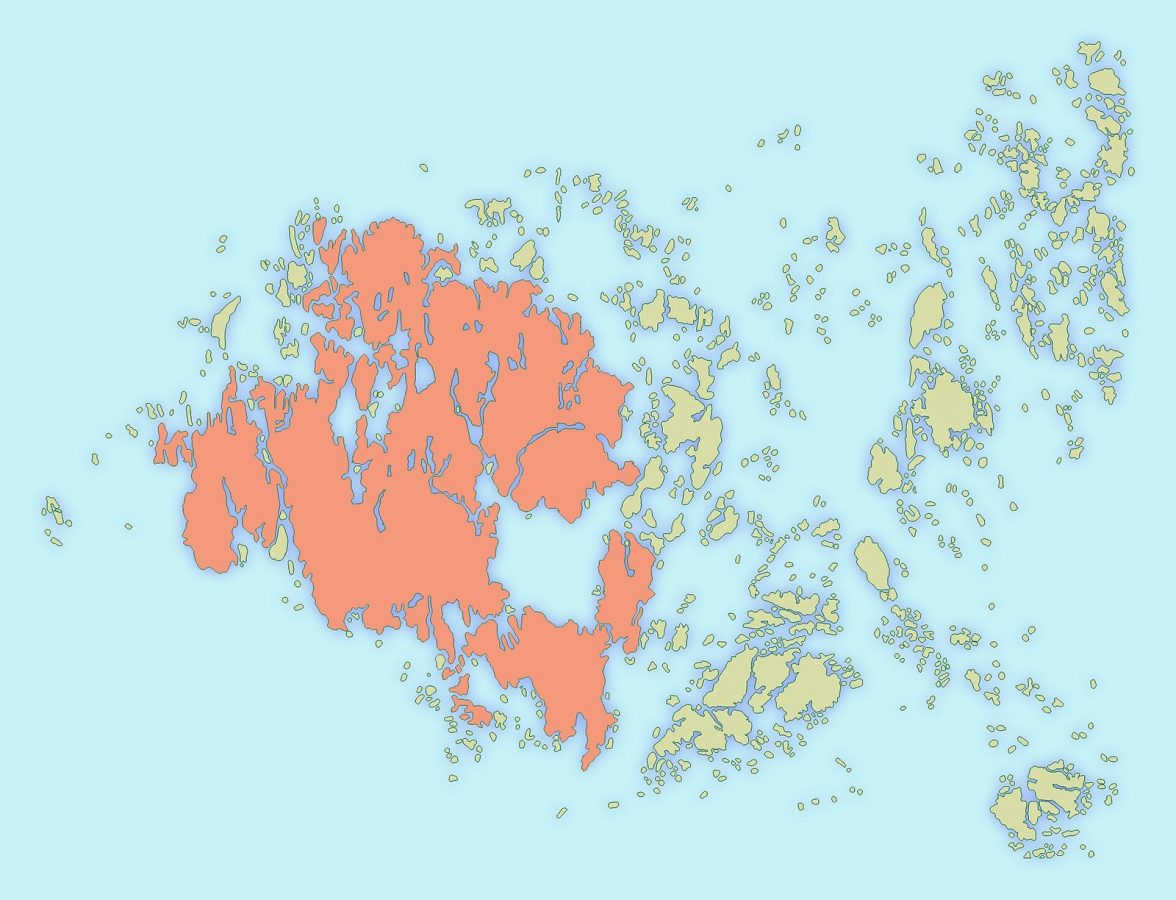
Photo: Håkan Skogsjö, CC BY-SA 4.0
| Getting there | Ferry from Stockholm or Turku 5 to 6 h, from Kapellskär or Grisslehamn 2 h; flights from Helsinki, Stockholm |
|---|---|
| Gateway | Stockholm or Turku (ferry); Mariehamn airport |
| Travel time | 2 to 6 h by ferry or under 1 h by air |
| Days | 3 to 5 nights |
| Best months | Jun–Aug; midsummer in late June; May and Sep quiet and cool; winters dark |
| Getting around | Cycle or drive; flat roads and bike routes everywhere, sparse buses from Mariehamn |
| Booking | Car places on summer ferries and rooms around midsummer; bikes a day ahead in July |
| Cost | Mid-range for the Nordics; ferries are cheap |
| Beaches | Smooth granite slabs and small sand coves; swim from the rocks, the water is cool |
| Sea | Baltic Sea |
| Archipelago | Åland Islands |
| Area | 685 km² |
| Highest point | 129 m (Orrdalsklint) |
| Airport | Yes, scheduled flights |
| Car-free | No |
| Checked | October 2026 |
Nothing is sold online specifically for Fasta Åland, and most visitors simply arrive on a car ferry and travel independently. The islands are made for doing it yourself: distances are short, roads are quiet, signposting is good and almost everyone speaks Swedish and English.
The cheapest way to get a taste is a round-trip cruise from Stockholm or Turku on one of the big ferries that call at Mariehamn. Many people take them for the tax-free shopping, but some sailings give a few hours ashore, enough for the Maritime Museum, the sailing ship Pommern and a walk through the town. This is a glimpse, not a visit.
For a proper stay, bring a car or a bicycle on the ferry, or rent bikes in Mariehamn. The tourist office there sells cycling maps, and the main routes connect Kastelholm, Bomarsund and the medieval churches over two or three days. Guided visits are mostly arranged locally: summer guiding at Kastelholm Castle and Bomarsund, boat trips from Mariehamn, fishing trips and kayak hire in the bays. Sailing is central to local life, and guest harbours welcome visiting yachts.
The plain recommendation is to skip the day cruise if you can and come for three or four nights with a bike.
The small capital lies on a peninsula between two harbours and is known for its lime-tree avenues. In the western harbour the four-masted barque Pommern, one of the last of the grain-race sailing ships, is a museum you can board, next to the Maritime Museum. Walk to the eastern harbour for the marina and the restaurants along the shore.
About 25 km north-east of Mariehamn, the medieval stone castle stands on a bay in Sund and was the seat of Swedish power over the islands. Summer guided tours explain its history. Next door, the Jan Karlsgarden open-air museum gathers old farm buildings, windmills and a midsummer pole, and the nearby prison museum shows a 19th-century jail.
A few kilometres further east, the remains of a huge Russian fortress lie scattered in the woods and along the shore. It was still unfinished when British and French ships destroyed it in 1854 during the Crimean War. Walk the paths between the granite walls and the towers, and visit the small museum across the strait at Prästö.
Fasta Åland has a group of grey stone churches from the 12th to 15th centuries, among the oldest in Finland, with painted interiors and detached bell towers. Jomala, close to Mariehamn, is thought to be the oldest; Finström, Saltvik and Hammarland are worth a stop on a cycling route. Most are open in summer and free to enter.
The north of the island is higher and wilder, with forest, deep inlets and granite cliffs. In Geta a marked trail climbs through boulder fields and caves to a viewpoint over the archipelago, and in Saltvik a path reaches Orrdalsklint, the highest point at 129 metres. These are the best walks on the island and are quiet even in July.
At the western tip, where ferries arrive from Sweden, stands the grand post and customs house built under Russian rule to impress visitors from Stockholm. The old mail route across the sea is remembered in a small museum. Nearby, flat red granite shores face the open Sea of Aland, a good place to swim and watch the sunset.
Big car ferries run daily all year from Stockholm and Turku to Mariehamn, taking roughly five to six hours, and overnight sailings between Helsinki and Stockholm also call there. The shortest crossings come from Sweden: from Kapellskär, north of Stockholm, to Mariehamn or to Långnäs on the east side, and from Grisslehamn to Eckerö, both about two hours. From Finland, ferries from Turku also call at Långnäs, and smaller car ferries cross the archipelago from the Finnish coast via the outer islands. Ferry fares are low because of the tax-free shopping on board, and cars and bikes are easy to bring. Book car space for July and midsummer. Mariehamn airport has flights of under an hour from Helsinki and Stockholm, but schedules are thin and fares usually higher than the boat.
Fasta Åland is flat to gently rolling and laced with quiet roads and signposted cycle routes, so a bicycle is the classic way to explore; rentals in Mariehamn include electric bikes. Distances are modest, around 40 km across the island. A car makes day trips easier, and parking is rarely a problem outside central Mariehamn. Buses from Mariehamn reach the main villages but run infrequently, especially at weekends. Free road ferries link Fasta Åland to the smaller islands of the archipelago.
The season is short and intense. June to August brings long light evenings, with almost no darkness around midsummer, daytime temperatures around 20 degrees and sea water reaching about 18 to 20 degrees in late July and August. Midsummer, in late June, is the biggest celebration of the year, with decorated poles raised in every village, dancing and busy ferries and accommodation.
July is the peak month, when Finnish and Swedish families take their holidays and yachts fill the guest harbours. May and September are calm and cheaper, good for cycling and walking, but cool, and many cafes, museums and campsites keep short hours or close after mid-August. From October to April the islands are dark, windy and quiet; some sights shut entirely, though Mariehamn stays open and the cruise ferries keep running. Three to five nights is a good length: one for Mariehamn, the rest for the countryside.
Mariehamn has most of the hotels, restaurants and the ferry terminal, and suits travellers without a car or those staying only a night or two. For the countryside, look for cottages, farm stays and campsites by the water in Sund, near Kastelholm and Bomarsund, or in Saltvik and Geta in the north for walking. Eckerö in the west is handy for the Swedish ferry and has sunset shores. Self-catering cottages are the local way to holiday and should be booked early for July.
People have lived on the islands since the Stone Age, and Viking-era graves and hill forts dot the countryside. For centuries Åland belonged to Sweden; Kastelholm and the stone churches date from that time. In 1809 it passed with Finland to Russia, which built Bomarsund until the Crimean War. After Finnish independence, the League of Nations decided in 1921 that the islands would stay Finnish but autonomous, Swedish-speaking and demilitarised. Today they have their own parliament, flag and stamps, and a long seafaring tradition.
Åland fits naturally into a trip between Sweden and Finland: stop for a few days on the ferry between Stockholm and Turku, both about five to six hours away. From Fasta Åland, small car ferries reach the outer islands such as Kökar and Föglö, quieter still, and you can continue through the Turku archipelago to the Finnish mainland, a classic summer route by car or bike.
104 km away
The Stockholm Archipelago is a maze of about 24,000 islands, islets and skerries spreading east from the Swedish…
6 tours & trips
131 km away
Djurgården is a green island in central Stockholm, a former royal hunting park that now holds the Vasa Museum, the…
5 tours & trips
247 km away
Saaremaa is Estonia's largest island, about 2,670 square kilometres of flat juniper heath, pine forest,…
3 tours & trips
Ferry from Stockholm or Turku 5 to 6 h, from Kapellskär or Grisslehamn 2 h; flights from Helsinki, Stockholm.
From Stockholm or Turku (ferry); Mariehamn airport: 2 to 6 h by ferry or under 1 h by air.
3 to 5 nights.
Jun–Aug; midsummer in late June; May and Sep quiet and cool; winters dark.
Cycle or drive; flat roads and bike routes everywhere, sparse buses from Mariehamn.
Go if you like cycling flat country roads, red rocky shores, castles and maritime history in a quiet, well-run corner of the Baltic. Skip it if you want warm sea, nightlife or anything beyond June to August, when the islands are at their liveliest.
Mid-range for the Nordics; ferries are cheap.
Smooth granite slabs and small sand coves; swim from the rocks, the water is cool.
Car places on summer ferries and rooms around midsummer; bikes a day ahead in July.