Santorini
Cyclades, Greece
Santorini is the ring of a drowned volcano in the southern Cyclades: white villages along a 300-metre cliff, black-sand…
772 tours & trips
Greece · Aegean Sea · Beach island
Polyaigos is an uninhabited island of about 18 square kilometres between Milos and Kimolos in the south-western Cyclades, a mass of bare volcanic hills ringed by small bays. Its name means many goats, and apart from them there is nothing here but turquoise water, sea caves and quiet coves, reached only by boat.
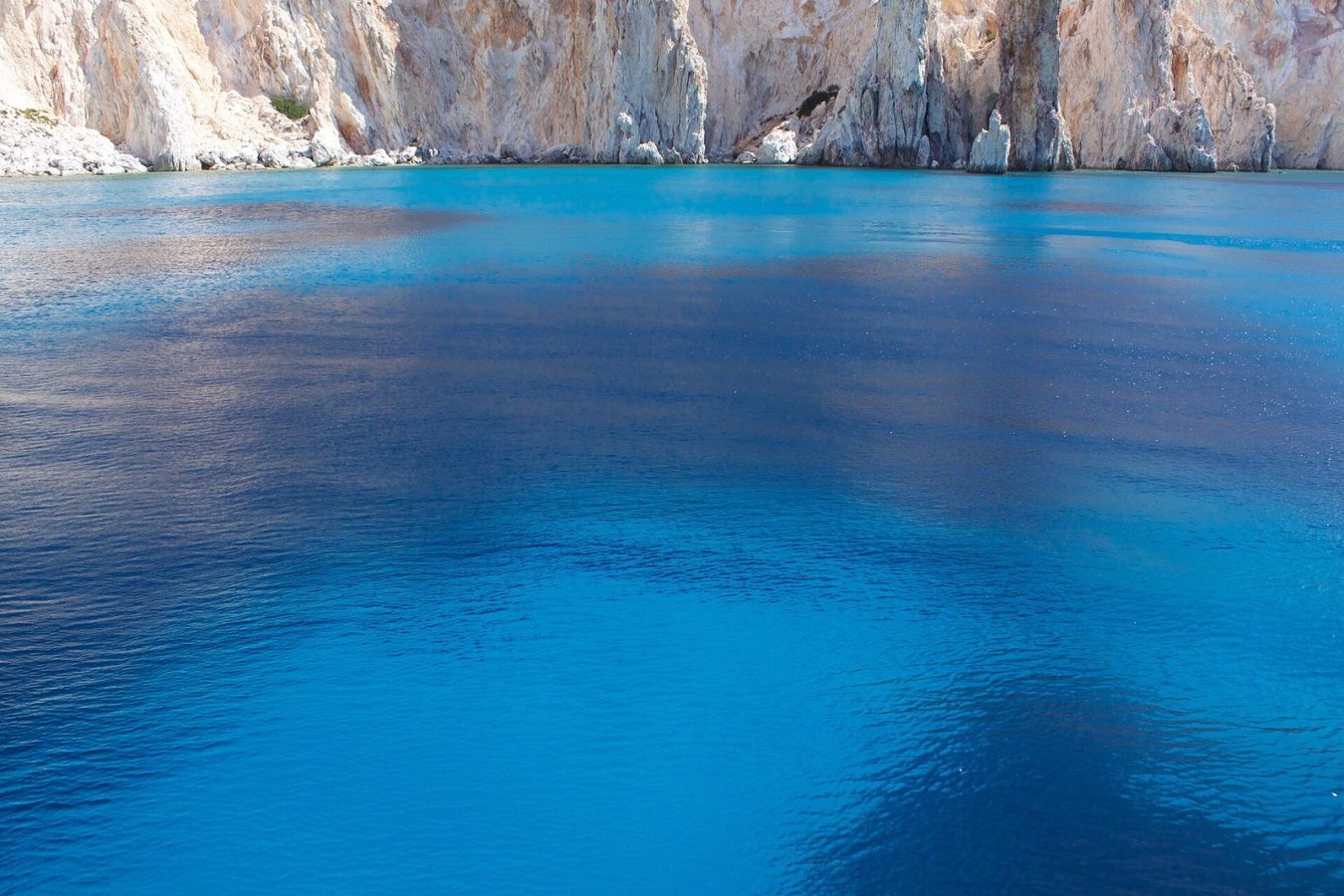
Photo: Ellie Βarmpagiannis, CC BY-SA 4.0
| Getting there | Only on a boat trip, mainly from Pollonia on Milos in about 30 min, or from Kimolos |
|---|---|
| Gateway | Milos (Pollonia) or Kimolos |
| Travel time | About 20 to 40 min by boat from Pollonia |
| Days | A day trip is enough |
| Best months | Jun–Sep; meltemi winds can cancel boats in Jul–Aug; May and Oct cooler water |
| Getting around | No roads or services: you stay on the boat and swim ashore |
| Booking | Private boats weeks ahead in July–August; shared trips a day or two ahead |
| Cost | Expensive: private boats from Milos cost a lot |
| Beaches | Small white-sand and pebble coves with turquoise water, mostly on the south side |
| Sea | Aegean Sea |
| Archipelago | Cyclades |
| Area | 18 km² |
| Population | Uninhabited |
| Highest point | 370 m (Psilo Vouno) |
| Airport | No |
| Checked | October 2026 |
There is no ferry to Polyaigos, so every visit is a boat trip, and the products differ mainly in boat size, privacy and where they start.
Most leave from Pollonia, the fishing village on the north-east tip of Milos and the closest harbour. Half-day trips of four to five hours go out in the morning, the afternoon or at sunset on a speedboat or a small cabin cruiser, either private or shared with a few other people. They anchor in two or three bays for swimming and snorkelling and usually include a skipper, snorkelling gear, drinks and a light snack. Group morning trips on larger boats cost less.
Full-day sailing trips of about eight hours, from Adamas or the south coast of Milos, combine Polyaigos with Kleftiko and other sights around Milos, or with Kimolos, and include lunch cooked on board. Catamarans and yachts are slower but more comfortable. Sailing boats also leave from Kimolos, and private speedboats come from Sifnos and even Santorini, a long and costly day.
Hotel pickup is sometimes included around Pollonia and Adamas; check this, and ask what happens if the meltemi blows.
For most people the best choice is a shared or private half-day trip from Pollonia, booked for a calm morning.
The southern shore is where boats spend most of their time: a chain of small coves with pale sand and pebbles, framed by low cliffs of white and ochre volcanic rock. With no buildings and almost no vegetation, the water over the sand takes on intense shades of turquoise. Boats anchor offshore and you swim in; bring reef shoes for the rocks.
The coast is riddled with caves and arches, some large enough for a small boat to slip inside on a calm day. The rock walls drop into clear water, good for snorkelling over boulders and sea grass with shoals of small fish. Rare Mediterranean monk seals shelter in the remote caves; keep your distance if you are lucky enough to see one.
Ashore, the island is a dry landscape of thyme, rock and two summits, Psilo Vouno at 370 metres and Stroggylo a little lower. Goats grazed by herdsmen from Milos and Kimolos keep it bare, and most of the land belongs to the church. There are no paths or facilities, so few visitors go far beyond the beach.
Most trips start from this fishing village on the north-east tip of Milos, about 10 km from the port of Adamas. Its curved waterfront has tavernas serving fish and octopus, a short sandy beach shaded by tamarisks, and the small ferry to Kimolos. It is a pleasant place to stay, or to eat after a day on the water.
The small island just north-west of Polyaigos is easy to add, as a car ferry crosses from Pollonia in about 20 minutes. Its white village of Chorio surrounds a medieval fortified core, and the beach at Prassa has pale sand and turquoise water. Some boat trips stop there for a swim or lunch.
Our pick for each kind of trip, with live dates and prices. Free cancellation on most.
Best for: First visit, a shared morning trip
A group boat from Pollonia in the calmer morning hours, with swimming stops in the clearest bays; the most affordable way to see the island.
Polyaigos has no harbour, ferry or permanent inhabitants, so you come on an organised or private boat trip, nearly always from Milos.
Milos has a small airport with flights from Athens of about 45 minutes, and ferries from Piraeus that take about three hours on fast boats and five to seven on conventional ones, docking at Adamas. In summer, fast boats also link Milos with Sifnos, Folegandros, Santorini and the other western Cyclades.
From Adamas it is a 20-minute drive or a bus ride across to Pollonia, where most boats to Polyaigos leave; the crossing then takes 20 to 40 minutes depending on the bay and the boat. Kimolos, reached from Pollonia by a short ferry, is the other base. Boats do not sail when the meltemi is strong.
There is nothing to get around on the island itself: no roads, jetties, shops or shade. Visitors stay on the boat and swim ashore, or are taken in by dinghy, and most explore only the beaches. Bring sun protection, water and reef shoes, and take all rubbish back with you. On Milos, rent a car, scooter or quad to reach Pollonia, or take the bus from Adamas; many boat operators collect guests from hotels nearby.
June to September is the season, when the sea is warm, around 22 to 25 degrees, and boats run daily. June and September are the best months: calm days are common, the water is clear and Milos is less crowded.
July and August bring the meltemi, the strong north wind of the Aegean, which can blow for several days and make the open crossing rough or impossible. Operators cancel or switch to sheltered routes around Milos, so leave flexibility in your plans and book a morning trip, when the wind is usually lighter.
May and October are possible on warm days, with fewer boats and cooler water, and from November to April trips hardly run. A half-day on the water is enough to see the island; base yourself on Milos for three or four nights so you have a choice of calm days.
Nobody stays on Polyaigos, and camping on the island is not allowed. Pollonia on Milos is the best base for it: closest to the boats, quiet, with good tavernas and rooms by the water. Adamas, the main port, has the most choice and the ferry and bus links, while the hilltop villages of Plaka and Tripiti offer sunset views. For an even quieter stay, choose Kimolos, a short ferry ride from Pollonia.
The island was known to ancient geographers, Ptolemy and Pliny among them, and its name, many goats, describes it as well today as it did then. With little water and poor soil it was never properly settled, but herdsmen from Milos and Kimolos have used it as pasture for centuries, and the Greek Orthodox Church owns most of the land and rents it out for grazing. The hills are volcanic, like those of Milos, which explains the white and ochre colours of the cliffs. Its caves and quiet coves remain a refuge for monk seals, and the surrounding waters are protected for nature.
Polyaigos is a day out from Milos, which deserves three or four nights in its own right for the white rocks of Sarakiniko, the sea arches of Kleftiko and the fishing hamlets with painted boathouses. Kimolos is 20 minutes from Pollonia. Fast boats link Milos with Sifnos and Folegandros in one to two hours, and with Santorini in roughly two to three.
Only on a boat trip, mainly from Pollonia on Milos in about 30 min, or from Kimolos.
From Milos (Pollonia) or Kimolos: about 20 to 40 min by boat from Pollonia.
A day trip is enough.
Jun–Sep; meltemi winds can cancel boats in Jul–Aug; May and Oct cooler water.
No roads or services: you stay on the boat and swim ashore.
Go for a day on a boat swimming and snorkelling in turquoise bays with no buildings in sight. Skip it if you suffer from seasickness or come during a strong meltemi; choose the sheltered bays of Milos instead.
Expensive: private boats from Milos cost a lot.
Small white-sand and pebble coves with turquoise water, mostly on the south side.
Private boats weeks ahead in July–August; shared trips a day or two ahead.
Yes. Boat trips, guided tours and day trips for Polyaigos can be booked online; live prices and free cancellation on most are shown on this page.
Cyclades, Greece
Santorini is the ring of a drowned volcano in the southern Cyclades: white villages along a 300-metre cliff, black-sand…
772 tours & trips
Cyclades, Greece
Mykonos is a small, dry and windy island in the central Cyclades, about 85 square kilometres of brown hills ringed by…
294 tours & trips
Cyclades, Greece
Naxos is the largest and greenest of the Cyclades, 428 square kilometres of long sandy beaches, marble villages and…
208 tours & trips
Cyclades, Greece
Paros sits at the heart of the Cyclades, about 150 km south-east of Piraeus and a short hop from Naxos and Mykonos, a…
138 tours & trips
Cyclades, Greece
Milos is a volcanic island at the south-western edge of the Cyclades, wrapped round a large flooded caldera that forms…
122 tours & trips
Cyclades, Greece
Antiparos is a small, relaxed island in the Cyclades, separated from Paros by a channel less than two kilometres wide…
38 tours & trips