Mallorca
Balearic Islands, Spain
Mallorca is the largest of the Balearic Islands, about 3,640 square kilometres of coast and mountains off eastern…
909 tours & trips
Spain · Mediterranean Sea · Nature & wildlife island
Cabrera is an uninhabited island about 10 km south of Mallorca, the heart of a protected archipelago that forms one of Spain's national parks. A castle above a sheltered natural harbour, clear water, a blue sea cave and endemic lizards draw day visitors on the boats from Colònia de Sant Jordi.
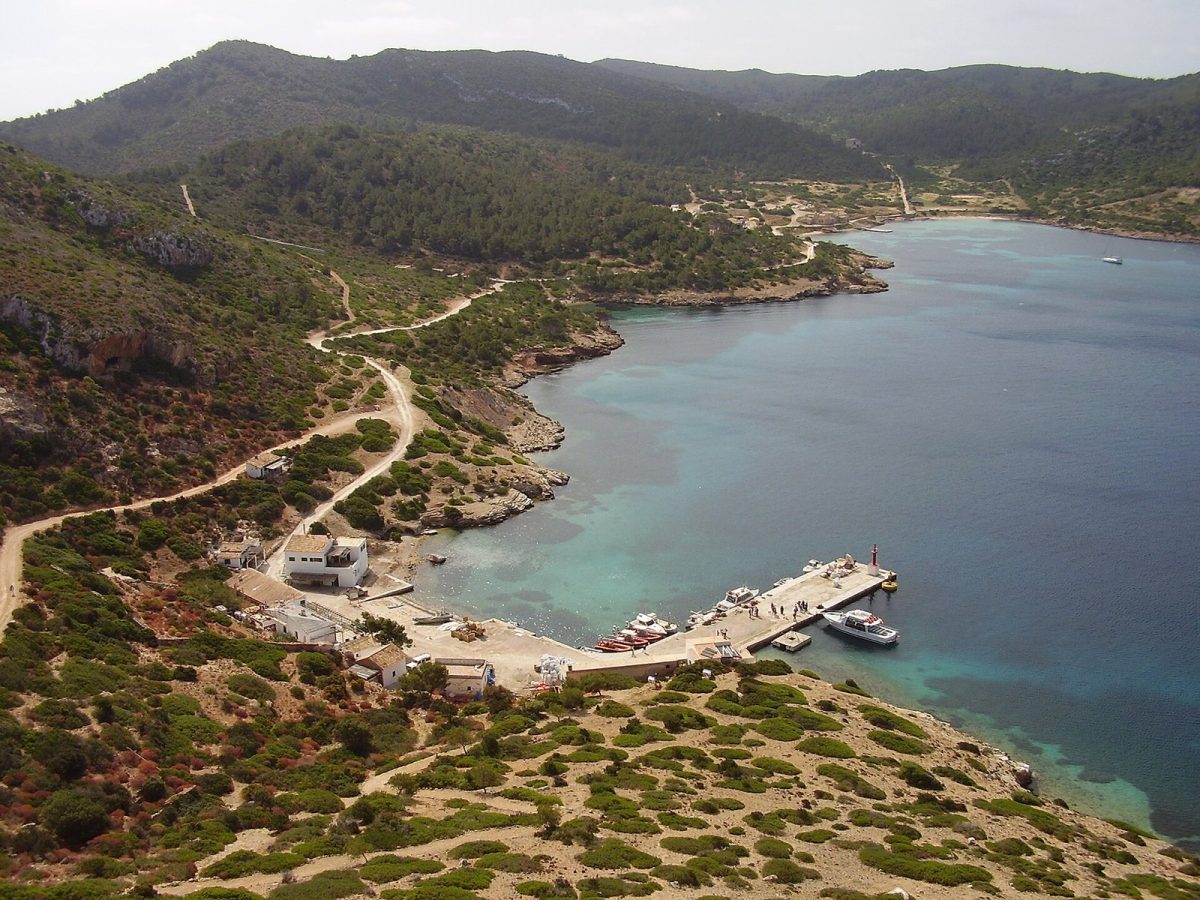
Photo: CC BY-SA 3.0
| Getting there | Day boats from Colònia de Sant Jordi in Mallorca, 30 min by fast boat or about 1 h by traditional boat |
|---|---|
| Gateway | Colònia de Sant Jordi (Mallorca) |
| Travel time | 30 to 60 min by boat |
| Days | A day trip is enough |
| Best months | May–Oct for boats and swimming; Jun and Sep calmest and least crowded |
| Getting around | On foot only: short marked paths from the harbour; some trails need a park guide |
| Booking | Boats a few days ahead in summer; private-boat permits and the hostel well ahead |
| Cost | Mid-range for Mallorca; the boat trip is the only cost |
| Beaches | One small sandy beach near the harbour, plus swims in the bay and the Blue Cave |
| Sea | Mediterranean Sea |
| Archipelago | Balearic Islands |
| Area | 16 km² |
| Population | Uninhabited |
| Highest point | 172 m (Na Picamosques) |
| Airport | No |
| Car-free | Yes |
| Checked | November 2026 |
Because Cabrera is a national park with daily visitor limits, almost everyone arrives on one of the licensed day boats from Colònia de Sant Jordi, on Mallorca's south coast.
There are two main formats. The traditional day trip on a larger, slower boat takes about an hour each way, docks in Cabrera's harbour for three or four hours of free time, and on the way back enters the Blue Cave, where you can jump in and swim. Fast boats cross in about 30 minutes and are better for those prone to seasickness or short of time; some circle the archipelago without landing, for viewing cliffs and seabirds. Some operators include a bus transfer from resorts further away, and a few trips leave from the Palma area. Tickets cover the boat; a picnic, drinks and snorkel gear are usually yours to bring. Guided walks on the restricted trails are offered by the park and must be arranged on the island or in advance.
Recommendation: take the traditional day boat with the Blue Cave stop, and bring a mask, water and a picnic.
A 14th-century castle stands on a rocky headland at the entrance to the harbour, built to defend against pirates. A path from the jetty climbs to it in about 20 minutes, with the best view on the island over the bay and the scattered islets. Go early in your visit, before the midday heat, and bring water.
On the island's west coast, Sa Cova Blava is a large sea cave where sunlight reflecting through the water turns everything intense blue. Most traditional day boats enter it on the way back to Mallorca and stop long enough for passengers to swim inside. The water is deep, so weaker swimmers should wear a life jacket.
The natural harbour, one of the best-protected anchorages in the Mediterranean, is where boats dock. A short walk along the shore leads to Es Celler, an old wine cellar turned into a small museum on the island's history and nature, from Roman fishermen to prisoners of war. Nearby is the monument to French prisoners held here.
Decades of protection mean exceptionally clear water and plentiful fish near the shore: groupers, sea bream and octopus are seen by snorkellers off the small beach near the harbour. On land look for the dark endemic lizards, which come close in search of food, and seabirds such as Audouin's gulls, shearwaters, ospreys and Eleonora's falcons.
Longer paths lead across the island to viewpoints and the lighthouse of N'Ensiola, on the south-west cliffs. Some routes are open for free walking; others, including the walk towards the highest point at 172 metres, require a park guide. Ask the rangers at the harbour which trails are open, and allow time to return before your boat departs.
Our pick for each kind of trip, with live dates and prices. Free cancellation on most.
Best for: First visit, the classic day trip
The standard day boat from Colònia de Sant Jordi with time ashore on Cabrera for the castle and museum, plus a swimming stop, which covers the essentials in one relaxed day.
Cabrera can only be reached by sea. Licensed day boats leave from the harbour of Colònia de Sant Jordi, on Mallorca's south coast about an hour's drive from Palma airport, daily from spring to autumn and less often in winter. Traditional boats take about an hour; fast boats about 30 minutes. A few excursions leave from resorts in the Bay of Palma, and some include bus pickups from hotels.
Visitor numbers are capped, so book a few days ahead in July and August. Private yachts need a navigation and mooring permit from the national park, booked online and often fully taken in summer; anchoring is allowed only on the buoys in the harbour. In Colònia de Sant Jordi, the park's visitor centre near the port is worth a stop before or after your trip.
There are no roads, vehicles or bikes on Cabrera; everything is on foot. From the harbour, short paths lead to the castle, the beach, the museum and the monument, all within 20 to 30 minutes. Longer trails cross dry, rocky hills with little shade, and some can only be walked with park guides. Wear proper shoes, carry plenty of water and stick to marked paths.
Boats run from about April to October, with the fullest timetable from June to September. July and August are hot, often above 30 degrees, with the sea at around 26 degrees and the most visitors; book ahead and expect full boats. June and September offer warm water, calmer conditions and smaller crowds, making them the best months.
In May and October the weather is mild and good for walking and birdwatching, though swims are cooler. In winter few boats operate and crossings can be cancelled because of wind, as they can at any time of year when the sea is rough. Migratory birds pass through in spring and autumn, a highlight for birdwatchers.
A day trip is enough for most people; a night in the park hostel, if you can get a bed, lets you see the island empty and silent.
The island has no hotels, only a small national park hostel near the harbour with a limited number of beds, which must be booked well in advance. Most visitors stay in Colònia de Sant Jordi, a small resort with hotels, apartments and restaurants close to the boats and to the long beach of Es Trenc. Ses Salines and Campos inland offer rural houses, and Palma is about an hour away by car.
Cabrera has been visited since antiquity, and Roman-era fish salting remains have been found by the harbour. In the Middle Ages it was a haunt of pirates, and in 1530 the Ottoman admiral Barbarossa captured the castle. After 1809 thousands of French prisoners of war were abandoned here, and many died of hunger and thirst; a monument recalls them. Later the island became a military zone, which kept it free of building, and in 1991 it was declared a national park.
Cabrera pairs best with Mallorca's south coast: Es Trenc beach next to Colònia de Sant Jordi, the salt pans of Ses Salines and the coves of Mondragó Natural Park, all within half an hour by car. Palma is an hour away, and the eastern coves near Santanyí are easy to combine with a stay of several days.
Day boats from Colònia de Sant Jordi in Mallorca, 30 min by fast boat or about 1 h by traditional boat.
From Colònia de Sant Jordi (Mallorca): 30 to 60 min by boat.
A day trip is enough.
May–Oct for boats and swimming; Jun and Sep calmest and least crowded.
No. Cabrera is car-free. On foot only: short marked paths from the harbour; some trails need a park guide.
Go if you want a boat day to a wild, protected island with snorkelling, a castle climb and a swim in a sea cave. Skip it or stay on Mallorca's beaches if you want sunbeds, restaurants and freedom to roam, as access is regulated.
Mid-range for Mallorca; the boat trip is the only cost.
One small sandy beach near the harbour, plus swims in the bay and the Blue Cave.
Boats a few days ahead in summer; private-boat permits and the hostel well ahead.
Yes. Boat trips, guided tours and day trips for Cabrera can be booked online; live prices and free cancellation on most are shown on this page.
Balearic Islands, Spain
Mallorca is the largest of the Balearic Islands, about 3,640 square kilometres of coast and mountains off eastern…
909 tours & trips
Balearic Islands, Spain
Ibiza is the third-largest of the Balearic Islands, 577 square kilometres of pine hills, small coves and salt pans…
372 tours & trips
Balearic Islands, Spain
Menorca is the quiet, green northern neighbour of Mallorca, about 50 km long, a UNESCO Biosphere Reserve since 1993…
123 tours & trips
Balearic Islands, Spain
Formentera is the smallest and most southerly of the inhabited Balearic Islands, a flat island of 83 square kilometres…
85 tours & trips
Balearic Islands, Spain
Es Vedrà is an uninhabited limestone rock rising 382 metres straight out of the sea about two kilometres off the…
19 tours & trips
Balearic Islands, Spain
Dragonera is an uninhabited, dragon-shaped islet off the western tip of Mallorca, about 3 km long and protected as a…
7 tours & trips