Mallorca
Balearic Islands, Spain
Mallorca is the largest of the Balearic Islands, about 3,640 square kilometres of coast and mountains off eastern…
909 tours & trips
Spain · Mediterranean Sea · Nature & wildlife island
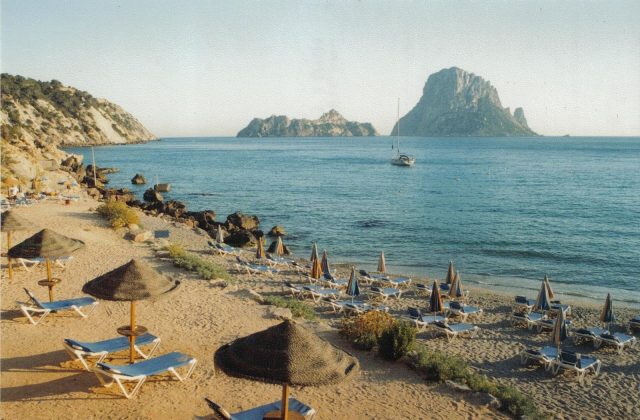
Es Vedrà is an uninhabited limestone rock rising 382 metres straight out of the sea about two kilometres off the south-west coast of Ibiza. Landing is not allowed, so people see it from boats circling its cliffs or from the headlands opposite, where the sunset behind the rock is one of the classic sights of the Balearics.
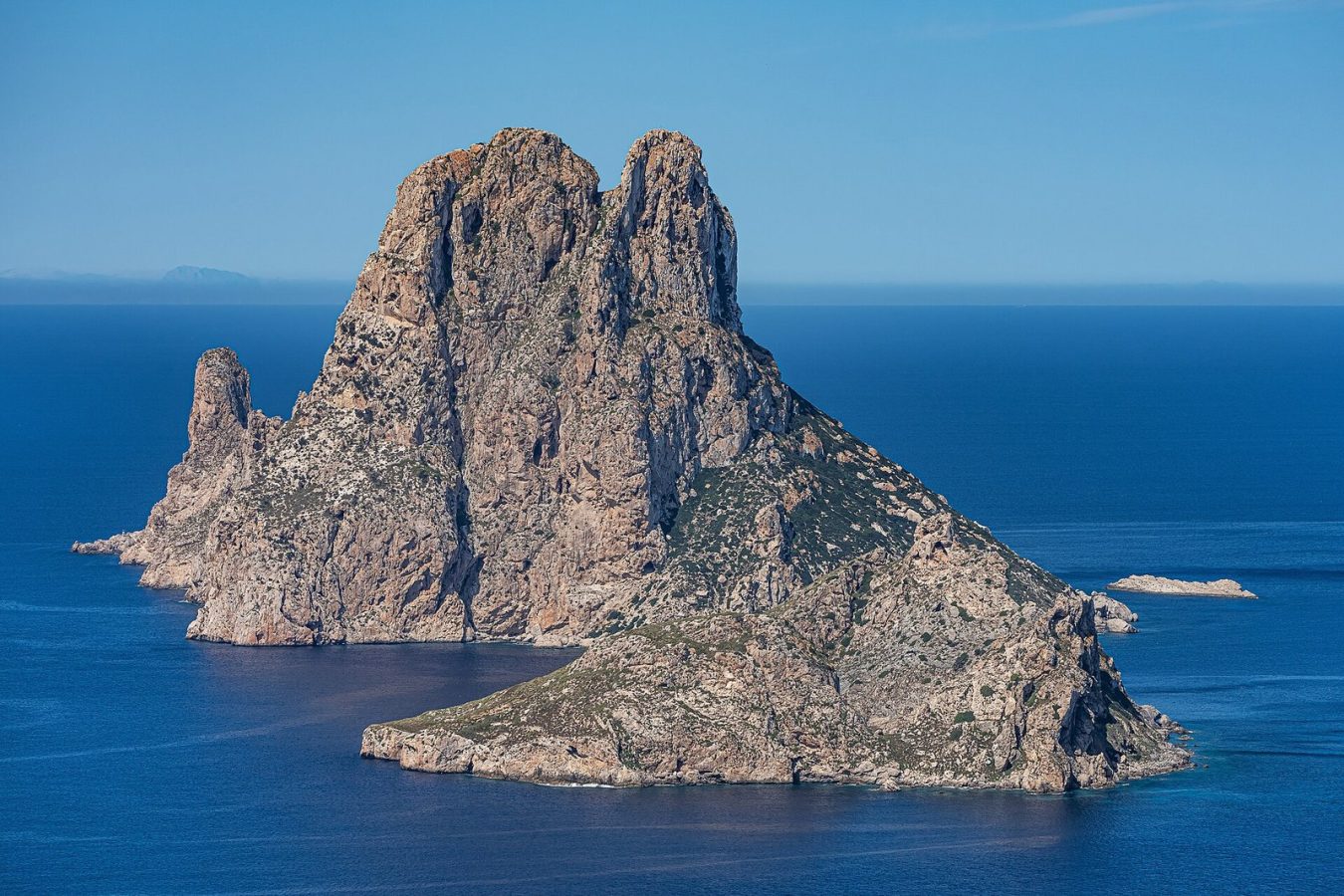
Photo: A.Savin, FAL
| Getting there | Boat trips from Sant Antoni in about 1 h; drive to Cala d'Hort, 25 min from Ibiza airport, to see it from shore |
|---|---|
| Gateway | Ibiza (Sant Antoni or Cala d'Hort) |
| Travel time | About 1 h by boat from Sant Antoni |
| Days | A half-day or sunset trip |
| Best months | May–Oct; sunset boat trips best Jun–Sep |
| Getting around | No landing; see it by boat or kayak, or walk the headlands opposite |
| Booking | Sunset boats and private charters a few days ahead in July–August |
| Cost | Expensive, like most of Ibiza |
| Beaches | No beaches on the rock; Cala d'Hort opposite has a sand and pebble beach facing it |
| Sea | Mediterranean Sea |
| Archipelago | Balearic Islands |
| Population | Uninhabited |
| Highest point | 382 m (Q124767376) |
| Airport | No |
| Checked | October 2026 |
Because nobody may land on Es Vedrà, everything sold is about seeing it, and most trips combine the rock with other stops on Ibiza's wild south-west coast.
The most popular option is a shared boat from Sant Antoni or nearby beaches, sailing down the coast in two to four hours, circling the rock and stopping to swim in a cove such as Cala d'Hort. Drinks, snacks and snorkelling gear are often included; sunset versions add music and an aperitif and are the busiest. Glass-bottom catamarans suit families.
Speedboat and jet-ski trips get there faster and add snorkelling at the old stone quarry known as Atlantis. Private boats and day charters let you choose the timing and the coves, at a much higher price. Sea kayak trips from the shore opposite are cheaper and quieter.
On land, half-day tours of Ibiza often include the viewpoints opposite the rock, sometimes with the salt flats or a sunset walk, and there are even photo shoots at the lookout.
Our advice: take a sunset boat if you want to be on the water, but if you have a car, the walk to the old watchtower opposite is free and just as memorable.
Close up, the cliffs rise almost vertically, streaked with colour and riddled with caves where seabirds nest. Boats circle the rock and its smaller neighbour, Es Vedranell, usually slowing at the western side for photos. On calm days you may stop to swim in deep, very clear water. In a swell the passage between them can be rough.
On the headland opposite, an eighteenth-century watchtower built against pirates stands above the sea. A dirt track and a walk of about 30 minutes lead to it, and from the cliffs around it the sun sets directly behind Es Vedrà on summer evenings. Arrive early to find a place on the rocks, and bring a torch for the way back.
The small beach facing Es Vedrà has sand and pebbles, a few fish restaurants and the best view of the rock from the water's edge. It is about 25 minutes by car from Ibiza airport. Parking fills quickly by late morning in summer, and the beach can be rocky underfoot, so water shoes help.
Below the watchtower, an old sandstone quarry was cut into the coast centuries ago to supply stone for Ibiza's walls. The cut blocks now form a maze of pools and carvings left by visitors, with Es Vedrà in the background. The path down is steep and unofficial, so many people visit by boat instead.
From the beaches opposite, guided kayak trips follow the cliffs and sea caves of the reserve, with the rock always in view. The seabed here is rich in seagrass meadows and fish, and the water is clearest in early summer. Snorkel close to shore and keep away from boat channels.
Our pick for each kind of trip, with live dates and prices. Free cancellation on most.
Best for: First visit, a boat from Sant Antoni
A shared boat down the west coast of Ibiza to circle the rock up close, with drinks and snacks on board and a swim stop.
Es Vedrà lies off the south-west coast of Ibiza, which has an international airport with flights from much of Europe and ferries from Barcelona, Valencia, Denia and Palma.
To see it from land, drive to Cala d'Hort or the Es Vedrà viewpoint, about 25 minutes from the airport and 30 from Ibiza Town; a few summer buses also serve Cala d'Hort, but a car is far more practical. The tower viewpoint is reached by a short walk from a car park.
To see it from the sea, join a boat trip from Sant Antoni, the main resort on the west coast, which takes around an hour each way, or from beaches nearer the rock. Boats from Ibiza Town also run down the south coast. All trips depend on the sea; strong winds cancel them.
You cannot land on Es Vedrà or climb it: it is part of a protected natural park and its cliffs are dangerous. On Ibiza, rent a car or scooter to reach the coves and viewpoints of the south-west, as buses are infrequent there. Roads to the coast are narrow and the last stretch to the tower is a dirt track; park carefully and walk the final part. Taxis are expensive and scarce at sunset.
Boat trips run from about May to October, with the most departures and the calmest seas from June to September. July and August are crowded and expensive across Ibiza, and the viewpoints opposite fill up an hour before sunset. In June and September the sea is warm, the light is soft and there are fewer people.
The sunset lines up behind the rock in summer; in spring and autumn it sets further to the side, though still beautifully. Wind from the south or west can make the crossing uncomfortable or cancel trips, so check the forecast.
In winter few boats run, but the walk to the tower and the views from the coast are lovely and almost empty. A single afternoon or a half-day trip is enough to see the rock; combine it with a few days on Ibiza.
There is nowhere to stay on the rock. Sant Antoni, with its sunset bars and frequent boat trips, is the most convenient base for boat excursions. Sant Josep and the villages and villas of the south-west are quieter and closer to Cala d'Hort and the viewpoints, but need a car. Ibiza Town suits those who want nightlife and the old walled town.
Es Vedrà has never had permanent inhabitants, but it is full of stories. Local legend makes it the island of the sirens, and modern myths claim it is magnetic, though geologists have found nothing unusual in its rock. In the nineteenth century a Carmelite friar, Francisco Palau, retreated here to pray and wrote of visions. The rock and its waters are protected as part of a natural park, and wild goats once kept on the island were removed to protect its plants and nesting falcons.
Es Vedrà is part of any trip to Ibiza. Pair it with the walled old town of Ibiza, the salt flats and beaches of Ses Salines in the south, and a day on Formentera, about 30 minutes by fast ferry from Ibiza Town. Some boat trips from Sant Antoni also continue to Formentera and the islet of Espalmador.
Boat trips from Sant Antoni in about 1 h; drive to Cala d'Hort, 25 min from Ibiza airport, to see it from shore.
From Ibiza (Sant Antoni or Cala d'Hort): about 1 h by boat from Sant Antoni.
A half-day or sunset trip.
May–Oct; sunset boat trips best Jun–Sep.
No landing; see it by boat or kayak, or walk the headlands opposite.
Go if you want Ibiza's most dramatic view on a sunset boat trip, a kayak paddle or a clifftop walk. Skip a dedicated trip if you hope to land and explore, as the island is a closed nature reserve, or if rough seas make you seasick.
Expensive, like most of Ibiza.
No beaches on the rock; Cala d'Hort opposite has a sand and pebble beach facing it.
Sunset boats and private charters a few days ahead in July–August.
Yes. Boat trips, guided tours and day trips for Es Vedrà can be booked online; live prices and free cancellation on most are shown on this page.
Balearic Islands, Spain
Mallorca is the largest of the Balearic Islands, about 3,640 square kilometres of coast and mountains off eastern…
909 tours & trips
Balearic Islands, Spain
Ibiza is the third-largest of the Balearic Islands, 577 square kilometres of pine hills, small coves and salt pans…
372 tours & trips
Balearic Islands, Spain
Menorca is the quiet, green northern neighbour of Mallorca, about 50 km long, a UNESCO Biosphere Reserve since 1993…
123 tours & trips
Balearic Islands, Spain
Formentera is the smallest and most southerly of the inhabited Balearic Islands, a flat island of 83 square kilometres…
85 tours & trips
Balearic Islands, Spain
Dragonera is an uninhabited, dragon-shaped islet off the western tip of Mallorca, about 3 km long and protected as a…
7 tours & trips
Balearic Islands, Spain
Cabrera is an uninhabited island about 10 km south of Mallorca, the heart of a protected archipelago that forms one of…
5 tours & trips