Ilha Grande
Brazil
Ilha Grande is a mountainous, rainforest-covered island off the coast of Angra dos Reis, about 150 km west of Rio de…
197 tours & trips
Brazil · Atlantic Ocean · Nature & wildlife island
Fernando de Noronha is a volcanic archipelago of 21 islands 354 km off the coast of north-east Brazil, protected as a marine national park and a UNESCO World Heritage Site. Visitor numbers are controlled and a daily environmental fee is charged, which keeps its beaches, clear water, sea turtles and spinner dolphins among the best in the South Atlantic.
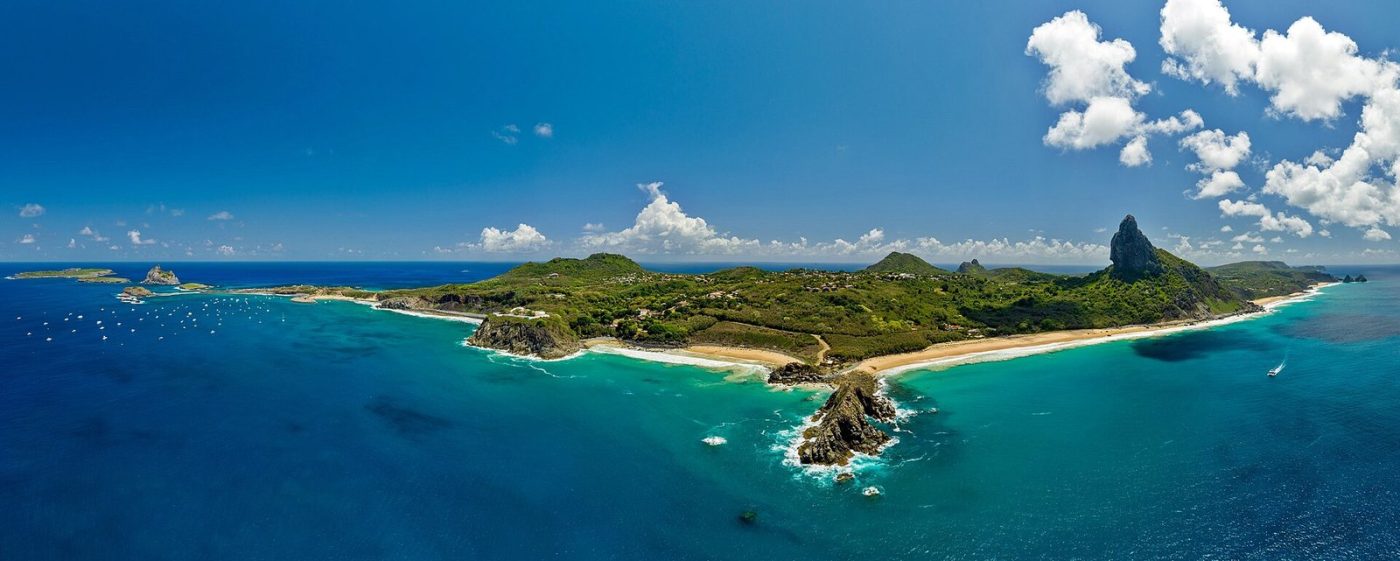
Photo: Fernandoantoniofotos, CC BY-SA 4.0
| Getting there | Flights from Recife (about 1 h 10 min) or Natal (about 1 h); no passenger ferry |
|---|---|
| Gateway | Recife or Natal (flights) |
| Travel time | About 1 h by air |
| Days | 3 to 5 nights |
| Best months | Aug–Feb dry, with the clearest water; rains Mar–Jul; surf Dec–Mar |
| Getting around | Rent a buggy, or use the island bus and taxis along the one main road |
| Booking | Flights, rooms and the Atalaia pool slots weeks ahead; park fee before arrival |
| Cost | Very expensive by Brazilian standards |
| Beaches | Golden sand and clear water: Baía do Sancho, Baía dos Porcos, Leão, Sueste and Cacimba do Padre |
| Sea | Atlantic Ocean |
| Area | 26 km² |
| Population | 3,101 (2020) |
| Highest point | 323 m (Morro do Pico) |
| Airport | Yes, scheduled flights |
| Car-free | No |
| UNESCO | Brazilian Atlantic Islands: Fernando de Noronha and Atol das Rocas Reserves |
| Checked | October 2026 |
What is sold here is built around the marine park, and almost everything is booked once you are on the island, often through your guesthouse. Day trips from the mainland are not practical.
The classic first booking is the island tour, a full day in an open buggy or four-wheel drive with a local guide that covers the beaches, the viewpoints over the Morro Dois Irmãos and the old village, with time to swim. Lunch and the park fee are normally extra. It is the easiest way to get your bearings before returning to favourite spots alone.
Boat trips run along the sheltered coast facing Brazil, the Mar de Dentro, past the Baía dos Golfinhos where spinner dolphins gather, often with a snorkelling stop. Sunset versions add drinks. Snorkelling is also sold as guided swims at Atalaia, a natural pool with strictly limited daily slots, and as planasub, where a boat tows you on a board over the reef.
Diving is the other big draw, with accredited centres taking certified divers and beginners to reefs and the wreck of the Corveta Ipiranga. Hikes on the protected trails, such as the coastal walk to Atalaia or the Capim-Açu trail, require a licensed guide.
Recommendation: book the island tour on day one, a dolphin boat on day two, and at least one dive or guided snorkel.
Often voted the finest beach in Brazil, this cove of golden sand sits below green cliffs on the inner coast. You reach it down steel ladders through a narrow crack in the rock, then swim over reefs with turtles and rays. Come early, and walk the clifftop trail for the view from the platforms above.
Next to Cacimba do Padre, a short scramble over rocks leads to this tiny cove with clear pools at low tide and the twin peaks of the Morro Dois Irmãos rising from the sea. It is the island's best-known view, and the snorkelling around the rocks is excellent when the sea is calm.
Above the bay between Sancho and the protected coast, a viewing platform lets you watch hundreds of spinner dolphins resting in the morning, leaping and spinning as they come in from the open sea. Swimming in the bay is forbidden. Arrive by about 6 am with binoculars for the best chance of seeing them.
On the windward side facing Africa, Sueste is a calm bay where green turtles and young sharks graze in shallow water, ideal for a guided snorkel. A little south, Atalaia is a natural rock pool full of fish, open only at low tide to small groups who book a slot.
The old village on the northern shore has a whitewashed 18th-century church, the ruins of the Portuguese fort of Nossa Senhora dos Remédios and a governor's palace. It is the island's centre for restaurants and evening life. Walk up to the fort at sunset for views over the beaches of Cachorro and Meio.
The basalt spire of the Morro do Pico, at 323 metres the highest point, rises behind Praia da Conceição, a long, easy beach near the village with a bar at the end. It is the sunset spot for many visitors. Climbing the peak itself is not allowed, but the beach walk beneath it is pleasant.
Our pick for each kind of trip, with live dates and prices. Free cancellation on most.
Best for: First day, the whole island by buggy
A guided day by open buggy that strings together the main beaches, viewpoints and village, with swimming stops, so you learn the island before exploring on your own.
The only practical way in is by air. Flights land at the small airport in the middle of the main island, from Recife in about 1 hour 10 minutes and from Natal in about an hour, with connections from São Paulo and other Brazilian cities via those two hubs. Book well ahead for December, January and Brazilian holidays, when seats sell out and fares rise.
Before or on arrival every visitor pays the environmental preservation fee, charged per day and rising steeply for longer stays, and most also buy the separate pass for the marine national park, valid for ten days, which is checked at the main beaches. There is no passenger ferry from the mainland. Sailing boats and occasional cruise ships call, but they are not a realistic option for most travellers. The island runs on its own time, one hour ahead of Brasília.
The main island is small: one paved road, about 7 km long and said to be the shortest federal highway in Brazil, runs from the port to Sueste, with dirt tracks to the beaches. Most visitors rent a buggy, which is fun but expensive, and drive carefully on the potholed tracks. A public bus runs along the road about every half hour, cheap and useful for most beaches, and taxis cover the rest. Walking between neighbouring beaches is easy, and some trails need a guide.
The water is warm, around 26 to 28 degrees, all year, and air temperatures rarely leave the high 20s. The dry season from August to February brings the calmest seas on the inner coast and the clearest visibility for diving, often 30 metres or more. From March to July heavier rain falls, mostly in short showers, and the island is greener and cheaper.
From December to March, northern swells reach the inner beaches, bringing surfers to Cacimba do Padre and sometimes making Sancho rough, while the windward side becomes calmer. Sea turtles nest on Leão and other beaches roughly from January to June.
December, January, Carnival and July school holidays are the busiest and most expensive times, when daily visitor limits are reached. Three nights is a bare minimum; four or five give time for diving, a boat trip and slow beach days.
Accommodation is mostly in family guesthouses called pousadas, with a few upmarket lodges, and all are expensive. Vila dos Remédios and nearby Vila do Trinta suit those who want restaurants, the bus and evening life within walking distance. Floresta Nova and Floresta Velha, a little inland, are quieter and often cheaper. The Boldro area is central for the sunset viewpoints and Praia do Boldro, while the higher-end lodges sit closer to Sancho and the protected coast, where nights are silent.
The islands were sighted by a Portuguese expedition around 1503 and granted to the merchant Fernão de Loronha, giving them their name. Dutch and French occupations prompted Portugal to build a ring of forts in the 18th century, whose ruins still stand above the beaches. For two centuries the island was a prison colony, used for political prisoners as late as the 1940s, and later held a United States tracking station. A federal territory until 1988, it then joined Pernambuco, the marine park was created and tourism began under strict limits.
Noronha is usually paired with the mainland city that you fly from. Recife and neighbouring colonial Olinda need two days, and Porto de Galinhas, with its own natural pools, is about an hour south of Recife airport. From Natal, the dunes of Genipabu lie just north and the beaches of Pipa about 90 minutes south, making a good one-week loop.
Flights from Recife (about 1 h 10 min) or Natal (about 1 h); no passenger ferry.
From Recife or Natal (flights): about 1 h by air.
3 to 5 nights.
Aug–Feb dry, with the clearest water; rains Mar–Jul; surf Dec–Mar.
Rent a buggy, or use the island bus and taxis along the one main road.
Go if you want Brazil's finest snorkelling and diving, empty-feeling beaches and close-up wildlife, and can pay for it. Skip it or choose Morro de São Paulo or Ilha Grande if your budget is tight or you want lively nightlife.
Very expensive by Brazilian standards.
Golden sand and clear water: Baía do Sancho, Baía dos Porcos, Leão, Sueste and Cacimba do Padre.
Flights, rooms and the Atalaia pool slots weeks ahead; park fee before arrival.
Yes. Boat trips, guided tours and day trips for Fernando de Noronha can be booked online; live prices and free cancellation on most are shown on this page.
Brazil
Ilha Grande is a mountainous, rainforest-covered island off the coast of Angra dos Reis, about 150 km west of Rio de…
197 tours & trips
Marajó Archipelago, Brazil
Marajó is the vast island at the mouth of the Amazon, about 40,000 square kilometres of savannah, mangrove and…
6 tours & trips
Brazil
Santa Catarina Island is the 424-square-kilometre island off southern Brazil that holds Florianopolis, the capital of…
No tours listed
Brazil
Ilha do Mel is a car-free island 4 km off the coast of Paraná in southern Brazil, where sandy paths link two fishing…
No tours listed
Brazil
Ilhabela is a mountainous, forested island just off the coast of São Paulo state, a 15-minute ferry ride from São…
No tours listed