Ishigaki
Yaeyama Islands, Japan
Ishigaki is a subtropical island in the far south of Japan, about 400 km south-west of Okinawa's main island and…
55 tours & trips
Japan · Seas of Japan & Korea · Nature & wildlife island
Iriomote is the largest of Japan's Yaeyama Islands, a mountainous island of subtropical jungle and mangrove rivers 40 minutes by ferry from Ishigaki, with one coastal road and about 2,300 people. Most of it is national park and part of a UNESCO natural site, home to the rare Iriomote wildcat.
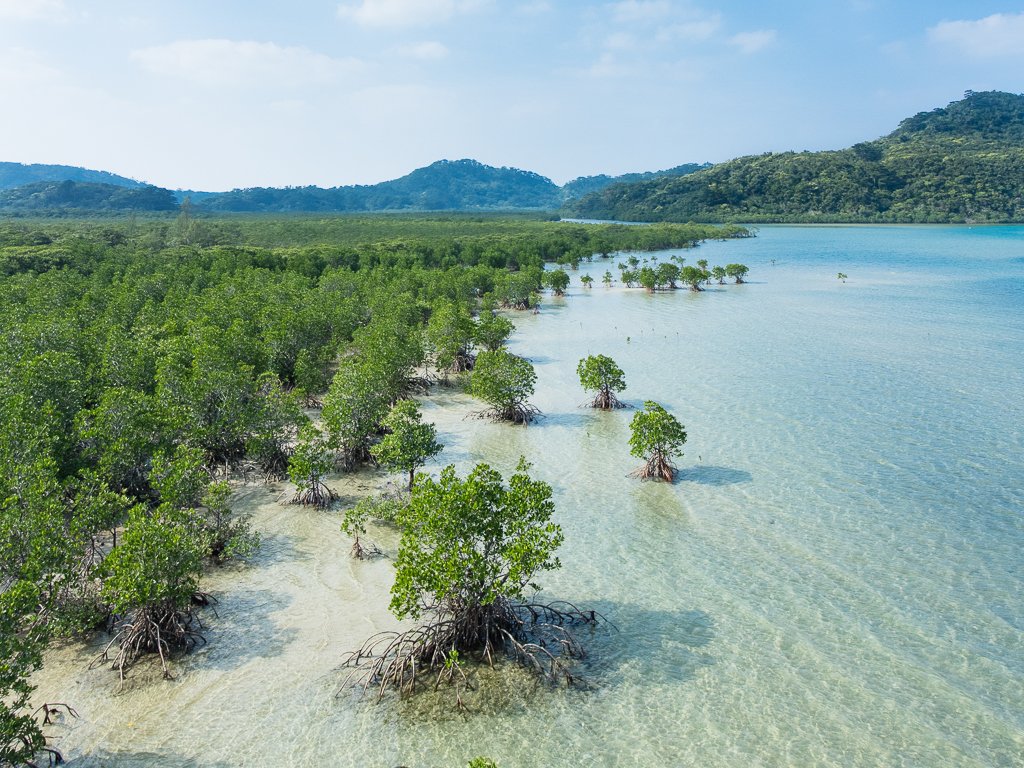
Photo: Anagounagi, CC BY-SA 4.0
| Getting there | Ferry from Ishigaki to Uehara or Ohara in about 40 min, many sailings daily; no airport |
|---|---|
| Gateway | Ishigaki (ferry to Ohara or Uehara) |
| Travel time | 40 to 50 min by high-speed ferry |
| Days | 1 to 2 nights |
| Best months | Mar–May and Oct–Nov; rainy season mid-May–June; typhoon risk Jul–Sep |
| Getting around | Rent a car; buses along the single road are infrequent; tours collect you |
| Booking | Guided river and waterfall tours a few days ahead; summer rooms and rental cars early |
| Cost | Mid-range for Japan; guided tours are the main expense |
| Beaches | Coral beaches: Hoshizuna with star sand, Tsuki-ga-hama and Barasu islet; sharp coral, wear shoes |
| Sea | Seas of Japan & Korea |
| Archipelago | Yaeyama Islands |
| Area | 289 km² |
| Population | 2,347 (2005) |
| Highest point | 470 m (Mount Komi) |
| Ferry | 40 min from Ishigaki (ferry to Ohara or Uehara) |
| Airport | No |
| Car-free | No |
| UNESCO | Amami-Oshima Island, Tokunoshima Island, Northern part of Okinawa Island, and Iriomote Island |
| Checked | October 2026 |
Iriomote is a place where guided trips matter more than elsewhere, because much of the island is roadless jungle and some sites can only be reached with a local guide.
The classic is a mangrove river tour by canoe, kayak or paddleboard on the Hinai, Nakama or Urauchi rivers, often combined with a jungle walk to a waterfall such as Pinaisara; half-day and full-day versions exist, and lunch and gear are normally included. Canyoning trips slide down natural rock chutes in the rivers, and night tours look for fireflies in spring and for coconut crabs and frogs in summer.
At sea, boats go out to the coral of Barasu, a small islet made of coral fragments, and to reefs near Hatoma for snorkelling or diving. From Ishigaki, packaged day trips include the ferry, a river cruise on the Urauchi or Nakama, and the ox-cart crossing to Yubu Island. A scenic flight by helicopter is the expensive extra.
Most operators pick you up at Uehara or Ohara port or your hotel. Staying one night lets you join a morning river trip and an evening firefly or night walk. If you have one full day, book the mangrove kayak and waterfall combination.
The tallest waterfall in Okinawa Prefecture drops about 55 metres over a forested cliff in the north. Most visitors paddle across the mangrove lagoon of the Hinai River at high tide, then walk about 40 minutes through jungle to the pool at the base or to the top for a view of the coast. Go with a guide; tides decide the timing.
The longest river in Okinawa flows through deep jungle on the north coast. Sightseeing boats run upstream for about 30 minutes, then a forest trail of about an hour leads to Mariyudu Falls, a wide two-step cascade, and on to Kanpire Falls, a series of rapids. The trail is muddy after rain; wear proper shoes.
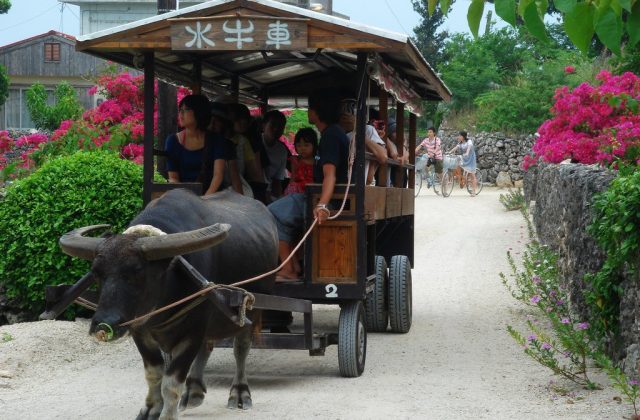
A tiny islet off the east coast is reached across a shallow channel in carts pulled by water buffalo, while the driver plays the sanshin and sings. On the island a botanical garden of palms and flowers and a butterfly house take an hour. It is touristy but charming, and it is included in most day trips from Ishigaki.
Near Uehara in the north, this beach is known for star sand: the tiny star-shaped shells of single-celled organisms that you can find by pressing your palm into the sand. At low tide rock pools form in the coral flat, and snorkelling is good on calm days. Swim only within the calm areas, as currents can be strong.
Between Iriomote and Hatoma, Barasu is a low bank of white coral fragments that appears in the sea, with healthy reefs around it. Boat tours from Uehara stop here to snorkel among table corals, reef fish and sometimes turtles. It is one of the best snorkelling spots in the Yaeyama Islands, but it is only accessible by boat.
Near Ohara port, boats and canoes go up the Nakama River through the largest mangrove forest in Japan, past a huge old tree that is a local landmark. Nearby the coast road passes quiet beaches and lookout points. The island's wildlife centre explains the Iriomote cat, which you are unlikely to see but should watch for on the road.
Our pick for each kind of trip, with live dates and prices. Free cancellation on most.
Best for: First visit, the mangrove river
Paddling a canoe or board up a mangrove river with a local guide is the essential Iriomote experience, suitable for beginners and run in calm water most of the year.
There is no airport, so you fly to Ishigaki, which has direct flights from Tokyo, Osaka, Naha and other cities, then take the ferry from the remote island terminal in Ishigaki port.
High-speed ferries run many times a day to two ports: Uehara in the north, about 40 to 45 minutes, closest to the river tours, Hoshizuna and most lodgings; and Ohara in the south-east, about 35 to 40 minutes. In winter the Uehara route is often cancelled when the north wind raises waves, and boats then go to Ohara with a connecting bus. Car ferries run less often and are slow, so most people rent a car on arrival. Buy tickets at the terminal; combination tickets with buses and tours are sold there too.
A single road follows the northern and eastern coasts from Shirahama to Ohara, about 50 km; the interior and the south-west have no roads at all. Rental cars are the most flexible option and should be booked ahead in summer; drive slowly, as the Iriomote cat is often hit by cars. Local buses run along the road a few times a day. Funauki village on the west coast is reached only by boat from Shirahama.
March to May and October to November are the best months, warm but not stifling, with good conditions for hiking and paddling; fireflies light up the forest from about March to May. The rainy season runs from roughly mid-May to late June, with heavy showers but lush waterfalls.
July to September is hot and humid, the sea is warmest at around 29 degrees and snorkelling is excellent, but typhoons can stop ferries for several days, so leave a spare day before an onward flight. Japanese holidays, especially Golden Week in early May and mid-August, fill rooms and tours. Winter is mild and rarely below 15 degrees but often grey and windy, with fewer swimming days. One or two nights is the usual stay.
The north around Uehara and Hoshizuna has most of the guesthouses, a few hotels and the departure points for river and snorkel tours, plus the most reliable ferry connections in summer. The east around Ohara is quieter and suits those exploring the Nakama River and Yubu. Accommodation is limited and simple, mostly family-run minshuku with dinner included, so book early. Restaurants are few, and many close early.
Iriomote has always been thinly settled. Malaria kept villages small for centuries, and attempts to open coal mines in the early twentieth century, worked by labourers in harsh conditions, left only ruins in the forest. Communities clung to the coast, and festivals such as the harvest celebration at Sonai preserve old Yaeyama traditions. The Iriomote cat was only described by science in 1967. The island became a national park, and in 2021 it joined UNESCO's list together with other islands of southern Japan.
Ishigaki, 40 minutes away, is the base for flights and has the most hotels and restaurants. Taketomi, with its preserved village of red-tiled houses, is ten minutes from Ishigaki by boat and pairs easily with Iriomote. Hatoma and Kohama are small neighbours reached by ferry, and Okinawa Island is an hour by plane from Ishigaki.
Ferry from Ishigaki to Uehara or Ohara in about 40 min, many sailings daily; no airport.
From Ishigaki (ferry to Ohara or Uehara): 40 to 50 min by high-speed ferry.
1 to 2 nights.
Mar–May and Oct–Nov; rainy season mid-May–June; typhoon risk Jul–Sep.
Rent a car; buses along the single road are infrequent; tours collect you.
Go if you want mangrove kayaking, jungle waterfalls, coral snorkelling and a wild island that feels far from mainland Japan. Skip it or choose Ishigaki if you want beach resorts, a wide choice of restaurants and nightlife. With about 40 min each way from Ishigaki (ferry to Ohara or Uehara), a day trip is easy to do.
Mid-range for Japan; guided tours are the main expense.
Coral beaches: Hoshizuna with star sand, Tsuki-ga-hama and Barasu islet; sharp coral, wear shoes.
Guided river and waterfall tours a few days ahead; summer rooms and rental cars early.
Yes. Boat trips, guided tours and day trips for Iriomote can be booked online; live prices and free cancellation on most are shown on this page.
Yaeyama Islands, Japan
Ishigaki is a subtropical island in the far south of Japan, about 400 km south-west of Okinawa's main island and…
55 tours & trips
Yaeyama Islands, Japan
Taketomi is a tiny, flat coral island 4 km south of Ishigaki in Okinawa's Yaeyama group, with a single village of…
9 tours & trips
Yaeyama Islands, Japan
Yonaguni is the westernmost island of Japan, a hilly island of about 29 square kilometres in the Yaeyama group, just…
2 tours & trips