Ishigaki
Yaeyama Islands, Japan
Ishigaki is a subtropical island in the far south of Japan, about 400 km south-west of Okinawa's main island and…
55 tours & trips
Japan · Seas of Japan & Korea · Nature & wildlife island
Yonaguni is the westernmost island of Japan, a hilly island of about 29 square kilometres in the Yaeyama group, just 107 km from Taiwan. Divers come for winter hammerhead sharks and the mysterious underwater rock terraces of the Monument, others for wild horses, sea cliffs and the last sunset in Japan.
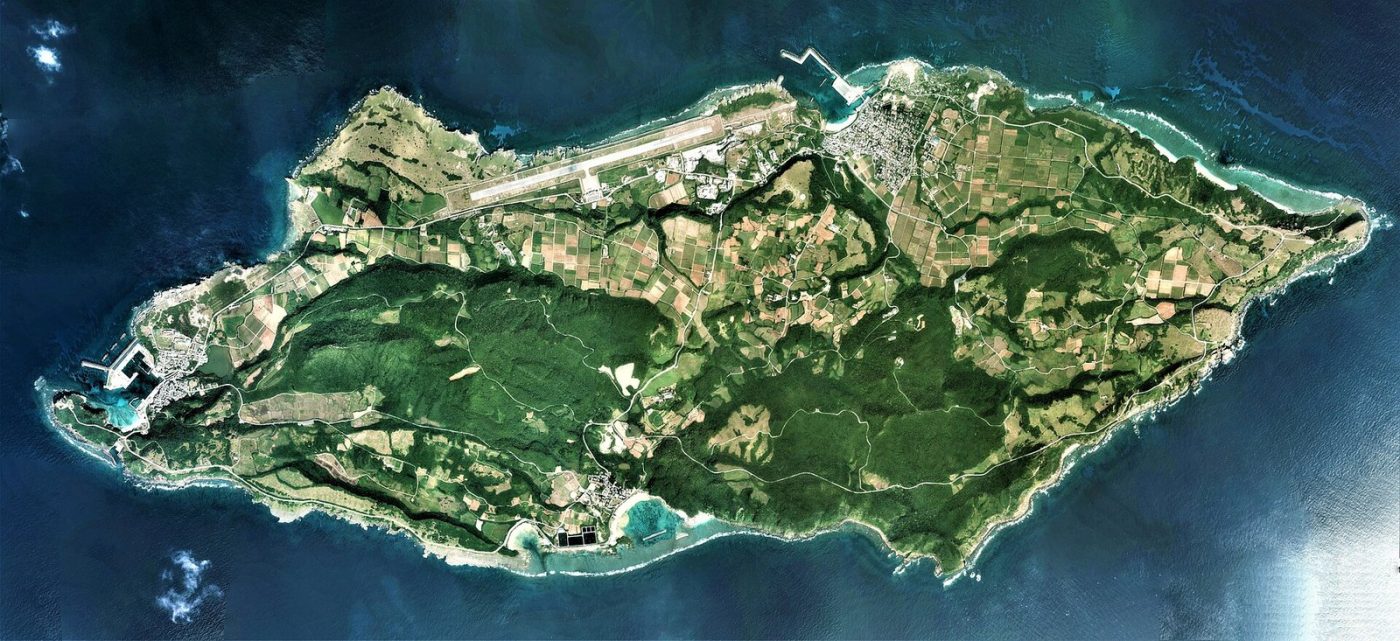
Photo: 国土地理院, Attribution
| Getting there | 30-min flight from Ishigaki or about 1.5 h from Naha; ferry from Ishigaki about 4 h, twice a week |
|---|---|
| Gateway | Ishigaki (flight or ferry) |
| Travel time | 30 min by air, about 4 h by ferry |
| Days | 3 to 5 nights |
| Best months | Oct–May; hammerheads Dec–Mar; Apr–Jun pleasant; typhoons Jul–Sep |
| Getting around | Rent a car or scooter; a few community buses a day; distances are short |
| Booking | Flights and dive boats weeks ahead for Dec–Mar and Golden Week; rooms are few |
| Cost | Mid-range for Japan |
| Beaches | Few swimming beaches: Nanta beach by Sonai and Higawa bay; most of the coast is cliff and rock |
| Sea | Seas of Japan & Korea |
| Archipelago | Yaeyama Islands |
| Area | 29 km² |
| Population | 1,491 |
| Highest point | 231 m (Mount Urabu) |
| Airport | Yes, scheduled flights |
| Car-free | No |
| Checked | October 2026 |
Yonaguni has only a handful of tours sold online, and most visitors arrange things locally through their guesthouse or a dive shop.
Diving is the main business. Several dive shops in Kubura and Sonai run boat dives to the Monument off the south coast and, from about December to March, to the hammerhead points off the western cape. Most require a certificate and some experience, as currents are strong; equipment hire and two dives a day are usually offered as a package.
Non-divers can see the Monument from a semi-submersible or glass-bottom boat, which runs in calm weather and takes about an hour. Snorkelling trips are also available in summer, and fishing boats in Kubura take visitors out for a morning on the water.
On land, small-group night walks look for wildlife and stars, and craft workshops teach traditional weaving and palm-leaf work. Taxi drivers and guesthouse owners can give island drives of a few hours, which is useful if you do not drive.
For most visitors, the best plan is a rental car for a day round the island, a Monument boat or dive, and one guided evening outing.
Off Arakawabana on the south coast lies a huge block of sandstone with flat terraces, steps and straight edges, discovered by a diver in 1986. Some believe it is man-made, most geologists think it is natural. Divers explore it at depths of 5 to 25 metres; non-divers can look down from a semi-submersible boat in calm seas.
At the western tip, a stone marker records Japan's westernmost point, and the sun here sets later than anywhere else in the country. On a few very clear days a year you can see the mountains of Taiwan on the horizon. Arrive before sunset with a jacket, as the wind is strong.
At the eastern cape, a lighthouse stands above grassy cliffs where the island's native horses graze freely. They are small, gentle and protected, so watch from a distance and do not feed them. The cape is about 15 minutes' drive from Sonai, with fine views along the south coast.
Sonai, the main village on the north coast, has old stone walls, red-tiled houses and a small museum. Above it, Tindabana is a sheer sandstone cliff with a viewpoint over the village and the sea, linked to the legend of a female ruler who once led the island.
On the south coast, Higawa village sits behind a sandy bay, one of the few places where swimming is easy. A clinic built for a popular Japanese television drama stands by the shore and draws domestic visitors. The nearby rock pillars of Tachigami-iwa rise from the sea east of the bay.
Our pick for each kind of trip, with live dates and prices. Free cancellation on most.
Best for: Night walk and stars
An evening outing into the island's forests and open hills, looking for nocturnal wildlife and then the very dark, star-filled sky far from any city.
Yonaguni has a small airport with flights of about 30 minutes from Ishigaki, several times a day, and about one and a half hours from Naha on Okinawa, usually once or twice a day. Ishigaki itself has direct flights from Tokyo, Osaka and other Japanese cities.
A ferry from Ishigaki runs about twice a week and takes about four hours. It is cheaper, but the open sea is often rough and sailings are cancelled in bad weather and typhoons, so it suits travellers with time and strong stomachs.
There is no ferry to Taiwan, despite talk of one. Rental cars are best collected at the airport on arrival.
A rental car or scooter is the best way to get around. A road circles the island in about 25 km, linking the three villages, Sonai, Kubura and Higawa, with the capes and viewpoints; there is little traffic but watch for horses and cattle on the road.
A community bus makes a few loops a day, and there are a couple of taxis. Cycling is possible, but the hills and wind are hard work.
Yonaguni is subtropical. From December to March, the hammerhead season, the north wind blows hard, days are around 18 to 22 degrees and the sea about 22 degrees; diving is good but crossings rough. April to June is warm and pleasant, though the rainy season usually brings showers from mid-May to mid-June.
July to September is hot, above 30 degrees, with calm seas between storms, but this is typhoon season, and flights and ferries can be cancelled for days. October and November are a good compromise, with warm water and fewer typhoons.
Golden Week in early May and the summer holidays bring Japanese visitors, and the few rooms fill. A marlin-fishing tournament takes place in early summer.
Three to five nights allow for weather delays and a few dives.
Sonai, the largest village on the north coast, has most of the guesthouses, a few restaurants and shops, and is a good base without a car. Kubura, the fishing harbour in the west near Cape Irizaki, is the dive base and the place for sunsets. Higawa in the south is the quietest, with a few small inns near the beach. Options are limited, so book ahead.
Yonaguni has its own language, Dunan, and a strong sense of separateness. Archaeologists debate how people first reached it from Taiwan, and in 2019 researchers paddled a dugout canoe across the current in two days. Under the Ryukyu Kingdom it paid heavy taxes, and its distinctive textiles and palm-leaf crafts are still made by hand. After 1945 it became a frontier island facing Taiwan, and a small defence base opened in 2016. Today about 1,500 people live by fishing, sugar cane, cattle and tourism, and a fierce local rice spirit is distilled only here.
Yonaguni is usually reached from Ishigaki, where you can spend a few days snorkelling, then take boats to Iriomote's jungle rivers, about 45 minutes away, and to Taketomi's traditional village, about 15 minutes. Hateruma, Japan's southernmost inhabited island, is about an hour by fast boat from Ishigaki. Naha and Okinawa's main island are an easy flight away.
30-min flight from Ishigaki or about 1.5 h from Naha; ferry from Ishigaki about 4 h, twice a week.
From Ishigaki (flight or ferry): 30 min by air, about 4 h by ferry.
3 to 5 nights.
Oct–May; hammerheads Dec–Mar; Apr–Jun pleasant; typhoons Jul–Sep.
Rent a car or scooter; a few community buses a day; distances are short.
Go if you are a diver, or want a remote island with wild horses, cliffs and almost no tourists. Choose Ishigaki or Iriomote instead if you want easy beaches, many restaurants and short boat hops between islands.
Mid-range for Japan.
Few swimming beaches: Nanta beach by Sonai and Higawa bay; most of the coast is cliff and rock.
Flights and dive boats weeks ahead for Dec–Mar and Golden Week; rooms are few.
Yes. Boat trips, guided tours and day trips for Yonaguni can be booked online; live prices and free cancellation on most are shown on this page.
Yaeyama Islands, Japan
Ishigaki is a subtropical island in the far south of Japan, about 400 km south-west of Okinawa's main island and…
55 tours & trips
Yaeyama Islands, Japan
Iriomote is the largest of Japan's Yaeyama Islands, a mountainous island of subtropical jungle and mangrove rivers…
12 tours & trips
Yaeyama Islands, Japan
Taketomi is a tiny, flat coral island 4 km south of Ishigaki in Okinawa's Yaeyama group, with a single village of…
9 tours & trips