Oahu
Hawaiian Islands, United States
Oahu is the third-largest of the Hawaiian Islands and home to about a million people, two thirds of the state's…
331 tours & trips
United States · Pacific Ocean · Nature & wildlife island
Molokini is a tiny crescent of a volcanic crater rim rising from the sea about 4 km off the south coast of Maui, with an area of just 9 hectares. Landing is forbidden, but the sheltered water inside the crescent, clear for 30 metres or more, makes it one of the best snorkelling and diving spots in Hawaii.
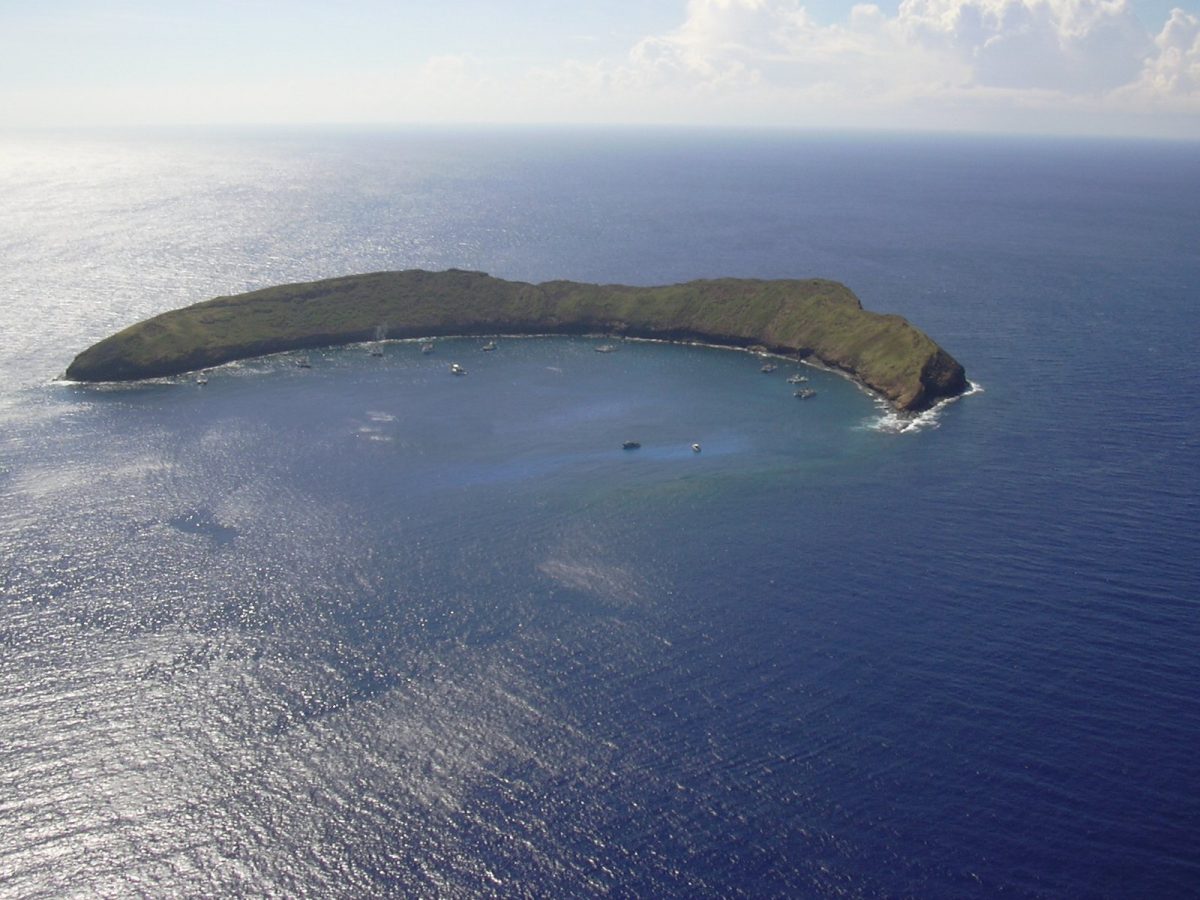
Photo: Forest & Kim Starr, CC BY 3.0
| Getting there | Boat from Maalaea Harbor in about 1 h, or from the Kihei boat ramp in about 20 min |
|---|---|
| Gateway | Maui (Maalaea Harbor or Kihei) |
| Travel time | 20 min to 1 h by boat |
| Days | A morning trip is enough |
| Best months | All year; calmest early in the morning; whales Dec–Apr |
| Getting around | No landing allowed: you stay in the water or on the boat |
| Booking | Morning trips a few days ahead, more in winter and summer holidays |
| Cost | Expensive, like most Hawaii boat trips |
| Beaches | No beaches and no landing; swim from the boat over sand and coral inside the crater |
| Sea | Pacific Ocean |
| Archipelago | Hawaiian Islands |
| Area | 9 ha |
| Population | Uninhabited |
| Highest point | 50 m |
| Airport | No |
| Car-free | Yes |
| Checked | October 2026 |
Every Molokini trip is a snorkelling or diving boat, and the choice comes down to boat size, departure point and time of day.
Large catamarans leave Maalaea Harbor early in the morning, take about an hour, and usually include breakfast, lunch, snorkel gear and flotation. They are stable and comfortable, with toilets and shade, and good for families and nervous swimmers. Smaller rafts and speedboats leave the Kihei boat ramp and reach the crater in about 20 minutes, offering shorter trips with fewer people and sometimes a snorkel on the back wall when the sea allows. Most trips add a second stop along the Maui coast, often at a turtle area.
Afternoon trips are cheaper, but the wind usually rises after midday and boats often switch to a sheltered coastal reef instead of Molokini. Divers book separate dive boats from Kihei or Maalaea. In winter, many trips include whale watching on the way.
Alcoholic drinks, wetsuit hire, underwater cameras and harbour parking are often extra. Book a morning trip; choose a big catamaran for comfort or a small boat for speed and fewer crowds.
Boats moor on fixed buoys inside the crescent, where the rim blocks the waves and currents. Below you, coral heads, rocks and sand patches lie in 3 to 15 metres of exceptionally clear water. Look for butterflyfish, triggerfish, parrotfish, moray eels and, now and then, a white-tip reef shark resting on the bottom.
The outer side of the crater drops in a sheer wall to around 90 metres. When the sea is calm, some smaller boats drift snorkellers along it, giving a dizzying view into blue depths with large fish passing below. It is for confident swimmers only, since currents can be strong, and trips go only if conditions allow.
Certified divers can explore the inner crater, the rim at Reef's End and the wall, with good visibility nearly all year. Expect large schools of fish, reef sharks, rays and, in winter, the sound of humpback whales singing underwater. Beginners can try an introductory dive inside the sheltered crescent.
Most Molokini trips add a second stop along the coast of South Maui, often off Makena, where green sea turtles graze on the reef and rest at cleaning stations. The water is shallower, and turtles are almost guaranteed. Keep at least 3 metres away and never touch them.
From December to April, humpback whales arrive from Alaska to breed and calve in the warm, shallow channels around Maui. On the crossing to Molokini you often see them breaching or slapping their tails, and some trips slow down to watch. February and March are the peak months.
Our pick for each kind of trip, with live dates and prices. Free cancellation on most.
Best for: First visit, the classic morning trip
A morning boat from Maalaea that snorkels the crater while the water is calmest, then stops near the coast to look for turtles.
Molokini can only be visited on a licensed boat, and nobody may land on the islet.
Most trips leave from Maalaea Harbor, on the isthmus between West Maui and Haleakala, about 20 minutes' drive from Kahului airport; the crossing takes about an hour. Smaller boats leave from the Kihei boat ramp in South Maui, about 20 minutes from the crater. Check in early, usually around 6 or 7 am for morning trips, and allow time for parking.
Kahului airport has direct flights from the US mainland and frequent connections from Honolulu. Bring reef-safe sunscreen, since sunscreens with certain chemicals are banned in Hawaii. Take seasickness tablets before boarding if needed.
There is nothing to get around on Molokini itself. The islet is a state seabird sanctuary and the water around it a marine life conservation district, so you stay on the boat or in the water inside the marked area. Fishing and feeding fish are banned. On Maui, rent a car to reach the harbour; there is little public transport at the early hours the boats leave, and parking at Maalaea fills up.
Molokini can be visited all year, since the water stays between about 24 and 27 degrees. The key is time of day: the trade winds usually pick up from late morning, so early boats find calm, clear water and afternoon boats may be diverted elsewhere.
Winter, from December to April, brings humpback whales and higher prices; north swells rarely affect the crater, but rough days do cancel trips. Summer is usually calm and sunny, and good for the back wall. Holidays fill the boats, so book a few days ahead.
If your trip is cancelled for weather, operators normally rebook or refund, so plan it early in your stay to leave room for a second try. A single morning is all Molokini needs.
You cannot stay on Molokini, so choose a base on Maui close to the boats. Kihei, in South Maui, has condos, apartments and mid-range hotels close to the boat ramp and an easy drive to Maalaea. Wailea, just south, has upscale resorts and calm beaches. Kaanapali and the West Maui resorts are about an hour away, a long early drive for a morning boat.
Molokini is the rim of a volcanic cone that erupted around 230,000 years ago, when the sea was lower; the ocean later flooded the crater, leaving only the crescent above water. In one Hawaiian legend it is the body of a woman cut in two by the jealous fire goddess Pele, her head becoming the cinder cone at Makena. Hawaiians fished here and collected seabird feathers. In the Second World War the US Navy used it for target practice. Since 1977 it has been protected, and it is now one of the busiest snorkelling sites in Hawaii.
Molokini is a morning on a Maui holiday. Pair it with the sunrise or a hike at Haleakala, the drive along the Road to Hana, or snorkelling from Maui's own beaches at Makena and Kapalua. Lanai, across the channel, can be visited by ferry or on a sailing trip, and the empty island of Kahoolawe is visible to the south.
Boat from Maalaea Harbor in about 1 h, or from the Kihei boat ramp in about 20 min.
From Maui (Maalaea Harbor or Kihei): 20 min to 1 h by boat.
A morning trip is enough.
All year; calmest early in the morning; whales Dec–Apr.
No. Molokini is car-free. No landing allowed: you stay in the water or on the boat.
Go if you want to snorkel or dive in very clear water among reef fish, with whales on the way in winter. Skip it or snorkel from Maui's beaches if you get seasick, hate crowds or want time on land.
Expensive, like most Hawaii boat trips.
No beaches and no landing; swim from the boat over sand and coral inside the crater.
Morning trips a few days ahead, more in winter and summer holidays.
Yes. Boat trips, guided tours and day trips for Molokini can be booked online; live prices and free cancellation on most are shown on this page.
Hawaiian Islands, United States
Oahu is the third-largest of the Hawaiian Islands and home to about a million people, two thirds of the state's…
331 tours & trips
Hawaiian Islands, United States
Maui is the second-largest of the Hawaiian Islands, two volcanoes joined by a low isthmus in the middle of the Pacific.
241 tours & trips
Hawaiian Islands, United States
The Big Island, officially Hawaii Island, is the youngest and largest of the Hawaiian Islands, at 10,430 square…
149 tours & trips
Hawaiian Islands, United States
Kauai is the oldest and greenest of the main Hawaiian Islands, a 1,456-square-kilometre volcanic dome cut by Waimea…
67 tours & trips
Hawaiian Islands, United States
Lanai is a small, quiet Hawaiian island across the channel from Maui, once covered in pineapple fields and now almost…
4 tours & trips
Hawaiian Islands, United States
Molokai is the quiet Hawaiian island between Oahu and Maui, 61 km long, with no traffic lights, no high-rise hotels and…
4 tours & trips