Waiheke Island
New Zealand
Waiheke Island lies in the Hauraki Gulf, about 40 minutes by fast ferry from downtown Auckland, and is the city's…
39 tours & trips
New Zealand · Pacific Ocean · Nature & wildlife island
Stewart Island, or Rakiura, is New Zealand's third-largest island, lying 30 km across Foveaux Strait from the southern tip of the South Island. More than 80 per cent of it is national park, and its one village, Oban, is the base for wild-kiwi spotting, bird sanctuaries and long tramping tracks under southern skies.
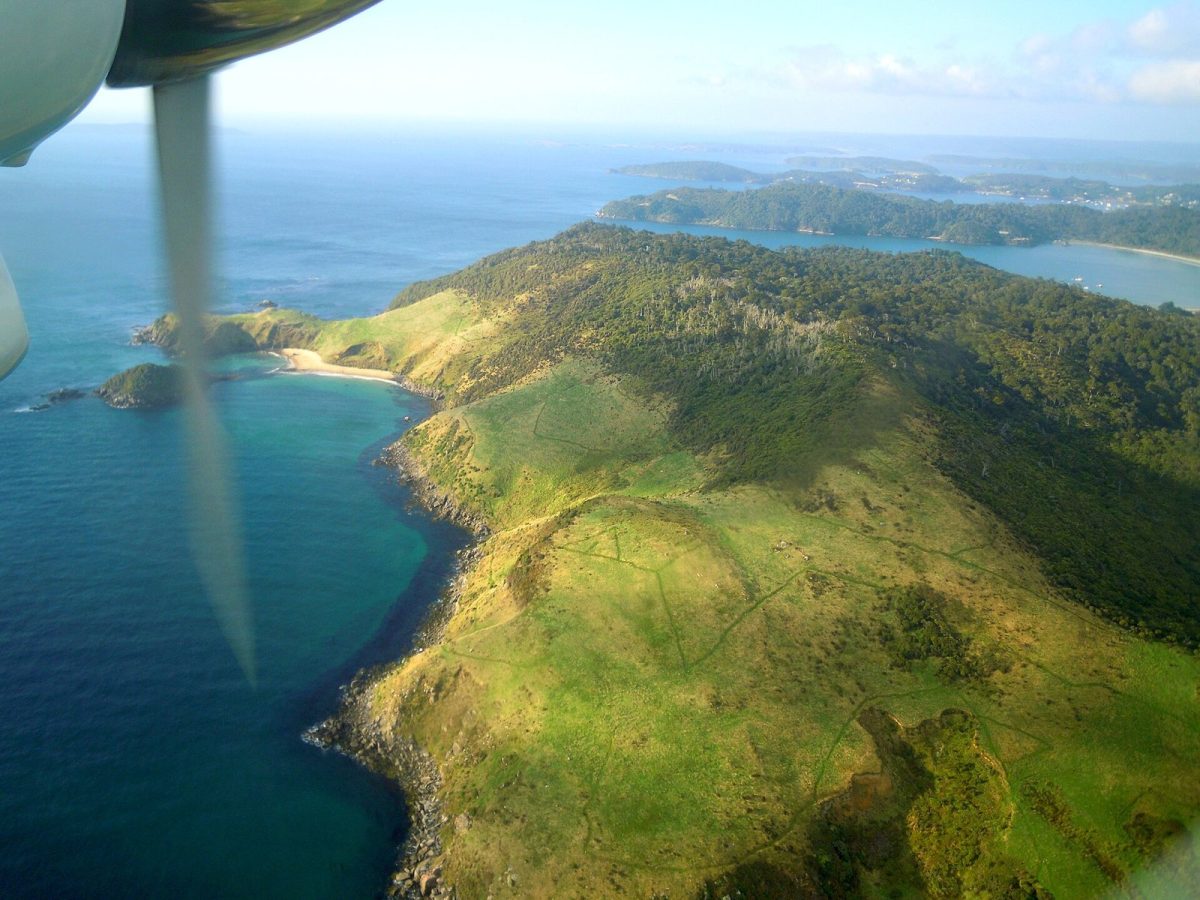
Photo: Lundtoft, CC BY-SA 3.0
| Getting there | Ferry from Bluff in about 1 h, or a 20-min flight from Invercargill; small planes can land on Mason Bay beach |
|---|---|
| Gateway | Bluff (ferry) or Invercargill (flights) |
| Travel time | About 1 h by ferry or 20 min by air |
| Days | 3 to 5 nights |
| Best months | Nov–Apr for walking; kiwi year-round; aurora best May–Aug; rain in any month |
| Getting around | Walk or take water taxis; a few hire cars and scooters for Oban's short road network |
| Booking | Ferry, rooms and Rakiura Track huts in Dec–Feb; kiwi tours a few weeks ahead |
| Cost | Mid-range to pricey for New Zealand; food costs more |
| Beaches | Sheltered sandy coves near Oban, the vast dunes of Mason Bay; cold sea year-round |
| Sea | Pacific Ocean |
| Area | 1,746 km² |
| Population | 486 (2023) |
| Highest point | 980 m (Mount Anglem) |
| Ferry | 1 h from Bluff (ferry) or Invercargill (flights) |
| Airport | Yes, scheduled flights |
| Car-free | No |
| Checked | October 2026 |
No tours for Stewart Island are sold on the big booking sites, so almost everything is arranged locally in Oban or directly with small operators. Most visitors simply buy a return ferry or flight and build their stay from a few kinds of excursion.
The first is a water taxi to Ulva Island, a predator-free sanctuary in Paterson Inlet. You can go on your own and follow the tracks, or join a guided walk with a naturalist, which roughly doubles the number of birds you will notice.
The second is kiwi spotting. Night tours by boat and on foot go out to beaches where the local brown kiwi feed on sandhoppers; numbers are capped and they fill up early in summer. Tramping to Mason Bay gives a chance of seeing kiwi by day.
The third is time on the water: pelagic trips for albatrosses and petrels, fishing charters, sea kayak rental in Paterson Inlet and harbour cruises. Packages from Bluff that combine the ferry with a village tour suit people with only a day. For the Rakiura Track and longer circuits, book huts with the conservation department and carry your own food.
For most visitors the best combination is two or three nights in Oban, Ulva Island by day and one guided kiwi night.
A 10-minute water taxi from Golden Bay drops you on a small island cleared of rats and stoats, where saddleback, yellowhead, robins, kaka and kakariki live among old rimu and podocarp forest. Easy gravel tracks loop to sandy coves. Allow half a day, take lunch and check your bags for stowaway seeds and rodents before boarding.
Stewart Island's brown kiwi, or tokoeka, are bigger and bolder than their mainland cousins and often forage on beaches. Guided night trips cross the harbour by boat and walk quietly with red torches to where they feed. Sightings are frequent but not guaranteed, and the outing lasts about three to four hours, finishing late.
The only village curls around Halfmoon Bay, with a general store, a museum on island history, cafes and the island's single pub, where fishermen and trampers meet in the evenings. Walk up to Observation Rock for the view over Paterson Inlet at sunset, and try the local blue cod and, in season, Bluff oysters.
One of New Zealand's Great Walks, the track loops for about 32 km from near Oban through coastal forest, along golden beaches and over a low ridge, usually in three days with two nights in huts. It is muddy after rain but never very steep, making it a good first multi-day walk. Book huts well ahead for summer.
A gentle track of about 3 km from the end of the road east of Oban leads to Ackers Point and its lighthouse. At dusk in summer you may see little blue penguins coming ashore and sooty shearwaters returning to their burrows. Other short walks reach Horseshoe Bay, Lee Bay and the chain-link sculpture marking the park entrance.
On the wild west coast, a 14-km beach backed by huge sand dunes is one of the best places in New Zealand to see kiwi in daylight. Most people fly in on a small plane that lands on the sand, stay a night at the hut, and either fly back or walk out across the island in a day.
The passenger ferry crosses Foveaux Strait from Bluff, 30 minutes' drive south of Invercargill, to Oban in about an hour. It runs several times a day in summer and less often in winter. The strait is often rough, so take seasickness tablets if you are prone. A shuttle bus links Invercargill with the ferry terminal, and there is secure paid parking at Bluff for your car, which you should leave behind.
Small planes fly from Invercargill airport to the airstrip above Oban in about 20 minutes, several times a day, with a minibus into the village; the views are excellent on a clear day, but low cloud causes delays. Planes can also land on the beach at Mason Bay or at Doughboy Bay for trampers.
Stewart Island has only about 28 km of roads, all around Oban, Halfmoon Bay and the nearby bays, so most visitors manage on foot. A few hire cars, scooters and e-bikes are available in the village for the outlying bays, and some lodges collect guests from the wharf. Water taxis are the real transport, running to Ulva Island, to the start and end of tracks and to remote huts. Beyond the roads, everything is walking track, often muddy, so bring waterproof boots.
Stewart Island has a cool, changeable maritime climate with rain spread through the year, often in short showers that clear quickly. Summer, from December to February, brings long days with light until after 10 pm and highs around 16 to 19 degrees; it is the busiest time, with full huts and rooms. November, March and April are quieter and often more settled, a good time for the Rakiura Track.
Winter, from June to August, is cold and short-dayed, but the long nights give the best chance of seeing the aurora australis, the glowing skies of the Maori name. Kiwi can be seen all year, and birdlife on Ulva is active in every season. The sea is cold for swimming at any time. Plan three nights for Oban and Ulva, five or more for tramping.
Almost all accommodation is in and around Oban: a hotel with the pub, motels, backpacker hostels, holiday homes and lodges in the bush on the hills above Halfmoon Bay. Stay in the village centre if you have no car and want to walk to the wharf, store and pub; the lodges in the surrounding bush suit birdwatchers and couples. Trampers sleep in conservation huts or campsites along the tracks, booked in advance.
Maori settled Rakiura in the 14th century, soon after reaching the South Island, and the island's southern people still harvest sooty shearwater chicks, the titi, on the islets offshore each autumn. The island takes its English name from William Stewart, an officer of a sealing ship that charted it in 1809. Sealers, whalers, timber millers, tin miners at Port Pegasus and, above all, fishermen followed. Most of the land later passed to the Crown, and in 2002 the larger part became Rakiura National Park; fewer than 500 people live here today.
Combine Stewart Island with the Catlins coast, two to three hours' drive east of Invercargill, for waterfalls, sea lions and yellow-eyed penguins, and with Fiordland, where Te Anau and Milford Sound are about three hours from Bluff. Queenstown is about three hours by road. Bluff itself is worth an hour for the signpost at Stirling Point.
Ferry from Bluff in about 1 h, or a 20-min flight from Invercargill; small planes can land on Mason Bay beach.
From Bluff (ferry) or Invercargill (flights): about 1 h by ferry or 20 min by air.
3 to 5 nights.
Nov–Apr for walking; kiwi year-round; aurora best May–Aug; rain in any month.
Walk or take water taxis; a few hire cars and scooters for Oban's short road network.
Go if you want wild kiwi, native birds, quiet tramping tracks and a remote village with one pub. Skip it or choose Rangitoto or the Abel Tasman coast if you want warm water, sunny beaches or reliable weather. With about 1 h each way from Bluff (ferry) or Invercargill (flights), a day trip is easy to do.
Mid-range to pricey for New Zealand; food costs more.
Sheltered sandy coves near Oban, the vast dunes of Mason Bay; cold sea year-round.
Ferry, rooms and Rakiura Track huts in Dec–Feb; kiwi tours a few weeks ahead.
New Zealand
Waiheke Island lies in the Hauraki Gulf, about 40 minutes by fast ferry from downtown Auckland, and is the city's…
39 tours & trips
New Zealand
The South Island is the larger of New Zealand's two main islands, about 150,000 square kilometres with only around…
6 tours & trips
New Zealand
Rangitoto Island is the youngest volcano in the Auckland volcanic field, a symmetrical cone that rose from the Hauraki…
5 tours & trips
New Zealand
The North Island is the smaller but busier of New Zealand's two main islands, home to three quarters of the…
3 tours & trips
New Zealand
Kapiti Island is a predator-free nature reserve 5.6 km off the Kapiti Coast, an hour north of Wellington.
2 tours & trips
New Zealand
Tiritiri Matangi is a 2.2-square-kilometre open bird sanctuary in the Hauraki Gulf, 3.4 km off the Whangaparāoa…
2 tours & trips