Mallorca
Balearic Islands, Spain
Mallorca is the largest of the Balearic Islands, about 3,640 square kilometres of coast and mountains off eastern…
909 tours & trips
Spain · Mediterranean Sea · Nature & wildlife island
The Medes Islands are a cluster of seven small, rocky islets about a kilometre off L'Estartit on the Costa Brava in Catalonia. They are uninhabited and protected as one of the oldest marine reserves in the western Mediterranean, famous for diving, glass-bottom boat trips and large groupers that swim close to divers.
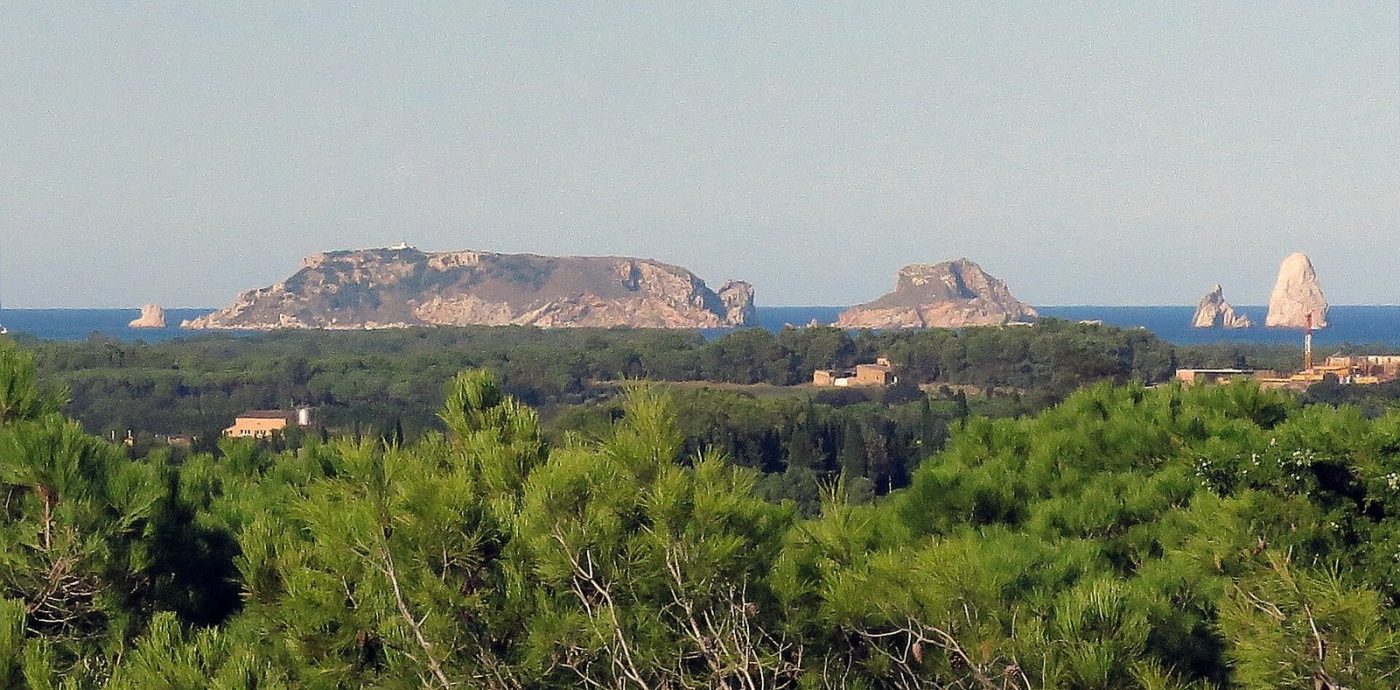
Photo: Enric, CC BY-SA 4.0
| Getting there | Boat trips, dive boats and kayaks from L'Estartit, a few minutes across; catamarans also from Roses |
|---|---|
| Gateway | L'Estartit (Costa Brava) |
| Travel time | 10 to 15 min by boat from L'Estartit |
| Days | A day trip is enough |
| Best months | Jun–Sep for boat trips; diving May–Oct; few trips in winter |
| Getting around | No landing on the islands; seen only from boats, kayaks or underwater |
| Booking | Dives and kayak trips a few days ahead in July–August; glass-bottom boats on the day |
| Cost | Mid-range for the Costa Brava |
| Beaches | No beaches on the islets; swim from boats or at the long sandy beach of L'Estartit |
| Sea | Mediterranean Sea |
| Area | 0.2 km² |
| Population | Uninhabited |
| Airport | No |
| Checked | October 2026 |
Since visitors may not land on the islands, everything sold is a way of seeing them from the water or beneath it, and almost all trips leave from the harbour or beach of L'Estartit.
The classic is the glass-bottom boat or catamaran with underwater viewing windows. Trips of about one to two hours circle the islets, then follow the limestone cliffs of the Montgrí coast with its caves and arches; some stop for a swim. No booking is needed outside August.
Snorkelling trips of two to three hours provide masks, fins, wetsuits and a guide, and suit families and beginners. Scuba diving is the main attraction: local dive centres run daily boats in season, handle the reserve's permits and quotas, and offer try dives for beginners.
Kayak tours cross from the beach with a guide in about half an hour of paddling and are fine for fit beginners on a calm morning. Private sailing boats and catamaran cruises from Roses add a longer day on the coast.
Our advice: if you dive, dive here; if not, take a snorkelling trip rather than just the viewing boat.
Protected since the 1980s, the waters around the islets have dense marine life: large groupers, schools of barracuda and sea bream, moray eels, octopus and red coral on deeper walls. Sites range from shallow rocky reefs to tunnels and caves for experienced divers. Visibility is usually best in late summer and autumn.
The boat leaves L'Estartit harbour and reaches the islands in a few minutes, slowing over the reefs so you can watch fish through the windows below deck. Look up at the cliffs of Meda Gran for nesting gulls and the lighthouse on its summit. The trip is calm and suits small children.
The largest islet, only about 18 hectares, rises in steep cliffs with scrub and seabird colonies. Its lighthouse was built in 1866 and was looked after by a keeper until the light was automated in the 1930s. You see it from the water only, best in the morning light from the east side.
North of L'Estartit, the limestone massif of Montgrí drops straight into the sea, carved into caves, arches and small coves reachable only by boat. Most island trips continue along this coast, entering some caves when the sea is calm, and kayakers can paddle into the narrow inlets.
The resort town of L'Estartit has a marina and a long sandy beach facing the islands, with a promenade and seafood restaurants. Six kilometres inland, Torroella de Montgrí is an old walled town with arcaded squares; a steep path climbs from it to the unfinished castle on the ridge, with views over the coast.
Our pick for each kind of trip, with live dates and prices. Free cancellation on most.
Best for: First visit, around the islands by boat
A short cruise from L'Estartit with underwater windows to watch the fish, circling the islets and continuing along the cliffs and caves of the Montgrí coast.
The islands are reached only by excursion boats, dive boats, kayaks or private vessels. Most trips start in L'Estartit, where the harbour is a few minutes' walk from the town centre and the beach; catamaran cruises also leave Roses, further north on the Bay of Roses.
Girona airport is about 45 minutes away by car, and Barcelona about two hours. Buses connect L'Estartit with Girona and Barcelona, more often in summer; by train, go to Flaçà or Girona and continue by bus or taxi.
With a car, parking near the harbour is limited in high season, so arrive early. Glass-bottom boats run frequently from spring to autumn, while dive centres offer trips most days in season. Private boats must follow strict anchoring and fishing rules inside the reserve.
There is nothing to get around on the islands themselves: landing is forbidden to protect nesting birds and vegetation. In L'Estartit everything is within walking distance, from the harbour to the beach and dive centres. A car or bike helps for Torroella de Montgrí, the Baix Ter wetlands and the coves north of town. Coastal paths lead along the Montgrí cliffs, and local buses link L'Estartit with Torroella.
The boat season runs from about Easter to October, with the busiest months July and August, when boats fill up and the town is crowded with families. The sea warms to the low to mid twenties in August, comfortable for snorkelling.
June and September are the best balance: warm water, calm seas and fewer people. For divers, the season runs from May to October; water visibility is often best after summer, though a thermocline can make deeper water cold.
The tramontana, a strong north wind, can blow at any time of year, especially in spring and autumn, and cancels trips when the sea gets rough. In winter few boats operate and many restaurants in L'Estartit close. A half-day is enough for the islands, but divers usually stay several days.
L'Estartit is the natural base, with hotels, apartments and campsites near the beach and the harbour, and it suits divers and families. Torroella de Montgrí inland is quieter, with a historic centre and a few small hotels, a short drive or bus ride from the boats. Begur and Pals to the south have more character and charming villages for visitors who want a broader Costa Brava stay.
The islets are the seaward end of the limestone Montgrí massif, separated from the mainland by the sea. Their position off the coast made them a refuge for pirates over the centuries and later a lookout guarding the mouth of the river Ter, and a fort stood on Meda Gran. In the twentieth century overfishing and coral collecting threatened the seabed, and in 1983 the waters were protected. The recovery of the fish since then shows how a reserve can work.
The Roman and Greek ruins of Empúries at L'Escala are about 20 minutes north by car. The medieval village of Pals and the coves of Begur are 20 to 30 minutes south. Girona, with its cathedral and old town, is about 45 minutes away, and the Dalí museum in Figueres around an hour.
Boat trips, dive boats and kayaks from L'Estartit, a few minutes across; catamarans also from Roses.
From L'Estartit (Costa Brava): 10 to 15 min by boat from L'Estartit.
A day trip is enough.
Jun–Sep for boat trips; diving May–Oct; few trips in winter.
No landing on the islands; seen only from boats, kayaks or underwater.
Go if you want some of the best diving and snorkelling in the Mediterranean on an easy half-day trip. Skip it or choose a longer coastal walk near Begur if you want to set foot on an island, as landing is not allowed.
Mid-range for the Costa Brava.
No beaches on the islets; swim from boats or at the long sandy beach of L'Estartit.
Dives and kayak trips a few days ahead in July–August; glass-bottom boats on the day.
Yes. Boat trips, guided tours and day trips for Medes Islands can be booked online; live prices and free cancellation on most are shown on this page.
Balearic Islands, Spain
Mallorca is the largest of the Balearic Islands, about 3,640 square kilometres of coast and mountains off eastern…
909 tours & trips
Canary Islands, Spain
Tenerife is the largest of the Canary Islands, 2,034 square kilometres of Atlantic volcano off north-west Africa,…
723 tours & trips
Balearic Islands, Spain
Ibiza is the third-largest of the Balearic Islands, 577 square kilometres of pine hills, small coves and salt pans…
372 tours & trips
Canary Islands, Spain
Gran Canaria is a round volcanic island of 1,560 square kilometres in the Canaries, rising from the dunes of Maspalomas…
350 tours & trips
Canary Islands, Spain
Lanzarote is the easternmost of the Canary Islands, about 125 km off the coast of Africa, a low island of black lava…
273 tours & trips
Canary Islands, Spain
Fuerteventura is the second-largest of the Canary Islands and the closest to Africa, about 97 km off the Moroccan…
233 tours & trips