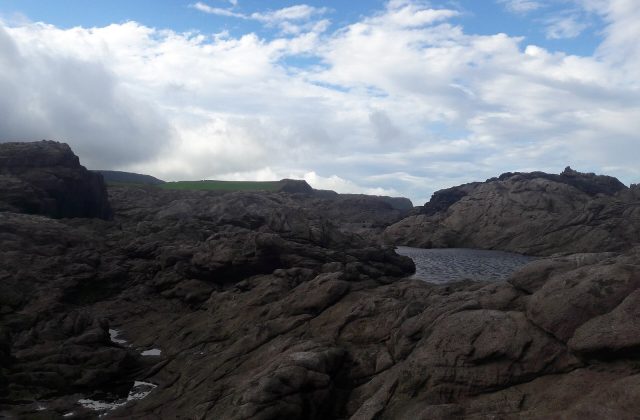
Corvo
27 km away
Corvo is the smallest and most northerly island of the Azores, an extinct volcano of 17 square kilometres with a single…
4 tours & trips
Portugal · Atlantic Ocean · Nature & wildlife island
Flores is the westernmost island of the Azores, 143 square kilometres of green volcanic ridges, crater lakes and waterfalls in the middle of the Atlantic, on the North American Plate. Far from mainland Portugal and quieter than the central islands, it is a place for walking, wild coastline and very few people.
| Getting there | Flights from Ponta Delgada, Terceira or Horta in about 1 to 2 h; a small boat links Corvo |
|---|---|
| Gateway | Ponta Delgada or Horta |
| Travel time | About 1 to 2 h by air, often with a stop |
| Days | 3 to 5 nights |
| Best months | Jun–Sep; rain, wind and flight delays common the rest of the year |
| Getting around | Rent a car; few buses; taxis for one-way hikes; steep, winding roads |
| Booking | Flights and rental cars well ahead for Jul–Aug; keep a spare day for the weather |
| Cost | Mid-range for Portugal; few restaurants and shops |
| Beaches | No sandy beaches; natural rock pools at Santa Cruz and Lajes, sea swimming at Fajã Grande |
| Sea | Atlantic Ocean |
| Archipelago | Azores |
| Area | 143 km² |
| Population | 3,397 (2025) |
| Highest point | 914 m (Morro Alto) |
| Airport | Yes, scheduled flights |
| Car-free | No |
| Checked | October 2026 |
Nothing is sold online for Flores alone. The island is too remote and too small for packaged day trips, so visitors fly in independently and arrange the rest locally.
The main activity is walking, and it needs no guide. Several waymarked trails cross the island, the best known descending from the high plateau of the crater lakes to Fajã Grande on the west coast; taxis will drop you at the start and collect you at the end, which suits one-way routes. Local guides offer canyoning in the streams of the west, a serious activity to do only with a qualified instructor.
From Santa Cruz and Lajes small boats run trips along the coast in calm weather, entering sea caves such as Enxaréus and passing the cliffs and waterfalls of the west; some continue to Corvo for the day. Boats provide life jackets and a skipper who explains the coast; lunch is rarely included. Diving and whale and dolphin watching are offered in summer by a few small operators.
The plan that works: three or four nights, a rental car, one or two long walks, a boat trip on the first calm day, and Corvo if the sea allows.
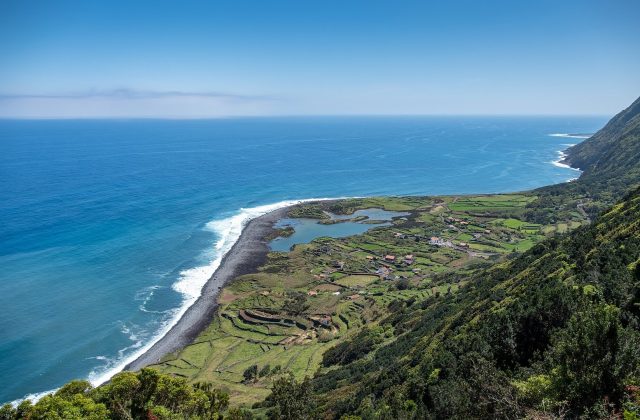
The western shore is a wall of cliffs streaked with waterfalls, and at its foot lies Fajã Grande, often called the westernmost village of Europe. Walk up to Poço do Bacalhau, where a tall cascade falls into a pool you can swim in, bathe in the rock pools by the small harbour and watch the sun set over open ocean.
Also called Alagoinha, this is the image of Flores: a semicircle of moss-covered cliff with a dozen or more waterfalls dropping into a still green pond. A paved path from the road near Fajãzinha takes about 15 minutes through woodland. Come after rain, when the falls are fullest, and early in the day, before anyone else arrives.
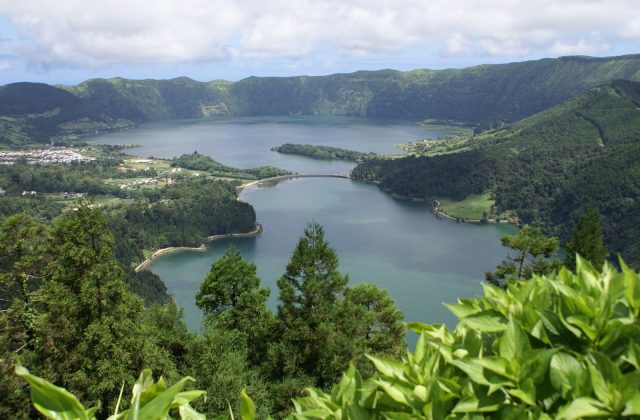
In the high centre of the island lie seven crater lakes. From the road, viewpoints look down on Lagoa Funda, deep and dark, and Lagoa Rasa beside it; Lagoa Comprida and Lagoa Negra are close by. The plateau is often in cloud, so check the sky before driving up, and combine the stop with the walk down to the west coast.
Near Mosteiro in the south-west, a cliff of vertical basalt columns rises like a giant organ, formed as thick lava cooled slowly and cracked. It is visible from the main road, with a lay-by and viewpoint; stop in the late afternoon when the sun lights the columns. Nearby Fajãzinha has a restored watermill and a short walk to the sea.
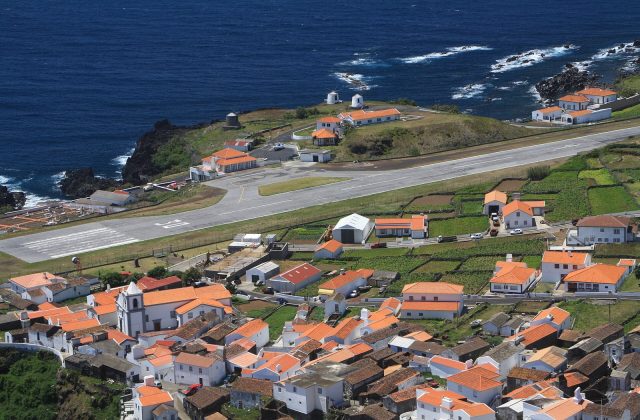
The small capital on the east coast has the airport at the edge of town, the harbour for boats to Corvo and the island museum in an old convent. Visit the former whaling factory at Boqueirão, now a museum with its boilers intact, and swim in the natural pools carved out of the lava just below the town.
Lajes, the second town, has the island's main cargo harbour, rebuilt after Hurricane Lorenzo wrecked it in 2019, and a bay where coast trips depart. From here the road climbs to the Fajã de Lopo Vaz viewpoint, where a steep path drops to a sheltered cove with a stony beach and small plots of bananas.
Flores has a small airport at Santa Cruz with daily flights in summer on the Azorean inter-island airline from Ponta Delgada on São Miguel, Terceira and Horta on Faial; some routes stop on the way. A direct flight from Ponta Delgada takes about an hour and a half. Connections from Lisbon and other European cities go through Ponta Delgada or Terceira, so most people need two flights. Low cloud and strong wind regularly cause delays or cancellations, especially outside summer, so do not plan a tight connection home.
In summer the inter-island ferry service sometimes includes Flores, but crossings from the central islands are long and infrequent, and most visitors fly. A small passenger boat links Santa Cruz with Corvo in about 40 minutes when the sea allows. Hire cars are collected at the airport.
A car is close to essential. The island is about 17 km long, and a road loops round it, with a branch across the central plateau past the crater lakes; Santa Cruz to Fajã Grande takes about 40 minutes on steep, winding roads. Rental fleets are small, so book ahead. Buses are few and timed for locals, not hikers. Taxis are reliable and useful for dropping walkers at a trailhead. Watch for cows, fog on the plateau and fallen rocks after heavy rain.
June to September is the season: the weather is mildest, hydrangeas line the roads in July and August, the sea reaches about 22 degrees and boat trips run regularly. Even then expect showers, fog on the plateau and sudden changes, so pack a waterproof. July and August are the busiest months, but busy on Flores still means quiet, with rooms and cars the only things that run short.
From October to April the Atlantic brings frequent rain, strong winds and big swells. The waterfalls are spectacular, but trails turn muddy, boats to Corvo often stop and flights are disrupted more often. Some guesthouses and restaurants close in winter. Spring is green and quiet, with longer days from May. Allow three to five nights: enough for two good walks, a boat trip and a margin for bad weather.
Santa Cruz has the most guesthouses, restaurants and shops, and is closest to the airport and the boat to Corvo, which makes it the practical base, especially for a short stay. Fajã Grande and Fajãzinha on the west coast are the choice for walkers and sunsets: quiet, surrounded by waterfalls and at the end of the main trails, though with only a couple of places to eat. Lajes in the south suits travellers who want the harbour for boat trips and rural houses nearby.
Portuguese navigators reached Flores in 1452 and named it for the flowers growing along its shore, though settlement came slowly because of its isolation. For centuries islanders lived from farming, cattle and the sea, and from the nineteenth century from shore whaling in open boats, which lasted until the 1980s. A French missile-tracking station near Santa Cruz operated from the 1960s to the 1990s, bringing jobs and foreigners for a time. Emigration to North America steadily drained the villages, and today about 3,400 people live on the island, many of them in Santa Cruz and Lajes.
Corvo, the smallest island of the Azores, is the natural add-on: a short boat ride from Santa Cruz to a single village and a vast crater, best as a day trip. Most visitors pass through Ponta Delgada on São Miguel or Horta on Faial on the way, so a route of São Miguel, then Faial or Pico, then Flores works well for ten days.
27 km away
Corvo is the smallest and most northerly island of the Azores, an extinct volcano of 17 square kilometres with a single…
4 tours & trips
239 km away
Faial is a volcanic island of 173 square kilometres in the central Azores, facing the cone of Pico across a channel…
23 tours & trips
270 km away
Pico is the second-largest island of the Azores, a black volcanic cone rising 2,351 metres out of the Atlantic, the…
181 tours & trips
Flights from Ponta Delgada, Terceira or Horta in about 1 to 2 h; a small boat links Corvo.
From Ponta Delgada or Horta: about 1 to 2 h by air, often with a stop.
3 to 5 nights.
Jun–Sep; rain, wind and flight delays common the rest of the year.
Rent a car; few buses; taxis for one-way hikes; steep, winding roads.
Go if you love long walks, waterfalls, crater lakes and empty landscapes and can live with rain. Skip it or choose São Miguel if you want beaches, hot springs, varied restaurants, reliable weather or easy access.
Mid-range for Portugal; few restaurants and shops.
No sandy beaches; natural rock pools at Santa Cruz and Lajes, sea swimming at Fajã Grande.
Flights and rental cars well ahead for Jul–Aug; keep a spare day for the weather.
Azores, Portugal
São Miguel is the largest island of the Azores, a green volcanic island in the mid-Atlantic about two hours'…
269 tours & trips
Azores, Portugal
Santa Maria is the southernmost and oldest island of the Azores, a 97-square-kilometre island less than 100 km south of…
210 tours & trips
Azores, Portugal
Pico is the second-largest island of the Azores, a black volcanic cone rising 2,351 metres out of the Atlantic, the…
181 tours & trips
Azores, Portugal
Terceira is a green volcanic island of 400 square kilometres in the central Azores, about 1,200 km west of Lisbon,…
86 tours & trips
Azores, Portugal
Faial is a volcanic island of 173 square kilometres in the central Azores, facing the cone of Pico across a channel…
23 tours & trips
Azores, Portugal
Sao Jorge is a long, narrow island in the central Azores, 53 km long and only 8 km wide, a volcanic ridge with high…
15 tours & trips