São Miguel
Azores, Portugal
São Miguel is the largest island of the Azores, a green volcanic island in the mid-Atlantic about two hours'…
269 tours & trips
Portugal · Atlantic Ocean · Beach island
Santa Maria is the southernmost and oldest island of the Azores, a 97-square-kilometre island less than 100 km south of São Miguel. It is the warmest and driest of the nine, with pale sand beaches instead of the black volcanic sand found elsewhere, terraced vineyards falling to the sea and white villages with broad chimneys.
| Getting there | 30-min flight from Ponta Delgada on São Miguel; a seasonal ferry from Ponta Delgada in summer |
|---|---|
| Gateway | Ponta Delgada (São Miguel) |
| Travel time | About 30 min by air |
| Days | 3 to 5 nights |
| Best months | Jun–Sep, warmest and driest in the Azores; August busy with the music festival |
| Getting around | Rent a car; buses are few, and taxis wait at the airport and in Vila do Porto |
| Booking | Car hire and rooms for Jul–Aug well ahead, above all festival week; flights weeks ahead |
| Cost | Mid-range for the Azores |
| Beaches | Pale sand at Praia Formosa and São Lourenço; seawater pools at Maia and Anjos |
| Sea | Atlantic Ocean |
| Archipelago | Azores |
| Area | 97 km² |
| Population | 5,406 (2021) |
| Highest point | 587 m (Pico Alto) |
| Airport | Yes, scheduled flights |
| Car-free | No |
| Checked | October 2026 |
Almost nothing is sold online for Santa Maria on its own. The island is small and receives few foreign visitors, and the excursions that exist are arranged locally rather than booked from abroad.
The usual way to visit is independently. Fly in from Ponta Delgada, collect a hire car at the airport and drive yourself: the island is about 17 km from end to end, and every beach and village is within half an hour of Vila do Porto. A long-distance trail runs around the whole coast, and several shorter signposted paths can be walked without a guide.
What is worth arranging once you arrive is time on the water. Dive centres in Vila do Porto run summer trips to offshore banks such as Ambrósio and to the Formigas islets, known for groups of mobula rays, sharks and large shoals of fish; these need certification, calm seas and a day or two of flexibility. Dolphin watching and coastal boat trips also leave from the marina in season, and you book them in person or by phone a day or two ahead. Guided walks can be arranged through local operators if you prefer company.
The plain advice: plan the trip yourself, book the flight and the car early, and keep one calm day free for a boat or a dive.
The long beach on the south coast, about ten minutes by car from Vila do Porto, has the palest sand in the Azores and some of the calmest swimming. In summer there are lifeguards, a cafe and a campsite behind it, and in August the bay becomes the stage of Maré de Agosto, a music festival held here since the 1980s.
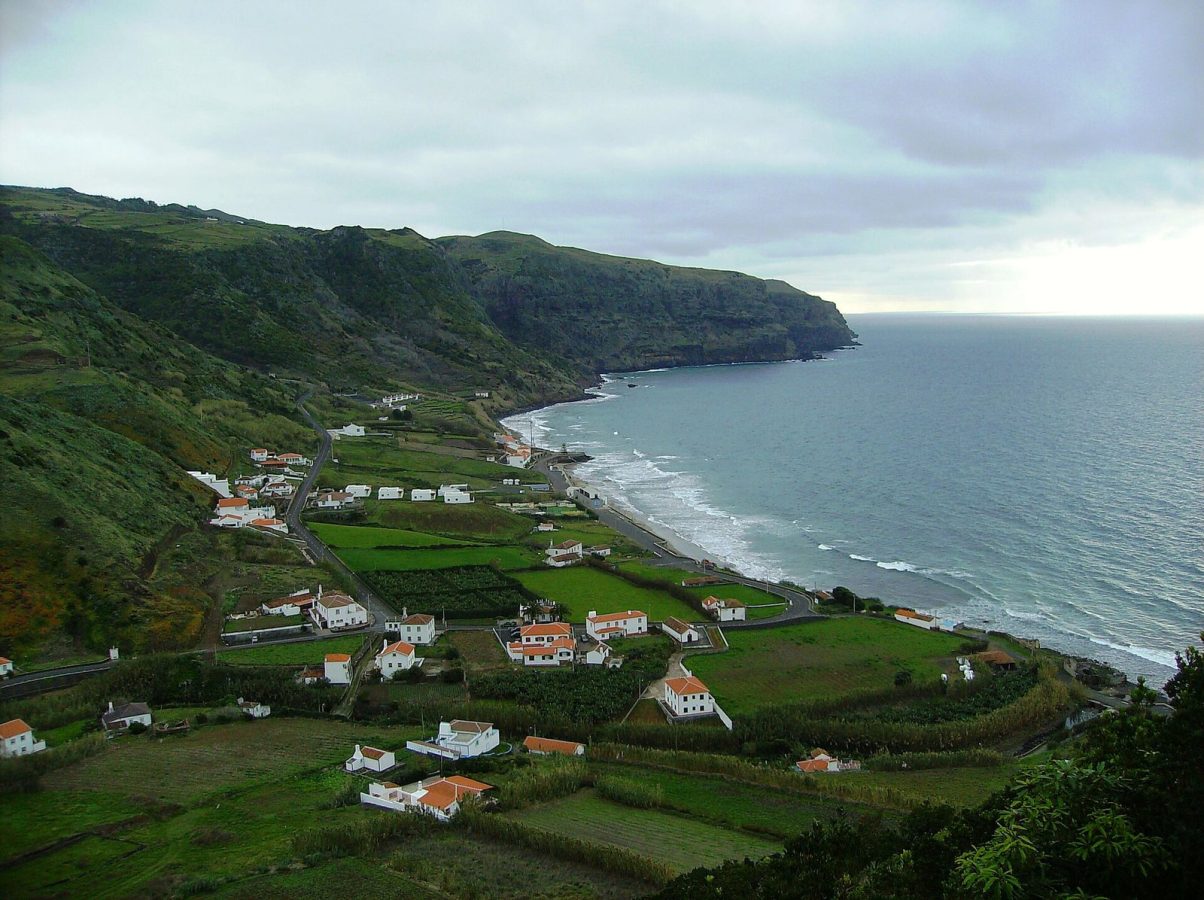
On the north-east coast a natural amphitheatre is covered in tiny walled vineyards that fall in terraces to a curved beach. Stop at the viewpoint on the road above for the best view of the terraces and the islet of Romeiro, then drive down to swim off the beach or from the rocks. It is about 25 minutes from Vila do Porto.
The capital and harbour is considered the oldest town in the Azores, a long main street running down a ridge to the fort and the marina. Walk it from the parish church past old manor houses to the Forte de São Brás above the harbour, then eat grilled fish near the port. The airport is on the edge of town.
In the dry north lies a patch of red clay and sparse scrub that locals call the red desert, unlike any other landscape in the Azores. A short marked trail crosses it to the cliffs above the north coast. Go in the late afternoon, when the colour is strongest, and continue to Anjos, about a quarter of an hour away.
Anjos, on the north-west tip, is where sailors from the ship of Columbus came ashore in 1493 to pray at the small chapel that still stands, and it has a natural sea pool. Maia, on the far east side, is a fishing village below vine terraces with its own seawater pool; nearby the Aveiro waterfall drops down a sheer cliff.
The highest point of the island, 587 metres, rises in the greener, wetter east. A road leads almost to the top, where on a clear day you see the whole island and the ocean all round. Cloud often settles on it by midday, so go early. Trails across the centre pass through cedar and laurel woodland and pine plantations.
Live dates and prices. Free cancellation on most tours.
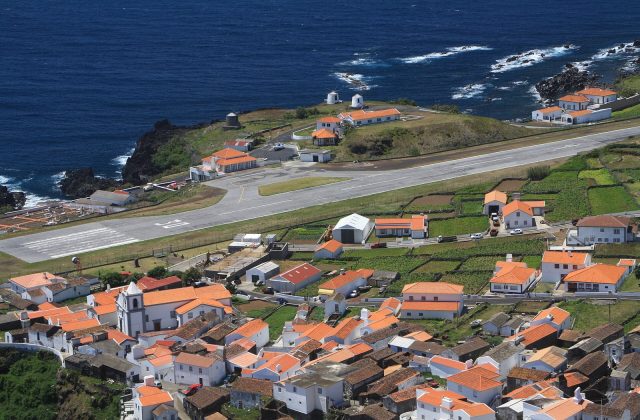
Santa Maria has its own airport just outside Vila do Porto, with a runway far longer than such a small island needs, built by the Americans during the Second World War. The regional airline flies from Ponta Delgada on São Miguel several times a day, and the flight takes about 30 minutes. Book early for July and August, when seats on the small planes sell out.
By sea, the regional ferry links Ponta Delgada and Vila do Porto in the summer season only, a few times a week. The crossing takes several hours, so it suits travellers island hopping slowly rather than those short of time. From autumn to late spring the flight is the only practical way. Hire cars are collected at the airport, so there is no need to bring one.
You need a car. Buses link Vila do Porto with the villages, but they run mainly for school and work hours and are no use for beaches or trails. Hire firms at the airport offer small cars at fair prices; book ahead for summer, when the fleet is limited. Roads are narrow and winding but quiet, and parking is easy everywhere except at Praia Formosa on August weekends. Taxis can be called for transfers or to drop walkers at the start of a trail.
Santa Maria is the sunniest and driest island of the Azores. June to September is the beach season, with air temperatures in the mid twenties and the sea reaching about 23 degrees in August, the warmest water in the archipelago. July and August are the busiest months, and the week of the Maré de Agosto festival fills every room on the island.
May and October are good for walking, with green hills, quiet trails and a sea that is still mild, though showers are more frequent. Between November and April the weather is changeable and windy, some restaurants close or shorten their hours and boat trips stop, but the island stays mild and almost empty.
Plan three to five nights: two days for beaches and villages, one for a long walk, and spare time in case wind keeps the dive boats in harbour.
Vila do Porto is the practical base, with most of the restaurants, the supermarkets, the harbour and the airport, and everything else within a half-hour drive. For a beach holiday, Praia Formosa has rooms and holiday houses steps from the sand and gets the most sun. The north and east, around Santo Espírito, Maia and São Lourenço, offer restored stone houses in the countryside with sea views and quiet nights, but you will drive for every meal. Book village houses early, as there are few of them.
Santa Maria was the first island of the Azores to be settled, in the 1430s, by Portuguese families led by Gonçalo Velho Cabral, and Vila do Porto grew into the first town of the archipelago. In 1493 men from the ship of Columbus stopped at Anjos on the way back from the Americas. Settlers from the south of Portugal brought the white houses and broad chimneys you still see. In the Second World War the Americans built the large airport, which for decades was a refuelling stop on transatlantic routes and still houses the control centre for a vast area of North Atlantic airspace. Geologically it is the oldest island of the group, with fossil beds in its sedimentary rocks.
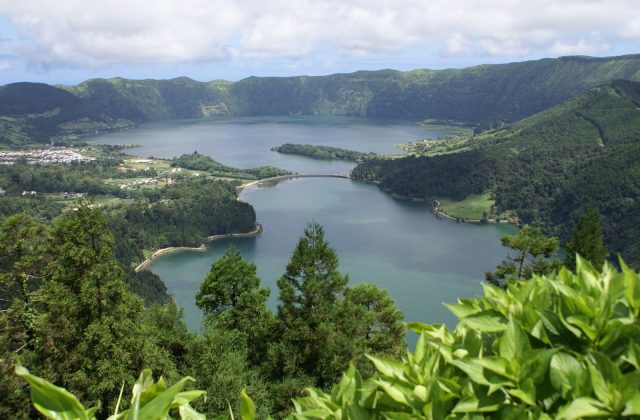
Santa Maria pairs naturally with São Miguel, half an hour away by air: spend four or five days around Ponta Delgada, Furnas and Sete Cidades, then fly south for the beaches. From Ponta Delgada, flights continue to Terceira, Pico and Faial for a longer tour of the Azores, and in summer the ferry lets you travel back by sea.
30-min flight from Ponta Delgada on São Miguel; a seasonal ferry from Ponta Delgada in summer.
From Ponta Delgada (São Miguel): about 30 min by air.
3 to 5 nights.
Jun–Sep, warmest and driest in the Azores; August busy with the music festival.
Rent a car; buses are few, and taxis wait at the airport and in Vila do Porto.
Go if you want warm, quiet beaches, easy coastal walks and village life in the Azores without crowds. Skip it or choose São Miguel if you want crater lakes, hot springs and a wide choice of organised tours.
Mid-range for the Azores.
Pale sand at Praia Formosa and São Lourenço; seawater pools at Maia and Anjos.
Car hire and rooms for Jul–Aug well ahead, above all festival week; flights weeks ahead.
Yes. Boat trips, guided tours and day trips for Santa Maria can be booked online; live prices and free cancellation on most are shown on this page.
Azores, Portugal
São Miguel is the largest island of the Azores, a green volcanic island in the mid-Atlantic about two hours'…
269 tours & trips
Azores, Portugal
Pico is the second-largest island of the Azores, a black volcanic cone rising 2,351 metres out of the Atlantic, the…
181 tours & trips
Azores, Portugal
Terceira is a green volcanic island of 400 square kilometres in the central Azores, about 1,200 km west of Lisbon,…
86 tours & trips
Azores, Portugal
Faial is a volcanic island of 173 square kilometres in the central Azores, facing the cone of Pico across a channel…
23 tours & trips
Azores, Portugal
Sao Jorge is a long, narrow island in the central Azores, 53 km long and only 8 km wide, a volcanic ridge with high…
15 tours & trips
Azores, Portugal
Corvo is the smallest and most northerly island of the Azores, an extinct volcano of 17 square kilometres with a single…
4 tours & trips